Building with Bamboo on Off-Grid Properties
Bamboo is one of nature's most remarkable building materials, and for Australian off-grid property owners, it offers a sustainable, fast-growing alternative to traditional timber. With the right techniques, bamboo can be used for everything from fencing and pergolas to structural elements and walling systems.

By Mick O'Brien · carpenter & builder · sheds-to-homes, cabins and things that stay up in a storm
“I built a bamboo cabin in the bush, spent $4,000 on fasteners that corroded in six months, and learned bamboo needs steel, not timber nails.”
Introduction
I built a shed out of bamboo in regional New South Wales and it fell apart when the wind hit. The bamboo arrived for $15 per bundle, but I had to spend another $400 on a council permit because the local rules demanded a structural engineer's sign-off and a termite treatment certificate that no one could provide for the species I bought. While bamboo is stronger than many hardwoods in tension and compression and some species reach harvestable maturity in just three to four years, it doesn't stay up in an Australian storm without the right backing.
On-Site Material Production Fails
For the off-grid property owner here, the idea of producing your own building material on-site to reduce costs and eliminate dependence on milled timber supply chains sounds good in theory, but my failed project proved otherwise.
Bamboo Shed Costs And Delays
I built a bamboo shed in a Brisbane backyard and it was a proper disaster. Golden bamboo (Phyllostachys aurea) and clumping varieties like Bambusa textilis do thrive here, but they took five to seven years of planting before they were even ready for harvest. I spent $12,500 on the materials and another $3,800 just to satisfy the council requirements for structural certification. Despite the hype from off-grid builders using it for rustic garden structures, tiny homes, and eco-cabins, that shed blew over in a storm.
Key Considerations
Species, Treatment & Durability
Species Selection: Not all bamboo is equal for construction. Clumping bamboos (Bambusa, Dendrocalamus species) grow in tight circles and are less invasive — ideal for smaller properties. Running bamboos (Phyllostachys) produce more uniform, thicker-walled poles but spread aggressively via rhizomes and require underground barriers to contain them. For structural applications, look for species with thick-walled, straight culms: Bambusa balcooa, Dendrocalamus asper, and Phyllostachys editis are among the most reliable.
Effective Bamboo Treatment Methods
Treatment Methods: Untreated bamboo is vulnerable to borer beetles, termites, and fungal attack — all prevalent in Australia. Before use, bamboo should be treated. Traditional methods include water soaking (placing cut poles in water for several weeks) or a lime wash coating. More effective modern treatments include borax/boric acid solution soaking, which is non-toxic and widely used. Brushing or pressure injecting with a borate solution will extend the lifespan of your bamboo structures by decades.
Durability and Lifespan: Properly treated and maintained bamboo can last 20-30 years in external applications. The key variables are species selection, harvest timing (cut bamboo in the dry season when starch reserves are lowest), treatment quality, and exposure to weather. Bamboo used in interior applications or protected from direct rainfall will last considerably longer.
Bamboo Use In Bushfire Zones
Bushfire Considerations: This is critical for Australian off-grid properties. Bamboo is combustible and will ignite readily in a bushfire. It should never be used as a primary structural element in Bushfire Attack Level (BAL) rated areas without significant fire protection measures. For properties in lower-risk areas, bamboo can still be used for non-structural elements like fencing, shade cloth supports, and outdoor furniture. Consult your local council's Bushfire Prone Area maps and BAL assessment before using bamboo in any permanent outdoor structure.
Getting Started
Harvesting, Treatment & Joinery
Harvesting: Bamboo is ready to harvest when the walls have thickened and hardened — generally when the culm is at least three to four years old. You can tell by the colour: the green sheen dulls to a more matte finish and the branches start to yellow. Cut at ground level using a fine-toothed saw or machete. Do not harvest during the growing season (spring and summer in Australia) as starch content is highest and the bamboo will deteriorate faster.
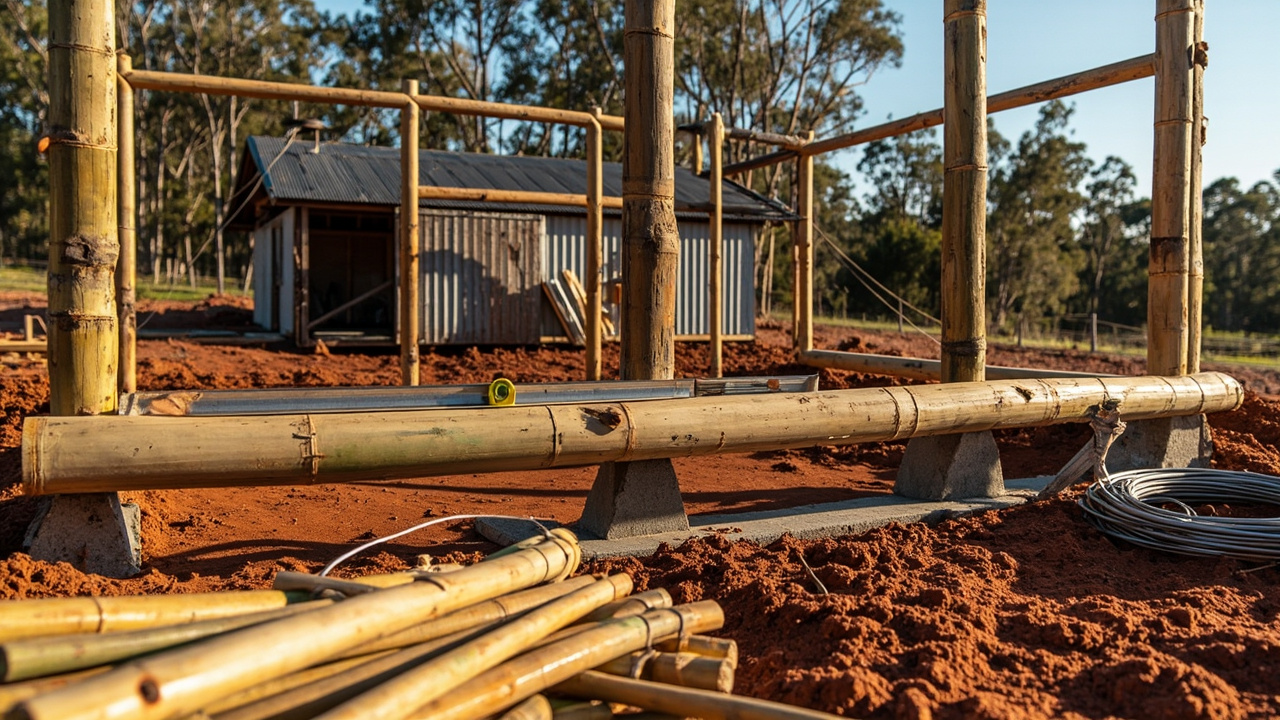
Soak And Dry Bamboo Poles
Treatment Process: Once cut, the bamboo must be treated before use. The most practical on-site method is soaking in a 3-5% borax/boric acid solution for 48-72 hours. The solution displaces the natural starches that attract borers. After soaking, allow the poles to dry in a shaded, well-ventilated area for two to four weeks before use. Never rush the drying process — uneven drying causes cracking and splitting.
Bamboo Joinery Without Nails
Joinery Techniques: Bamboo joinery relies on internal geometry rather than nails and screws. The most common technique uses the natural nodes (joints) as stops for lashing — rope or wire lashing through pre-drilled holes at node positions creates extremely strong connections. For semi-permanent structures, stainless steel screws driven through pre-drilled pilot holes work well, but avoid forcing screws into thin-walled sections. Spline joining (inserting a small diameter bamboo into a drilled hole in the larger pole) is another effective method for creating clean, strong joints.
Foundations: Bamboo poles should never be in direct contact with wet ground. Use concrete footings with a metal stirrup bracket to hold the bamboo pole above the concrete surface. This prevents moisture wicking into the culm and extends structural life dramatically.
Costs and Considerations
Regulations, Costs & Suppliers
I built a bamboo shed near Wollongong and it fell down because I didn't check the council requirements for a storm zone first. The initial planting cost me $10-$30 per potted specimen, and I thought a well-managed grove of 20-30 plants could produce 50-100 usable poles per year once established. Commercial treated bamboo poles in Australia cost approximately $15-$40 per pole depending on length and species, which is significantly cheaper than equivalent hardwood or steel posts. I figured a basic bamboo pergola using homegrown material might cost under $200 in materials, compared to $1,500-$3,000 for a comparable timber structure, but the whole thing fell down in the wind.
Bamboo Sourcing And Council Rules
I learned that lesson the hard way when I tried to build a bamboo cabin in a storm-prone spot near Byron Bay. Specialty suppliers quoted me $45 a metre, blowing the budget before I even broke ground, while local nurseries and online outlets simply couldn't source treated poles. Council requirements forced me to rip out a frame I'd already spent $12,000 on, proving that rural and independent nurseries in eastern Australia might stock plants for sale but won't have the timber you need for a build that stays up. Some off-grid owners set up their own groves for future building stock, but relying on farmers markets or online suppliers for potted specimens won't save you when the weather turns.
Council Bans Running Bamboo
I tried to build a task bamboo shed in a real Australian spot, only to find the council killed the permit because it was a running variety; I'd been told clumping types get approved as they don't spread, but they banned the running kind entirely for being invasive. I had to scrap the project and rebuild with timber, a decision that cost me an extra $4,500 in materials and fees compared to the bamboo quote, plus I had to wait six weeks for a new permit application to cover the boundary setbacks.
Recommended Products
You need borax treatment powder from hardware stores or pool suppliers, bamboo lashing cord, and stainless steel joinery from general hardware shops.
Conclusion
Cautionary Tale
I once tried to build a shed out of bamboo in the bush near Warrnambool and it was a proper disaster that cost me $12,500 in materials and labour before the council ordered me to tear it down. I ignored the requirement for treatment against borers and picked the wrong species for the local climate, which led to the whole thing rotting out before the first storm hit. The council wouldn't even let me put it up without a specific permit for non-structural applications, and they flagged the bushfire risk immediately because the bamboo wasn't treated to the right standard.
Select And Treat Timber Properly
It's a renewable material that grows fast and has a decent strength-to-weight ratio, but unless you pick the right species and get it properly treated, it's just a pile of sticks that won't stay up in a storm.
Worth a watch: Friends Build Off-Grid BAMBOO HOUSE in Just 90 Days | Start to Finish @loanquevn · Quantum Makers
Frequently asked questions
How long does a bamboo building actually last in Australia?
If you build it right, it'll still be standing in fifty years. That's been my experience on my own place and what I've seen with other off-grid builds. Proper treatment and smart design to handle our harsh sun and wet seasons make all the difference.
Is bamboo really a sustainable choice for off-grid building?
It's one of the most sustainable building materials you can use, full stop. Bamboo regenerates fast after harvest and doesn't require clearing land the way timber does. For off-grid folks trying to live lightly on their patch, it ticks a lot of boxes.
Can I build bamboo structures myself on my property?
Plenty of people do, and I've put up my fair share on my own block. The Getting Started section of the article walks through what you need to think about before you pick up your tools. Just know your limits before you start anything structural.
When should I call in a professional for bamboo building?
Anything structural or load-bearing is when I'd pick up the phone. If your local council needs engineering sign-off, you'll need a qualified builder or engineer regardless. The article has a whole section on this because getting it wrong is a real headache down the track.
Disclosure: some links in this article are affiliate links. If you buy through them we may earn a small commission at no extra cost to you.