By Jenny Mills· rural nurse & homesteader · health, safety, law and the paperwork of going bush
“After three hours of failed suturing with a neighbour's goat milk soap, I learned that bartering skills requires the same sterile precision as saving a life.”
Bartering Skills for Off-Grid Australia: No Bullshit Guide
Living off-grid in Australia ain't about fancy gear. It's about swapping goods with your neighbours. If you're not good at bartering, you'll end up with a bag of rocks and no firewood. Here's how to do it right.
Bartering is one of the oldest forms of commerce. It predates currency by thousands of years, and it still works wherever cash is scarce, the supply chain is broken, or neighbours simply trust each other more than they trust a card reader. On a property in Central Queensland, kilometres from the nearest shops, the question isn't whether you'll ever trade goods and labour for things you can't grow or make — it's how prepared you'll be when the moment arrives.
This page covers the bartering skills that actually move in an off-grid Australian context: the productive skills worth offering, the goods and services worth accepting, the records that keep a network honest, and the safety and legal edges you don't cross alone.
Why Bartering Matters Off-Grid
Off-grid living means you've disconnected from the local power grid and you generate your own electricity using solar, wind, or hydropower. You're also often physically disconnected from mains water, sewerage, and the freight networks that stock the supermarkets in town. That independence lowers your utility bills and reduces your environmental impact, but it also concentrates risk: when a cyclone cuts the Bruce Highway, when a regional carrier goes down, or when a fuel load arrives late, you either rely on your own reserves or you call on your neighbours.
Bartering frequently fills the gap in those situations. It's the primary form of commerce that communities fall back on when currency is unstable, difficult to obtain, or when the supply chain has been disrupted. The supply chain is the network of individuals, organisations, resources, activities, and technology involved in the creation and sale of a product — and if any one step or resource is removed from that chain, it breaks. When it breaks, the people who still have something to offer are the people who still eat.
There's a documented case worth taking seriously: after Hurricane Katrina, neighbours in one neighbourhood bartered baby formula, convenience foods, generator power (with the fuel to run them), and physical labour. None of those items came from a shop. All of them came from a household that had prepared for the day the trucks stopped.
Bartering Skills: What You're Actually Offering
A "skill" in a bartering context is something you can reliably deliver to someone else, more than once, at a known quality. The list below isn't aspirational — it's the working minimum that holds value in rural and remote Queensland.
Food production skills
Seed starting and seedling management. Know the difference between cold crops (kale, peas) and warm crops (tomatoes, squash), and start each at the right time for our southern hemisphere seasons. Harden off seedlings — the process of gradually transitioning them outdoors — to avoid shock from sun, wind, and temperature changes.
Soil testing and amendment. Test pH, drainage, and nutrient content with an inexpensive kit (around $10). Apply amendments such as compost, lime, manure, wood ash, and biochar as indicated.
Composting. Balance "green" materials (food scraps) with "brown" materials (leaves, straw). Do not add meat, dairy, or oily foods to outdoor compost piles, as they can cause problems in the compost.
Seed saving. Distinguish self-pollinating plants (tomatoes, peas) from cross-pollinating plants (squash, corn), and store seed correctly. Note that seed viability varies — lettuce seeds last 2–3 years, while onion seeds last about 1 year.
Mechanical and trades skills
Diesel and petrol generator servicing. Filter changes, oil changes, fuel polishing, carburettor cleaning, and basic electrical output checks on 230V/50Hz machines. Off-grid means you are your own service agent.
Solar PV maintenance. Panel cleaning, inverter fault reading, basic wiring checks on DC strings, and battery state-of-charge monitoring. The off-grid system protects you from power outages, but only if the panels, regulator, and battery bank are kept in working order.
Trailer and 4WD recovery. Load calculations (a 1.8 m × 1.2 m × 0.3 m trailer is roughly 0.65 m³ of volume), tyre changes, snatch strap work, and winching.
Welding and fabrication. Even basic MIG competency turns scrap steel into gates, fire pits, trailer repairs, and tank stands.
Domestic and medical skills
Water treatment. Filtering, boiling, and chemical disinfection of rainwater and bore water.
First aid and remote-area response. Stops bleeds, splints fractures, manages heat stress, and knows when to escalate to a higher level of care.
Food preservation. Water-bath canning, pressure canning, dehydrating, smoking, and salt curing.
Animal husbandry. Basic veterinary care for chickens, goats, and cattle — vaccinations, worming, hoof trimming, and recognising when a vet is needed.
The hard part isn't acquiring these skills. It's being honest about your level. "I can change a fuel filter" is a skill. "I can rebuild a fuel injection pump" is a different one. Bartering for jobs you can't finish damages your reputation faster than anything else.
Specs and Requirements: What Holds Value in Trade
The list below ranks categories by how reliably they can be exchanged in an off-grid network. Use it as a working inventory for what to keep on hand, and what to learn to produce.
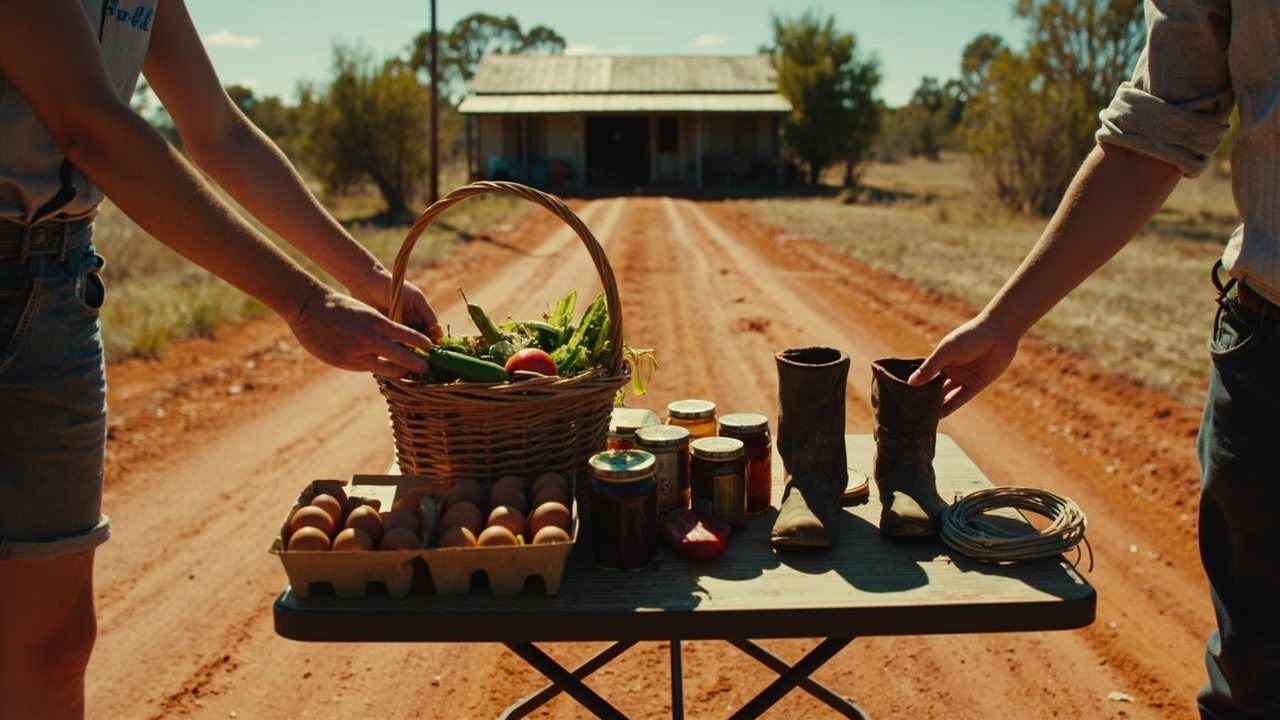
An informal swap table on a remote outback driveway
Category
What to stock or produce
Why it trades well
Fuel
Diesel and unleaded petrol in properly ventilated jerry cans; kerosene
Off-grid systems burn fuel for backup generation. A 20L jerry at $1.98/L is roughly $39.60 of value to swap.
Drinking water
Tanked rainwater, bottled, or filtered
Universal need; legal to provide in clean containers.
Fresh produce
Eggs, leafy greens, root vegetables, herbs
Eggs lose value fast in a Central Queensland summer — refrigerate or trade within 24 hours.
Always needed for cooking, heating, and boundary work.
Seed and seedlings
Heirloom vegetable seed, propagated fruit trees, tube stock
Multiply at no ongoing cost once you hold a parent plant.
Skill vouchers
Pre-agreed hours of generator servicing, welding, first aid, tutoring
Tradeable between households without moving a physical item.
Animal products
Honey, eggs, raw fleece, manure, compost
Easier to trade than live animals; lower disease and transport risk.
Tools and equipment
Short-term loan of post-hole digger, chainsaw, pressure cleaner
Useful on a fee-for-use or labour-swap basis.
Information
Local knowledge: water sources, road conditions, weather windows, supplier contacts
High value, low cost; tradable as advice.
The list leans heavily on consumables and skills that produce consumables. That's deliberate. Non-consumables (a chainsaw, a generator) are useful, but they tend to be loaned or used as collateral rather than swapped outright.
Keeping the Books: Ledgers, Reputation, and Fairness
Honesty and follow-through are critical to successful bartering. Without records, even good neighbours drift into arguments about who owed whom what.
Practical record-keeping:
A single A5 notebook per household works. Date, item or service, direction (in/out), and counterparty name.
A running balance per neighbour, signed off when both parties agree.
A digital backup photo of the page once a week. Phones die in heat; backups don't.
Fairness over equality. Barter exchanges do not have to always be equal, but they should always be fair. A senior neighbour might trade you three dozen eggs for an hour of generator repair because you've cut the job down with experience. A younger neighbour might trade you four dozen eggs for the same hour because they're still learning. Both are fair. Neither needs to be exactly even.
Trust before crisis. Build bartering relationships with trusted friends and neighbours before a crisis occurs. Bartering works best where trust has been established — and trust isn't something you build the day the Bruce Highway closes.
Safety and Legal Edges
Bartering is mostly neighbourly. A small slice of it is regulated, and another slice is genuinely dangerous if you wing it.
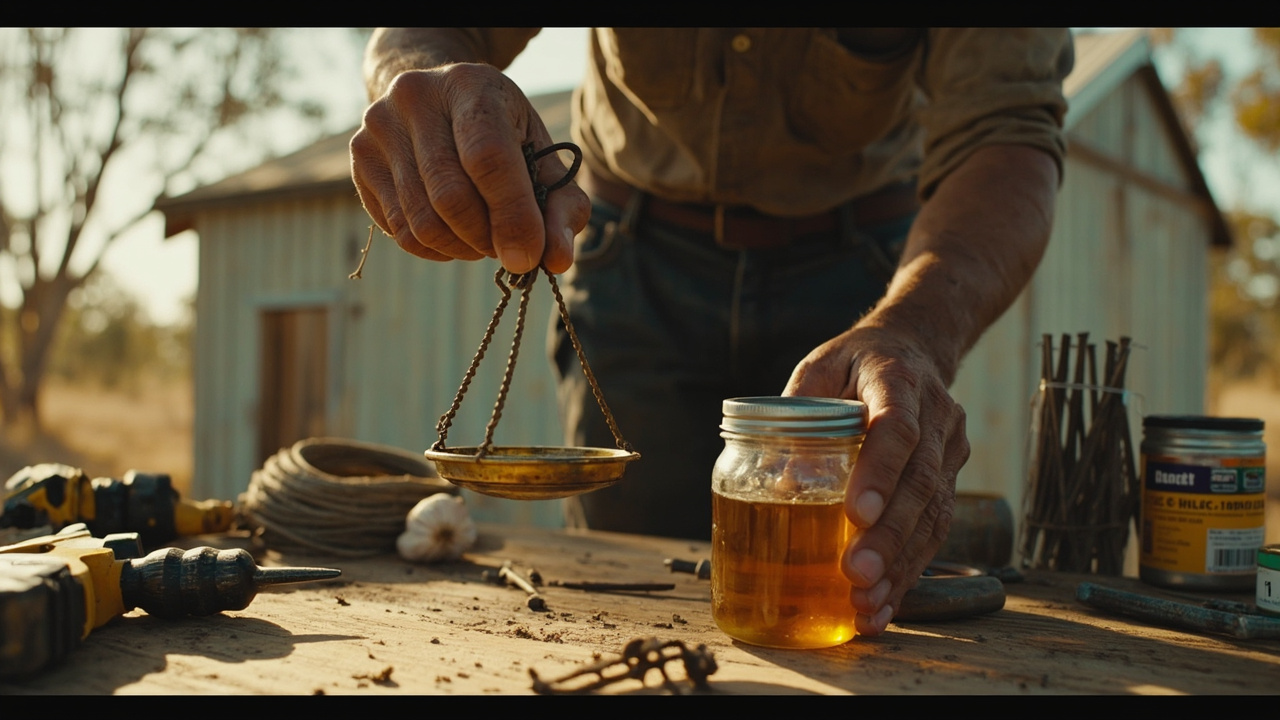
Weighing trade goods on a portable brass scale
Do not barter if:
You don't hold the skill to deliver. "I'll have a go" is how property burns down.
The item is regulated. Prescription medicines, firearms, certain veterinary chemicals, and unlabelled food products all carry restrictions under Australian law.
The transaction would create a tax or Centrelink reporting obligation you can't meet.
When to call a licensed professional:
Any electrical work beyond swapping a 230V plug or resetting an RCD — wiring changes, inverter installation, switchboard work — must be done by a licensed electrician in Queensland.
Any gas work on LPG appliances must be done by a licensed gas fitter.
Any structural building work above the DIY threshold (typically anything needing council approval) must go through a licensed builder.
Any medical situation beyond basic first aid must go to a clinician.
Any pest or disease outbreak in livestock or crops that you can't identify must go to a vet or agronomist.
Personal safety: Don't enter a stranger's property alone to settle a trade. Don't bring strangers onto your property alone. Do the deal in daylight at a neutral spot if you don't already know each other.
Frequently Asked Questions
What skills are most valuable for bartering off-grid in Australia?
Generator and solar PV servicing, first aid, food preservation, welding, and water treatment consistently rank highest because they address problems that stop a household functioning. Skills that produce consumables (gardening, cooking, preserving) trade more frequently than one-off services.
Is bartering legal in Australia?
Yes. Goods and services can be swapped between private individuals without involving the ATO. If the activity becomes a regular business (regular customers, advertising, structured income), normal tax and registration rules apply.
What shouldn't I accept in a barter?
Anything you can't verify is safe or legal — unlabelled meat, homemade "medicine", unregistered firearms, and stolen property. If in doubt, decline.
How do I value items in a barter?
Anchor to a cash price you can both verify. Eggs at $8 a dozen locally means a dozen eggs swaps for about $8 of value, even if no money changes hands. Fairness is easier to see when both sides use the same yardstick.
Should I keep records?
Yes. A simple ledger of date, item, direction, and counterparty prevents most disputes and supports any tax question that arises later.
Can bartering replace an income?
Not as a primary income stream. It can substantially reduce ongoing costs, build community resilience, and absorb the gaps when cash flow is tight.
Closing Note
The honest version of bartering isn't glamorous. It's keeping diesel in a ventilated jerry, knowing when a generator needs a service, and writing "3 dozen eggs ↔ 1 hr welding" in a notebook with a date. It's doing the same thing your great-grandparents did before currency reached Central Queensland — and recognising that the supply chain, which is the network of all individuals, organisations, resources, activities, and technology involved in the creation and sale of a product, is one disruption away from being irrelevant again.
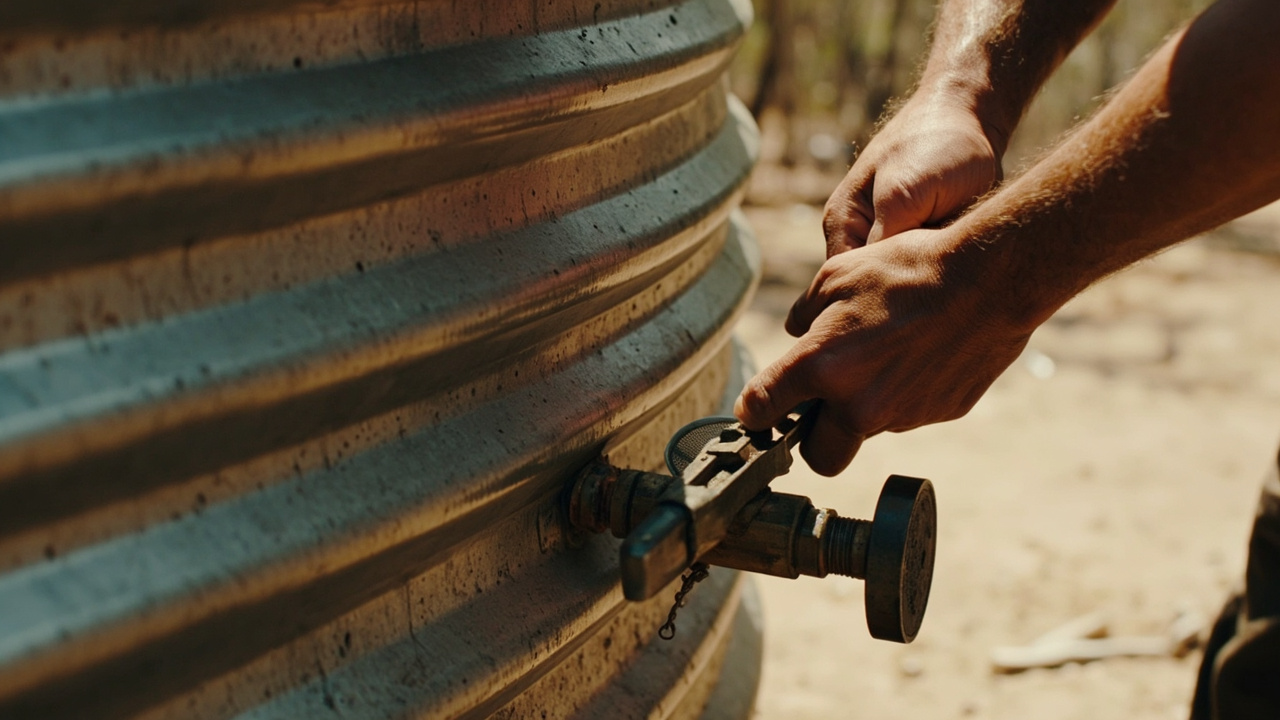
Servicing a rainwater tank valve by hand
Learn the skills. Know your neighbours. Keep the books. And if anyone offers you a suspiciously large trade for something you can't verify, walk away.
It lays out the top legal and logistical checkpoints—water rights, site approvals, and basic infrastructure planning—that you need to nail before you start swapping skills and goods, which is exactly the groundwork my guide assumes you’ve got sorted.— Jenny Mills
Frequently asked questions
Do I really have to barter if I live off-grid in Australia?
Yeah, pretty much. Cash is tight out here, the nearest tradie might be over an hour down a dirt road, and sometimes your neighbour is the only one with the gear or the know-how. Bartering keeps the community ticking over when the bank account can't.
How do I negotiate a fair swap without looking like a stingy bastard?
Be upfront about what you're putting on the table before anyone swings a hammer — never after. Keep it straight, keep it fair, and don't try to grind someone down once they've already done the work. Respect earns more goodwill down the track than a bargain ever will.
How do I work out what my skills are actually worth to trade?
Stop plucking a figure from the air and think about what you'd happily pay someone else to do the same job. Add on their time, fuel, materials and the trip out to your place, and you'll land somewhere honest that both sides can live with.
When should I stop bartering and just pay a professional?
Anything electrical, plumbing, structural, or where a shonky job could burn the joint down or void your insurance — that's when you call a licensed tradie. Barter's brilliant for fencing, firewood, produce and the like, but not for work that legally needs a ticket.