> US Edition — 120/240V split-phase, 60Hz, USD, NEC/UL standards.

By Dave Miller · off-grid sparky · 22 years wiring solar, batteries and sheds in central QLD
“I once blew three cheap Chinese inverters in one heatwave, learning that off-grid gear must handle 45°C like a shed in central QLD.”
Best Off-Grid Solar Inverters: USA Buyer's Guide
The inverter is the heart of any off-grid solar system. It converts the DC electricity stored in your battery bank into the AC power your lights, fridge, and tools actually run on. Pick the wrong one and you'll either trip every time a motor kicks in, cook your sensitive electronics, or watch your batteries die faster than they should. Pick the right one and the system just works.
This guide covers what to look for in an off-grid inverter for US installations: the specs that matter, the standards to require, and the categories of inverter that suit different setups.
Continuous vs. Surge Power: The Two Ratings That Actually Matter
Every inverter carries two power ratings, and confusing them is the most common sizing mistake.
Continuous power is what the inverter can deliver all day, every day, without overheating or tripping. Surge power is a brief boost — typically a few seconds — for the moment an inductive load starts. Motors, pumps, and refrigerator compressors pull a multiple of their running wattage at startup, and the inverter has to cover that spike or it will fault.
The rule: choose an inverter with a continuous rating that exceeds your calculated continuous load by 20–30%, and confirm that surge capacity meets or exceeds the startup draw of your largest motor-driven appliance. Skip that headroom and the inverter will nuisance-trip; oversize it and you're paying for capacity you'll never use.
Sizing Your Inverter to Your Load
Rough sizing bands for US off-grid households:
| Load profile | Continuous inverter size | Typical battery voltage |
|---|---|---|
| Cabin / RV / small outbuilding (lights, phone charging, small fridge) | Under 1 kW | 12V |
| Small home (efficient fridge, lights, electronics, occasional microwave) | 1–3 kW | 24V |
| Standard home (full kitchen, well pump, washing machine) | 3–5 kW | 48V |
| Large home, workshop, or small farm | 6–10 kW+ | 48V |
A 3–5 kW continuous inverter covers most basic US off-grid households. Larger residences, workshops, and farms generally need 6–10 kW or more.
Battery voltage scales with system size. 12V systems work for small setups under 1 kW (RVs, boats, compact cabins) but require thicker cables due to higher currents. 24V systems suit the 1–3 kW range and reduce current load. Above 3 kW — full off-grid homes, farms, and commercial builds — 48V is the standard. Higher voltage also supports higher MPPT input voltages, which lets you run longer solar panel strings and reduces voltage drop across the wiring.
Pure Sine Wave Is Non-Negotiable
Off-grid inverters output AC in one of two waveforms: modified sine wave (a stepped square approximation) or pure sine wave (a clean waveform matching grid power).
Pure sine wave is required for sensitive electronics — anything with a switch-mode power supply or microprocessor — and for inductive loads like motors and transformers. Modified sine wave units are cheaper but can cause buzzing, overheating, or outright damage in modern electronics and some motors. For any fixed US off-grid installation, specify pure sine wave.
Inverter Categories and What Each Suits
The three main inverter topologies for solar are:
- Microinverters — one unit per panel, best for smaller roof mounts with shading or orientation issues.
- String inverters — a single inverter handling a string (or array of strings), best for ground mounts with consistent orientation.
- String inverters with power optimizers — panel-level DC optimization feeding a central string inverter, best for complex or shaded roofs.
For US off-grid work specifically, a fourth category matters: hybrid / battery-based inverters (sometimes called "all-in-one" or "inverter-chargers") that combine inverter, charge controller, and often an automatic transfer switch for generator backup. Most off-grid installations end up here because grid-tie string inverters won't run without the grid present.
There is no single best inverter for every situation. The right choice depends on installation type, whether battery backup is a goal, and the scale of the system.
Matching the Inverter to the Rest of the System
An inverter doesn't work alone. The DC-side matchups are critical:
- Battery bank voltage must match the inverter's nominal input (12V / 24V / 48V family). A mismatch can destroy the inverter. Always confirm that the inverter's voltage rating matches the battery bank.
- Solar charge controller (MPPT or PWM) sits between the panel array and the battery bank. The controller and inverter must be compatible with each other and with the battery chemistry. Confirm compatibility with the solar charge controller for safe, stable, and efficient operation.
- Panel array voltage must fall within the inverter's or charge controller's MPPT input window. Higher voltage systems support higher MPPT input voltages, enabling longer string configurations and minimizing voltage drops.
Skip any of these matchups and the system will underperform at best and fail at worst.
Standards and Listings to Require (US Edition)
For fixed US off-grid PV equipment, insist on:
- UL 1741 — the safety standard for inverters, charge controllers, and similar power conversion equipment.
- UL 458 — for mobile / RV power conversion.
- IEEE 1547 — interconnection standards relevant if you ever plan to tie back to the grid.
- NEC compliance — the National Electrical Code governs the wiring side; Article 690 covers solar PV, Article 710 covers stand-alone systems. Installations should follow NEC and use UL-listed components.
Manufacturer financial stability matters as much as the spec sheet. Solar inverters are warrantied for 10–25 years, and warranty claims are only as good as the company standing behind them. Evaluate manufacturer financial stability, monitoring quality, and customer support — not just peak efficiency.
Anti-Backfeed and Generator Transfer
If you're pairing the inverter with a generator (common in off-grid for cloudy stretches and high loads), you need anti-backfeed protection between the two sources. Without it, the inverter and generator can backfeed each other — a condition called "islanding" that can damage both units, backfeed the grid if you're ever interconnected, and create a lethal hazard for anyone working on the lines.
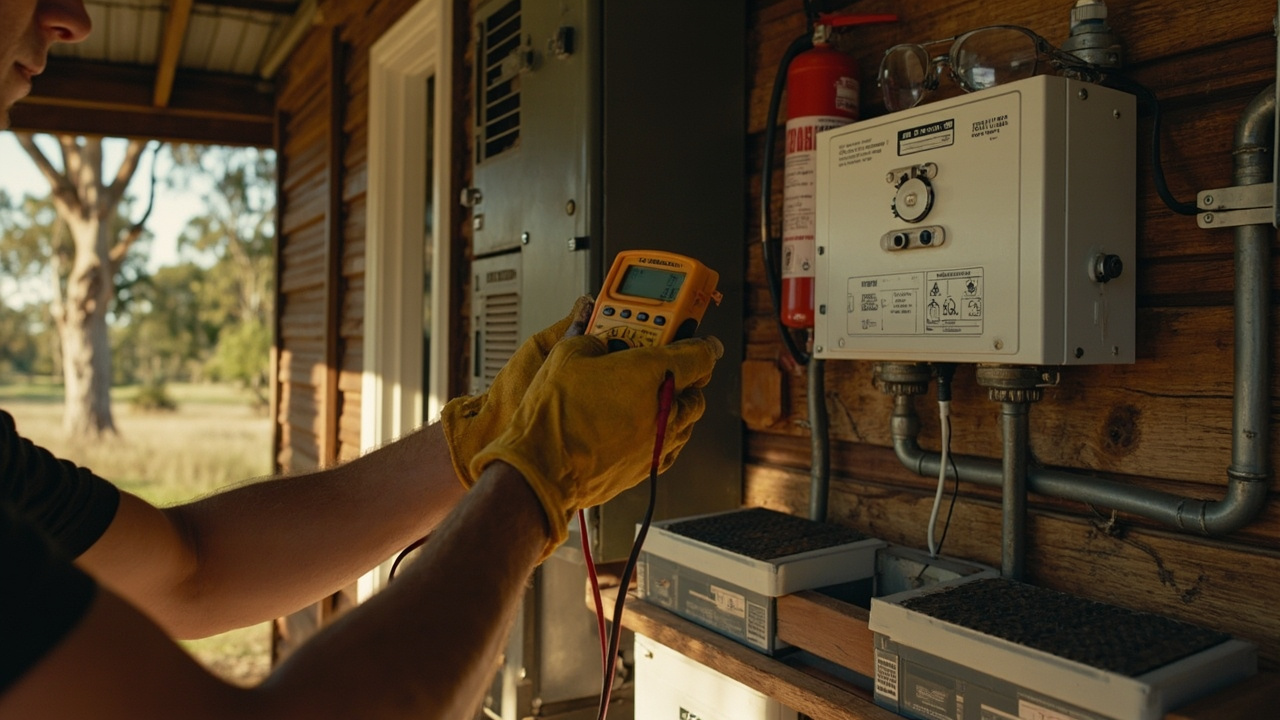
Two safe approaches:
1. Inverter-charger with built-in automatic transfer switch (ATS) — the unit handles switching internally. Most hybrid inverters designed for off-grid include this.
2. Manual transfer switch or interlock — mechanically prevents both sources from feeding the load at once.
Either solution must be installed so that the inverter and generator cannot energize each other's input simultaneously.
Maintenance and Longevity
An off-grid solar system is only as reliable as its weakest maintained component. Routine checks should include:
- Battery state — terminal corrosion, specific gravity (for flooded lead-acid), state-of-charge readings, equalization cycles as specified.
- Panel cleaning — dust, debris, and bird droppings all cut output. In colder regions, snow loading is an additional concern for readers up north.
- Connection tightness — thermal cycling loosens lugs over months, raising resistance and fire risk.
- Inverter logs — most modern units log fault history; review it periodically.
Proper installation is the foundation of longevity. Off-grid solar systems must be properly installed for maximum efficiency and longevity, and solar panels should be securely mounted for stability during bad weather. In the northern hemisphere, panels should face south for maximum sunlight; in the southern hemisphere (such as here in Central Queensland, where I write this), they should face north for the same reason.
When to Call a Licensed Professional
US off-grid solar work intersects building codes, electrical codes, and utility interconnection rules. Call a licensed electrician or NABCEP-certified PV installer when:
- The system ties into any structure's main panel or subpanel.
- You're sizing conductor ampacity, overcurrent protection, or grounding per NEC Article 690/710.
- You're installing an automatic transfer switch between inverter and generator.
- You're claiming any rebate, tax credit (e.g., the federal Residential Clean Energy Credit), or utility interconnection — paperwork requires licensed signatures in most jurisdictions.
- The battery bank exceeds 48V nominal or uses lithium chemistry with a Battery Management System that requires commissioning.
- You're working at any height on the roof or on a ground-mount structure that needs engineering certification for your wind/snow load zone.
A licensed pro doesn't just keep you safe — they keep the warranty valid and the inspector satisfied.
Quick-Spec Reference Table
| Specification | What to look for | Why it matters |
|---|---|---|
| Continuous power | 1.2–1.3× your calculated continuous load | Headroom prevents nuisance tripping |
| Surge power | ≥ startup draw of largest motor | Covers compressor / pump inrush |
| Waveform | Pure sine wave | Protects electronics and motors |
| Nominal battery voltage | Match battery bank (12/24/48V) | Mismatch destroys the inverter |
| MPPT input voltage | Cover your panel string's VOC (with cold-derate) | Avoids array clipping / damage |
| Listings | UL 1741 (fixed), UL 458 (mobile), NEC compliant | Safety and code compliance |
| Transfer switching | Built-in ATS or external transfer switch | Prevents inverter/generator backfeed |
| Warranty | 10–25 years; check manufacturer stability | Warranty is only as good as the company |
FAQ
Do I need a pure sine wave inverter for an off-grid cabin?
Yes. Even simple cabins now run LED drivers, laptop chargers, and variable-speed tools — none of which tolerate modified sine wave cleanly. Pure sine wave is the default for any modern installation.
Can I use a grid-tie string inverter off-grid?
No. Grid-tie inverters need to see grid voltage and frequency to operate; without the grid present, they shut off. You need a battery-based (hybrid) inverter for off-grid use.
What's the right battery voltage for a 5 kW off-grid home?
48V. Above 3 kW, 48V systems offer superior efficiency, lower cable losses, and better battery bank operation than 12V or 24V.
How big should the inverter be relative to my solar array?
Unrelated directly — the inverter is sized to load, not array. The array is sized to battery bank capacity and daily kWh consumption. Match the inverter to your biggest simultaneous loads, then size the array to refill the bank.
Do I need a charge controller if I have an all-in-one inverter?
Often yes — many "all-in-one" hybrid inverters have an MPPT charge controller built in, but verify the array's total wattage and string voltage fall within the built-in controller's limits. If they don't, add an external MPPT controller.
How long should an off-grid inverter last?
10–25 years is the typical range. Lifespan depends heavily on operating temperature, load cycling, and manufacturer build quality — which is why manufacturer financial stability matters when you're buying a unit warrantied for two decades.
One colourful aside, as per house style: picking an off-grid inverter is less like buying a stereo and more like buying a heart — you want one that matches the body, runs cool under load, and comes from someone who'll still answer the phone in 2035.
Sources
- https://www.srnesolar.com/articledetail/how-to-choose-the-right-off-grid-solar-inverter.html
- https://sungoldpower.com/blogs/news/best-off-grid-solar-power-systems-complete-guide
- https://www.paradisesolarenergy.com/blog/best-solar-inverters-buyers-guide/
Worth a watch: Offgrid Solar Inverter Buyer's Guide for Beginners · DIY Solar Power with Will Prowse
Disclosure: some links in this article are affiliate links. If you buy through them we may earn a small commission at no extra cost to you.