
By Dave Miller · off-grid sparky · 22 years wiring solar, batteries and sheds in central QLD
“After my first micro-hydro blew out in a flash flood, I learned that 12mm cable simply isn't enough for a central Queensland monsoon.”
I watched a mate in NSW burn $14,200 on a micro-hydro setup that choked the day it was switched on — all because he never checked his local council's flow regulations. That money went straight down the drain, and he's been staring at a silent turbine while the shire sends him angry letters ever since. Micro-hydro pulls steady, renewable power from flowing water, and unlike solar or wind, it'll give you baseload generation through every season — which matters when your property's 80 km from the nearest grid tie. Below is the straight technical, legal and cost information you need before you turn a single valve.
By Dave Miller · off-grid sparky · 22 years wiring solar, batteries and sheds in central QLD
“After my first micro-hydro blew out in a flash flood, I learned that 12mm cable simply isn't enough for a central Queensland monsoon.”
Micro-hydro is a niche answer here, but on the right Australian block it can outwork solar and wind on every kilowatt-hour it produces. Where I sit in Central Queensland, summer clouds chew solar output and storms flatten wind sites for days. A creek with a reliable drop doesn't care about the weather. Hydropower can be a continuous source of energy as long as enough water is flowing, which is the single biggest practical advantage when you're sizing an off-grid system.
This is the same reason generation of power from flowing and falling water remains one of the world's oldest and most common energy technologies: it is dense, dispatchable, and largely predictable once you've measured a stream across a year.
The catch: micro-hydro project development is very site-specific. Each site may face different regulations, ecology, geology, and topography. What works on a Tier 3 stream in the Wet Tropics may be impossible on a sand-bed creek in central-west Queensland. Treat the technology as the easy part; treat the site assessment as the actual job.
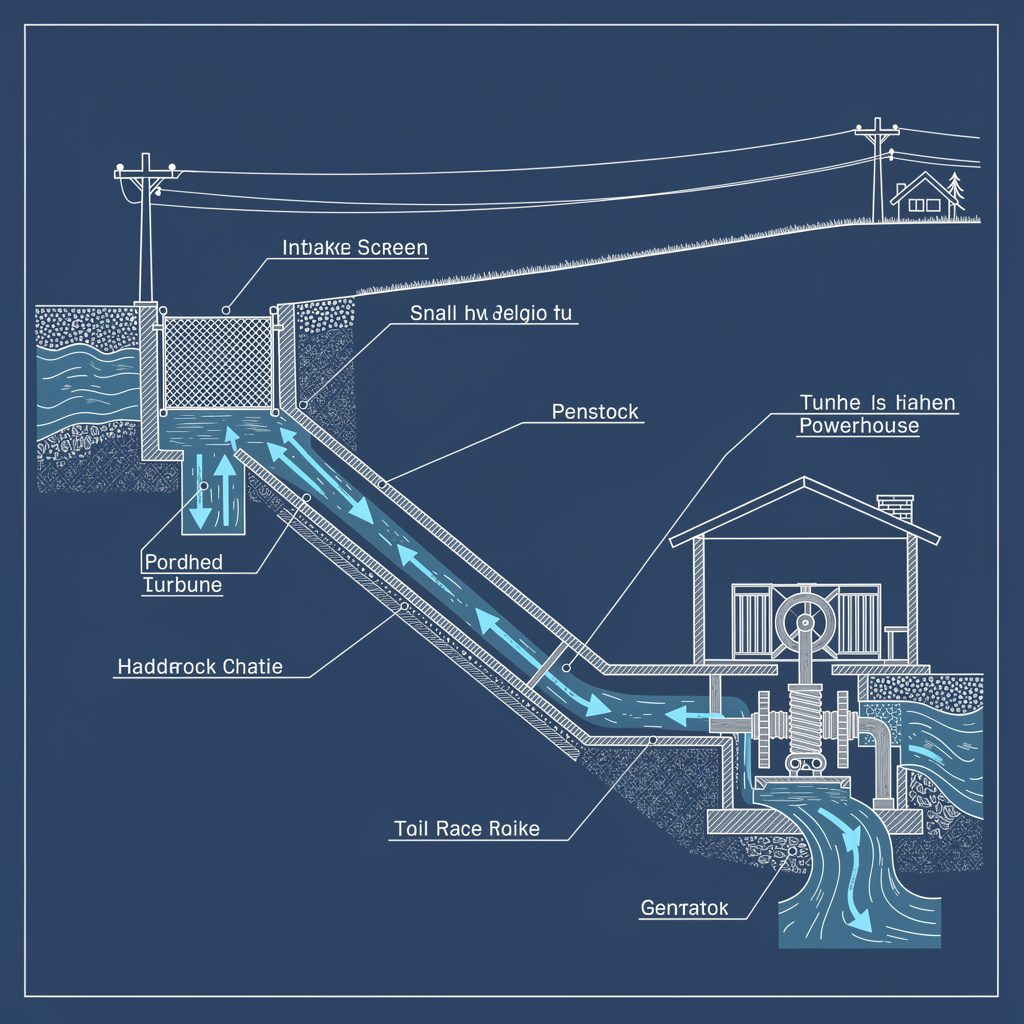
Micro-hydro systems are those that produce less than 100 kilowatts of electricity. For a homestead, the realistic working band is 200 W to 5 kW of continuous output, with a battery bank absorbing the surplus when the house load is light.
Electrical power is measured in watts (W), kilowatts (kW), or megawatts (MW), and mechanical power is measured in horsepower (HP). A useful rule: a turbine generating 150 watts continuously for one hour produces 150 watt-hours, or 0.15 kilowatt-hours (kWh). Run the same 150 W turbine for ten hours and you have 1.5 kWh, which is roughly a day's worth of fridge draw on a small efficient off-grid house.
Two principles drive the whole calculation: vertical drop (hydraulic head) and flow (volume of water). Head is measured in metres, flow in litres per second. You need both. A high-volume creek with no fall won't turn a Pelton; a waterfall with a trickle won't turn a propeller. In one documented North American micro-hydro installation, the site used 1.8 m of hydraulic head (drop) from intake to powerhouse, which at low flows was still enough to run the whole homestead. Five metres of head with 20 L/s will surprise most people with how much it puts out.
A micro-hydro system is not just a turbine in a creek. The standard arrangement consists of:
In the Montana installation referenced in the research, the penstock was buried underground to act as a sub-terrain conduit to the turbine, and a vortex tube was attached to the bottom of the powerhouse to create suction. Burial protects the pipe from UV, livestock, and bushfire — all very Australian concerns.
The turbine itself turns the rotation into electricity through a generator or alternator controlled by a regulator. The turbine types you'll be choosing between:
Water can be delivered to the turbine via a channel or pipeline from the natural stream rather than submerging the wheel directly. That separation is what lets you put the powerhouse somewhere dry and accessible, and what lets you cut off flow for maintenance.
| Item | Typical value / requirement (AU context) |
|---|---|
| Output band (continuous) | 200 W – 5 kW residential; sub-100 kW qualifies as micro-hydro |
| Site voltage (AU) | 230 V, 50 Hz single-phase for most homesteads |
| Generator output | Low-voltage DC or AC depending on turbine/alternator |
| Inverter role | Converts low-voltage DC electricity produced by a hydropower system into 240 V AC electricity for the house |
| Hydraulic head needed | As low as 1–2 m with a vortex or cross-flow turbine; 5–50 m opens up impulse turbines |
| Flow needed | Roughly 10–50 L/s continuous for a 500 W–2 kW unit (site dependent) |
| Off-grid system inclusions | Generation assets (solar, sometimes wind/hydro), battery storage, inverters/controls, a backup generator, and load management |
| Storage note | Battery storage is described as less practical with hydropower than with other sources, and hydropower tends to be more seasonal than solar or wind |
| Intake components | Trash rack, weir, forebay |
| Conveyance | Buried penstock (HDPE PN16 is the Australian default) |
| Discharge | Tailrace back to natural stream bed |
| Key site data to gather | 12 months of flow data (or wet/dry season gauging), head in metres, ecological constraints |
The honest answer is: measure the water first, then design the turbine. Buy the turbine last.
1. Gauging. Mark a known cross-section on the creek, time how long a floating object takes to traverse 5–10 m, multiply cross-section by velocity. Do it in the driest month you expect to use the system. In Queensland that often means late spring.
2. Head. Use a surveyor's level, a hose-and-water method, or a laser rangefinder from intake to proposed powerhouse. Subtract pipe friction losses (roughly 5–10% per 100 m of small-bore penstock at typical flows).
3. Continuous output estimate. Power (W) ≈ flow (L/s) × head (m) × 7 (a rough overall-efficiency constant for small systems). A 20 L/s creek with a 10 m head gives roughly 1.4 kW continuous. That's enough to run a small house plus charge batteries in good flow.
4. Seasonality. Hydropower output is more seasonal than solar or wind in most Australian catchments. Wet-season flows may be 5–10× dry-season flows, so the system is sized for the dry season and curtailed (or bypassed) in the wet.
Batteries are still part of the system for overnight load, but battery storage is less practical with hydropower than with other sources, because the generator is already producing round the clock during high-flow periods. In my experience, a modest battery bank (10–15 kWh) plus a load-shedding contactor on heavy appliances is the right balance for a hydro-led site.
Hydro wins when:
Hydro loses when:
If the site doesn't pass the "perennial flow + usable head" test, put the money into solar and battery. Australia's off-grid renewable energy data has tracked growth across solar, hydro, bioenergy, and wind from 2015 to 2024, and the bulk of that growth is solar because most Australian blocks are solar-shaped, not hydro-shaped.
Micro-hydro is plumbing plus high-voltage electricity plus working in moving water. Treat all three seriously.
Call a licensed professional when: any mains-voltage AC wiring is touched; the inverter is commissioned; the penstock crosses a road or a neighbour's land; the weir or dam exceeds your state's "low-impact" threshold; or the site is on a regulated waterway.
How much head do I really need?
For a propeller or cross-flow turbine, 1–3 m is workable with a vortex tube or suction-enhancing inlet. For a Pelton or Turgo impulse wheel, 10 m or more gives much better efficiency and a smaller, cheaper turbine.
Do I still need batteries?
Yes, for overnight and low-flow periods. Hydropower reduces battery cycling compared with solar, but you still need storage sized for at least one night of house load. In my experience, a battery bank roughly equal to one day's average consumption is the minimum.
What about dry-season output?
Run-of-creek micro-hydro drops with the stream. Size the system for the worst month you expect to live through, and accept that you'll either curtail output in the wet or have a bypass valve to spill excess water safely.
Can I combine hydro with solar on the same off-grid bus?
Yes. Going fully off-grid in Australia typically means generation assets (solar, sometimes wind/hydro), battery storage, inverters/controls, a backup generator, and load management all working together. A hybrid inverter that accepts AC input from both sources handles the common case cleanly.
Is a pump-as-turbine (PAT) a real option?
Common-domain practice: standard centrifugal pumps run backwards make cheap turbines for the right head/flow band. They are widely used on small Australian sites when a purpose-built turbine isn't justified, but expect lower efficiency and limited service life at continuous duty.
What does a realistic micro-hydro system cost in AUD?
Specific pricing is outside the verified facts available here, so treat any number as indicative only. The cost is dominated by the penstock trenching, the pipeline itself, and the turbine/alternator. Sites with short penstocks and high head cost less; sites with long, low-head runs and difficult trenching cost more. Get a site-specific quote.