By Jenny Mills · rural nurse & homesteader · health, safety, law and the paperwork of going bush
“After my first solar fridge failed in the peak of a 42°C summer, I learned we need at least 30% more battery capacity than the manuals suggest.”
By Jenny Mills · rural nurse & homesteader · health, safety, law and the paperwork of going bush
“After my first solar fridge failed in the peak of a 42°C summer, I learned we need at least 30% more battery capacity than the manuals suggest.”
Look, if you're living off-grid in Australia, your fridge better not be a power-hungry monster. You've got solar panels, batteries, maybe a generator – but that thing needs to run on gas or 12V DC, silently, and not cost you a fortune. Absorption fridges are the only game in town. No compressors, no noise, no stress. Let's cut the crap and get to the point.
Cold food storage is one of the first things that makes an off-grid kitchen feel like a real kitchen. Cold milk in the tea, cold water after fencing in 38 °C heat, a safe place for meat during a multi-day hunt, and somewhere to park the cheesemaking while it cultures. Getting refrigeration sorted correctly pays for itself in food saved and in annoyance avoided.
This article is the engineering view: what fridge types actually work off-grid, what they cost in watts, how to size the solar and battery side, the safety standards that matter in Australia, and where to draw the line and ring a licensed gas fitter or sparkie.
Off-grid living is built around a hierarchy of priorities that begins with shelter, then water, then food, and only then power and income. Once food security becomes the focus, preservation is the whole game. Refrigeration sits alongside other preservation methods such as a root cellar, home canning, smoking, and a pantry for dry goods, and on a working homestead you'll use several of them at once.
The job of a fridge on solar is to be predictable: a known daily kWh number you can design the battery bank and panel array around. Anything that surprises you with random compressor cycles or burns LPG on a calm night will eventually bite you.
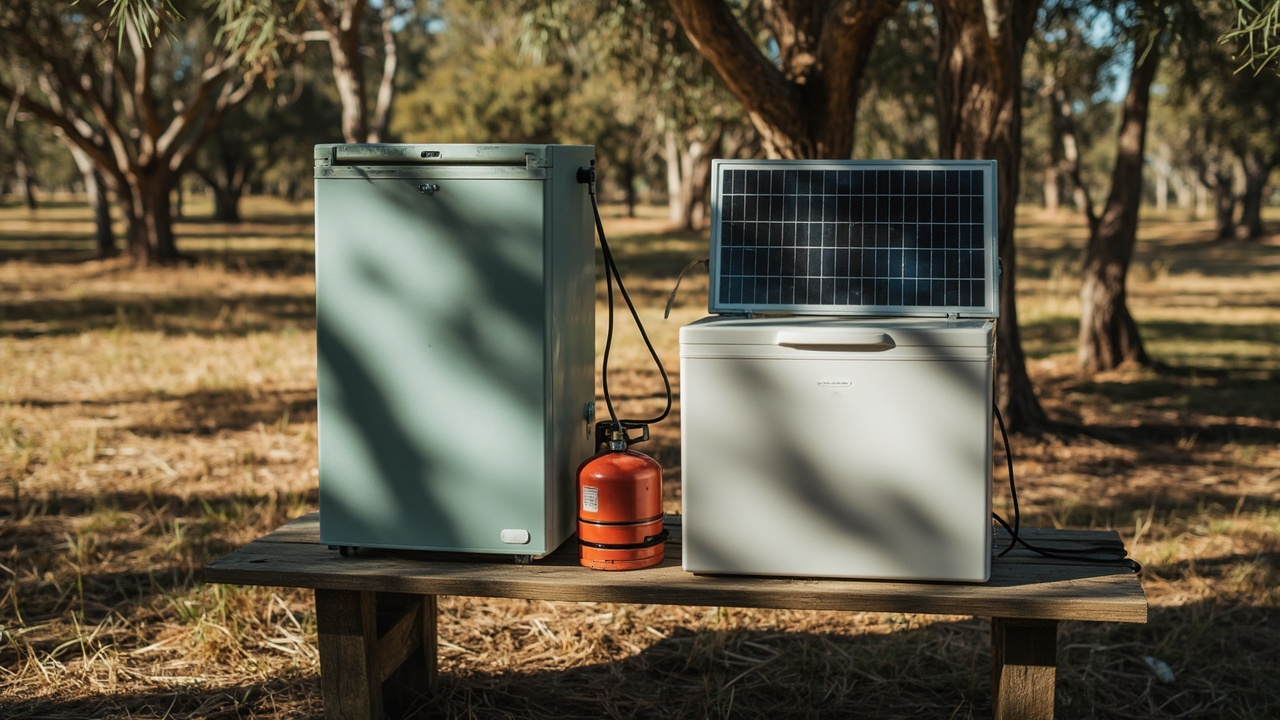
Off-grid, three fridge technologies dominate. Each has a different load profile, a different noise signature, and a different standard it must be installed to.
| Fridge Type | Energy Source | Typical Daily Use | Noise | Moving Parts |
|---|---|---|---|---|
| 12V DC compressor (e.g. portable/built-in) | Solar + battery | 0.4–1.2 kWh/day (size-dependent) | Compressor hum | Compressor, fans |
| 230V AC compressor (standard bar fridge, inverter run) | Solar → battery → inverter | 1.0–2.0 kWh/day | Compressor hum | Compressor, fan, inverter |
| Gas absorption (LPG or 12V/230V heater) | LPG bottle or electric heater | 0.5–1.5 kg LPG/week typical; ~250–400 Wh/day on electric heat | Silent on refrigerant side; burner hiss or heater tick | None on refrigerant side |
Compressor fridges are the workhorses. They cycle hard and fast, pull a known wattage, and respond well to a well-sized battery. A 230V bar fridge on an inverter adds inverter losses; a 12V compressor fridge avoids that round-trip entirely and is generally the most efficient choice per litre of stored food.
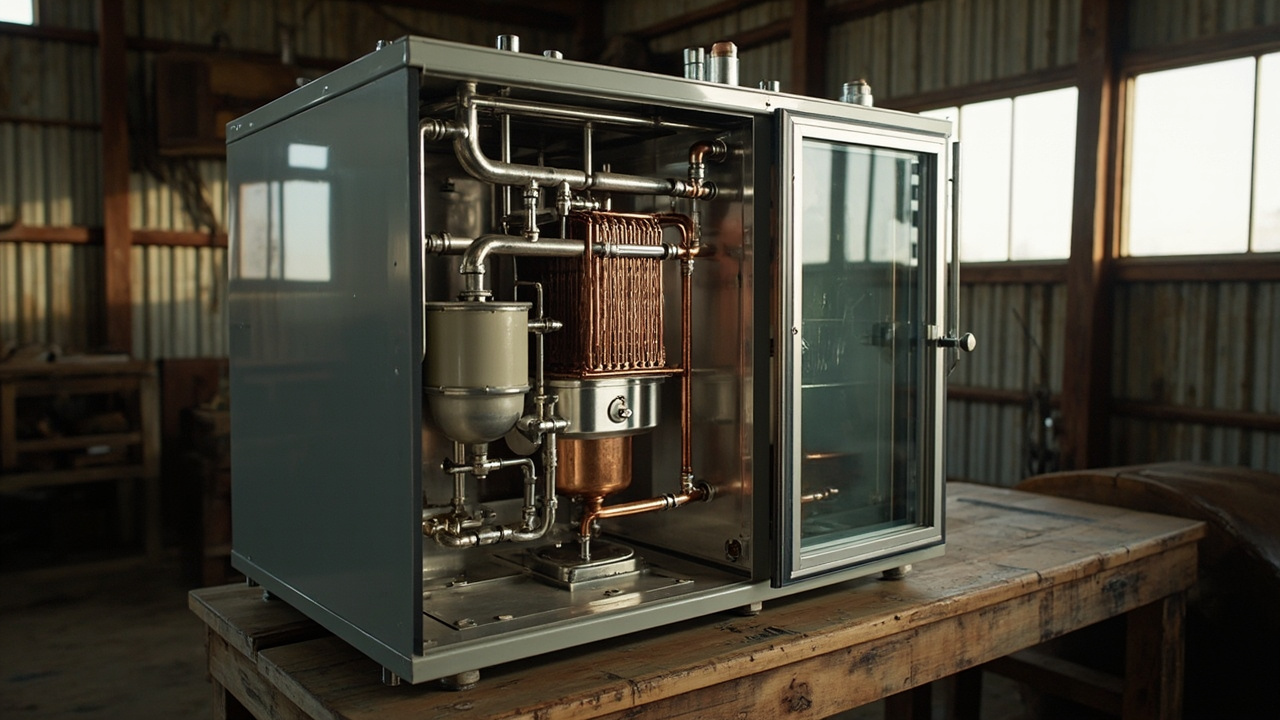
Gas absorption fridges have no compressor and no refrigerant pump. They are silent on the refrigerant side; whatever noise you hear is the burner or the 12V/230V electric heater element. They run for very long, gentle cycles, which suits unpowered shacks and cabins. The trade-off is real: open flame, flueing, and combustion products indoors.
Chest-style fridges and freezers beat uprights in efficiency because cold air stays put when the lid opens. If you're buying new, chest is the default off-grid choice.
Work out your daily fridge energy before you wire anything. A rough but defensible method:
1. Look up the fridge's rated daily kWh or annual kWh on the data plate or spec sheet.
2. Add a design margin. AS/NZS 4474 (fridge performance) and AS/NZS 4633 (energy labelling) test conditions are 32 °C ambient, not the 25 °C used by European EN standards. Central Queensland sheds regularly sit above 30 °C, so a 20–30% margin over the rated daily kWh is reasonable engineering practice for tropical ambients — and the AU test temperature makes this margin conservative against the AU standard itself.
3. Add inverter losses if you're running 230V AC, typically 5–15% depending on idle draw and load size.
4. Sum all refrigeration (kitchen fridge, freezer, beer fridge) into a single daily kWh figure.
Example: a rated 1.0 kWh/day fridge, 25% margin for heat, 10% inverter loss = 1.0 × 1.25 × 1.10 = roughly 1.4 kWh/day to design the battery bank around.
Lithium (LiFePO4) has effectively become the default off-grid battery because usable depth-of-discharge is around 80–90% versus roughly 50% for lead-acid, and the weight per usable kWh is much lower.
A defensible rule of thumb:
Practical sizing for a fridge-only circuit on LiFePO4: a 1.4 kWh/day fridge over 2 days of autonomy at 90% usable DoD needs roughly 1.4 × 2 ÷ 0.9 ≈ 3.1 kWh of battery. To hit that figure at 48 V you need around 65 Ah (3.12 kWh) at 48 V nominal; at 24 V a single 100 Ah pack is only 2.4 kWh — short by roughly 0.7 kWh — and you would need a second 24 V pack in parallel to reach the target. Pick the battery voltage to match the inverter, then size the Ah accordingly.
Solar sizing comes down to average peak sun hours at your latitude and season. Central Queensland gets strong insolation; design for the worst month, not the best.
A simple method:
Practical sizing: 1.4 kWh/day at 0.75 efficiency and 5 peak sun hours (winter-ish worst case) = 1.4 ÷ 0.75 ÷ 5 ≈ 0.37 kW, so a 400 W panel array is the minimum, and a 600–800 W array leaves comfortable headroom for cloudy days.
The compressor side is straightforward 12V or 230V. The off-grid-specific decisions are:
Gas absorption fridges are a genuine fire and carbon-monoxide hazard if installed badly. They need a dedicated flue, correct gas type (LPG vs natural gas), correct gas pressure regulation, and combustion products must be vented to outside air.
In Australia, gas appliance installation is governed by AS/NZS 5601.2. A licensed gas fitter is required by law to install, commission, and certify fixed gas work in Queensland, NSW, Victoria, Western Australia and South Australia. Owner-permitted gas work is effectively zero in those jurisdictions for fixed appliances; portable unflued LPG appliances used per the manufacturer's instructions sit outside the regulated installation framework altogether. The consequences of getting this wrong are not theoretical: incomplete combustion indoors can produce carbon monoxide, which is odourless and lethal.
Combustion air matters. Restricted combustion air combined with inadequate flueing is the dangerous combination — either alone may produce flame-out (releasing unburnt LPG) or incomplete combustion (producing CO), both hazardous. A gas fridge starved of oxygen in a sealed room may either flame out or run rich; neither outcome is acceptable indoors.
If you're going gas, ring a licensed gas fitter. It's a small bill next to the fridge.
This list is not optional. In Australia:
If I were starting a fridge circuit from scratch on a Central Queensland homestead:
A gas absorption fridge is still a sensible choice for an unpowered bush shack with no solar, where LPG delivery is reliable and the room is well ventilated.
How many solar panels do I need to run a fridge off-grid?
Work backwards from the fridge's daily kWh, not the panel wattage. A typical efficient 12V compressor fridge on a 1.4 kWh/day design load usually needs roughly 400–800 W of panels, depending on your latitude, season, and worst-case cloudy-day margin.
Is a 12V fridge better than a 230V fridge off-grid?
Generally yes. A 12V compressor fridge avoids the inverter round-trip, which costs 5–15% of the energy. It also handles low state-of-charge gracefully. A 230V fridge is fine if you already have an inverter and the load is small.
Can I run a fridge straight off a portable power station?
Yes for a 12V compressor fridge on the station's DC or Anderson output. Avoid running a 230V fridge through the station's AC inverter unless the station's inverter surge rating is comfortably above the fridge's starting surge.
Do I still need a gas fitter for a small gas fridge?
Yes, for new installations and any hard-piped gas work. AS/NZS 5601.2 governs LPG appliance installation in Australia, and licensed gas fitter work is required by law in most states. The flue and combustion-air requirements are the part DIY gets wrong.
How long will a gas fridge run on a 9 kg LPG bottle?
That depends on ambient, door openings, and load. As an order of magnitude, a small two-way absorption fridge in mild conditions uses roughly 0.5–1.5 kg of LPG per week. A 9 kg bottle therefore yields roughly 6 to 18 weeks of fridge-only use (about 1.5 to 4 months), but treat that as a planning estimate only and weigh the bottle.
What's the biggest mistake people make with off-grid refrigeration?
Under-sizing the battery for autonomy, then running the fridge on a low state-of-charge and killing a lead-acid bank in months. The second biggest is ignoring clearances around condenser coils so the fridge fights itself in a hot room.
Worth a watch: BougeRV CRX3: No AC, No 12V Plugs! The Ultimate Off-Grid Fridge? · RobnDob