Essential Strategies for Living Safely in Fire-Prone Land
By Jenny Mills· rural nurse & homesteader · health, safety, law and the paperwork of going bush
“After losing my old shed to a spot fire in 2019, I learned that the mandatory 30-metre asset protection zone must be cleared before the first ember lands.”
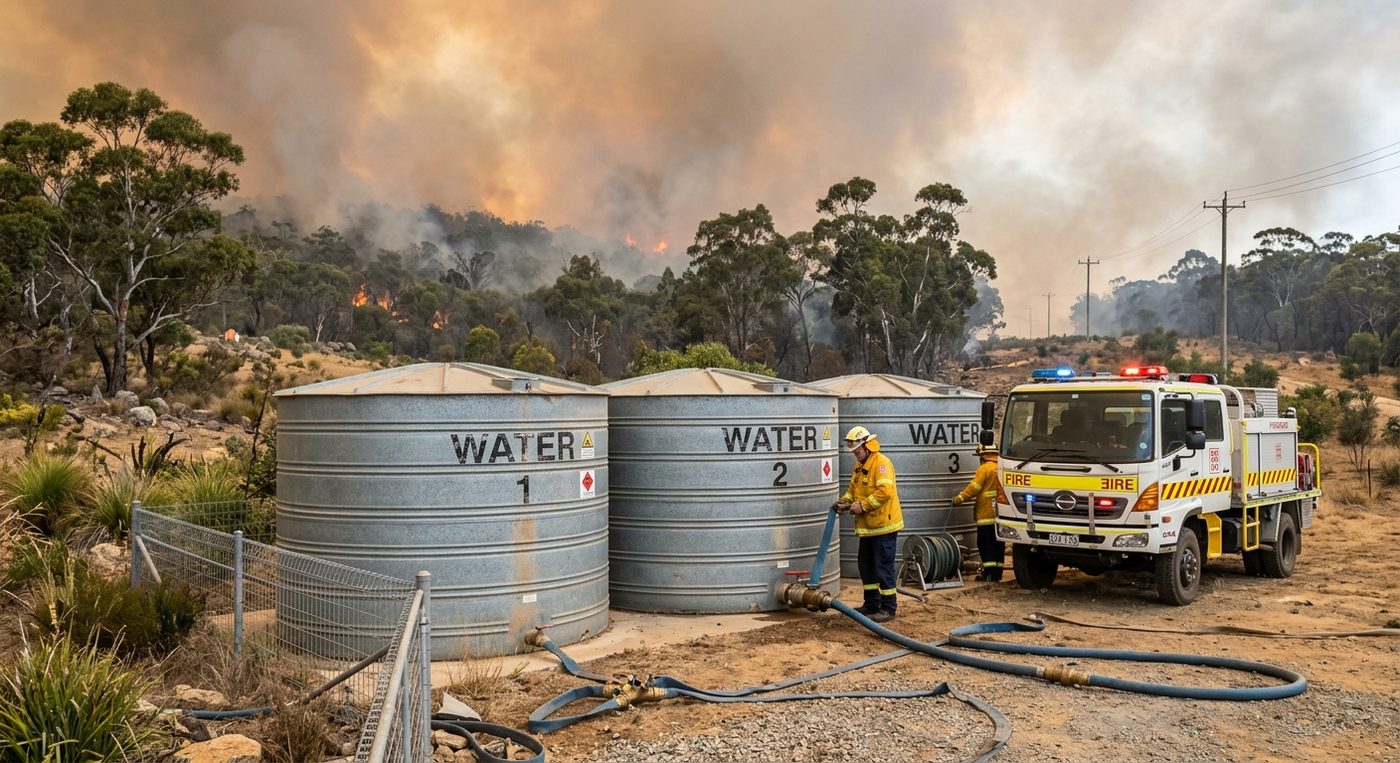
Bushfire is the headline risk for most off-grid properties in Australia, but the structure-fire problem inside the dwelling — battery banks, inverters, gas appliances, owner-wired circuits — is the one most people underestimate until it’s too late. Both need a plan, and the plan needs to work without grid power, without a phone signal, and without you standing next to it when it activates.
This guide covers the defensible-space rules, the suppression hardware that still works when the inverter is dead, and the Australian-specific electrical and gas points you’re legally required to get a licensed sparkie or gasfitter to sign off.
The Fire Triangle and Why Off-Grid Changes the Risk Profile
Fire needs three things: a heat source, an oxidising agent (generally oxygen), and fuel. Remove any one and you don’t get fire. For off-grid properties in Australia, this matters because:
Fuel load is often higher. Rural blocks carry timber, leaf litter, grass, and stored firewood that suburbia doesn’t.
Heat sources are concentrated. Battery banks, inverters, charge controllers, generator bays, gas cooktops, and wood heaters all sit in or near the dwelling.
Response time is longer. Off-grid sites are frequently outside brigade response range; by the time help arrives the fire is often out of control or already burnt out — the latter being cold comfort if it’s your home.
Bushfire Defensible Space: The 30-Metre Rule
A defensible zone of at least 9 metres immediately around the home is the standard guidance for ignition-hazard-free space around structures. The conservative Australian practice is to treat 9 metres as a bare minimum and push toward 10–20 metres of managed zone where vegetation is heavy.
Key tasks inside that zone:
Limb trees up to 3 metres from the ground — cutting lower branches reduces the chance a ground fire climbs into the canopy.
Remove all dead or overhanging branches from trees near the structure. Live trees and leaves can ignite almost as quickly as dead brush and help sustain and spread fire.
Clear dead leaves and pine needles from gutters, roofs, and around the home. They are highly combustible and act as fire starters.
Keep the area beneath decks and porches free of debris and leaves.
Do not pile yard waste cuttings near the house. Compost them out on the garden instead.
Mow or slash tall grass that has dried out — it provides a direct path for fire to the house.
Stack firewood at least 9 metres from structures. A spark landing in a woodpile stacked against the wall will light the house from the outside in.
During windy wildfire conditions, flames, sparks, and firebrands can travel from trees directly to the roof. Roof gutters full of leaf litter are one of the most common ignition points in Australian bushfire post-incident studies.
Structure-Fire Risk Inside an Off-Grid Dwelling
According to the U.S. Fire Administration, the leading causes of home fires are cooking, heating, and electrical malfunction — and off-grid dwellings tick all three harder than a standard home:
Ignition Source
Why It’s Worse Off-Grid
Practical Mitigation
Gas appliances — on-demand water heaters, cooktops, furnaces
Often owner-installed; LPG bottles stored close to the dwelling
Licensed gasfitter for install and commissioning; bottles external, ventilated, away from ignition
Battery banks and inverters
High continuous current, occasional fault heat, sealed enclosures trap heat
Ventilated enclosure, correct DC cabling sized to AS/NZS specs, BMS in circuit
Wood/pellet stoves
Minimal clearance to combustible walls in retrofits
Maintain manufacturer-specified clearances; non-combustible hearth and wall shielding
Choose Class A fire-rated lining where possible; seal penetrations
A tiny house or off-grid cabin can go from spark to flashover in under three minutes — far faster than a full-size home — because of the small air volume and the proximity between occupants and the fire. This is the single biggest reason suppression hardware matters more in small dwellings than in conventional houses.
Suppression Hardware: What Actually Works With No Power
Off-grid fire suppression has to satisfy four non-negotiable criteria:
1. No power required — it must still work when the inverter is off, the solar bank is drained, or the generator is cold.
2. Automatic and unattended — you won’t be standing next to it with an extinguisher at 2 a.m.
3. Targets real ignition points — battery bay, inverter shelf, cooktop, wood heater flue.
4. Tolerates environmental conditions — including the sub-zero mornings a Beecher winter throws at enclosures.
Heat-activated automatic suppression devices meet these criteria. They require no electricity and discharge a non-toxic, eco-friendly ABC dry chemical when the surrounding air reaches the device’s rated temperature. Mount them directly above real ignition points: battery banks, inverters, charge controllers, gas cooktops, wood heaters, and the generator bay.
Manual extinguishers still belong on the wall — Wet Chemical for cooking-oil/grease fires and ABF Dry Chemical (or ABC) for general structure fire are the Australian-standard pair. Service them annually to AS 1851.
Australian-Specific Requirements
Off-grid doesn’t mean off-regulator. The non-negotiables:
AS/NZS 3000 (Wiring Rules) applies to every 230V/50Hz circuit in the dwelling, on-grid or off. Battery and inverter installations must comply with AS/NZS 5139 for battery systems and the relevant clean-energy council guidelines.
Smoke alarms must be installed to AS 3786 and interconnected where required by state building code. Photoelectric alarms are the current best practice; every alarm needs a backup battery, and in many jurisdictions a 10-year sealed lithium alarm is now the default.
LPG and natural gas work must be done by a licensed gasfitter. Unlicensed work voids insurance and is a prosecutable offence in every state.
Bushfire Attack Level (BAL) rating applies to any new dwelling in a designated bushfire-prone area. BAL-LOW through BAL-FZ dictate construction standards (ember guards, screened vents, Class A fire-rated roofing, sealed decking). Check your state’s building authority for the BAL assessment process before you pour the slab.
Class A fire-rated roofing (e.g., corrugated steel, concrete tile) is correct general advice. Whatever roofing you choose, seal the gaps — gaps at the ridge, valley, and eaves are where embers get in.
Evacuation Plans: Two of Them
You need two evacuation plans, and they need to be different:
Bushfire plan. Triggered on high Fire Danger Rating days. Pre-decided; not a debate at 11 a.m. on a Code Red. Identify a route out, a place to shelter with a defendable building, and what you take (water, meds, documents, pets). Practice it twice a year.
Structure-fire plan. Triggered by alarm or smoke. Out the nearest safe exit, meeting point outside, no-one goes back in. In a small dwelling this plan has to be executable in under 60 seconds from detection.
A sit-down briefing with everyone who sleeps on the property is not optional.
When to Call a Licensed Professional
The following work is legally required to be done (or at minimum signed off) by a licensed tradesperson in Australia. If anyone — including a well-meaning off-grid forum — tells you to DIY, find someone else.
All 230V AC wiring, inverter AC-side installation, and switchboard work → licensed electrician.
LPG/natural gas appliance installation, commissioning, and bottle storage → licensed gasfitter.
Battery system design and installation → accredited battery installer under the CEC scheme (Clean Energy Council).
Structural fire-rated construction in BAL-rated zones → builder and certifier experienced in BAL construction; check with your state building authority.
Annual fire extinguisher service to AS 1851 → licensed fire-protection technician.
Smoke alarm interconnection or replacement where hardwired into 230V → licensed electrician.
Any post-fire electrical or structural assessment → licensed electrician and structural engineer. Do not re-energise after a fire without an inspection.
Specs & Equipment Summary
Item
Specification / Standard
Notes
Defensible space
≥9 m minimum around dwelling
Push to 10–20 m in heavy vegetation
Tree limbing height
Lower branches removed up to 3 m
Reduces ground-to-canopy fire climb
Firewood setback
≥9 m from structures
Spark-resistant stack location
Flashover time (small dwelling)
<3 minutes from spark
Drives need for automatic suppression
Suppression activation
Heat-activated, no electricity
Tolerates power loss, freezing temps
Suppression agent
ABC dry chemical, non-toxic
Targets real ignition points
Suppression mounting
Directly above ignition points
Battery bay, inverter, cooktop, heater
Home fire leading causes
Cooking, heating, electrical malfunction
Per U.S. Fire Administration
Smoke alarm standard
AS 3786
Photoelectric, 10-yr sealed lithium recommended
Wiring standard
AS/NZS 3000
Mandatory for all 230V/50Hz work
Battery standard
AS/NZS 5139
Plus CEC accreditation for installer
Extinguisher service
AS 1851 annually
Wet Chemical (F), ABE Powder (ABF/ABC)
Roofing
Class A fire-rated
Seal ridge, valley, eave gaps
Supply voltage / frequency
230 V / 50 Hz
AU default
FAQ
Q: What’s the single biggest fire risk on an off-grid Australian property?
For most rural blocks it’s the combination of leaf-littered gutters and a timber-lined roof under a bushfire-prone tree canopy. Clean gutters monthly during fire season and limb trees to 3 m — these two actions address more incidents than any suppression hardware.
Q: Do heat-activated suppression devices really work with no power?
Yes. They are mechanically triggered by reaching a rated ambient temperature and discharge without any electrical input. This is exactly why they’re suited to off-grid — they function when the inverter is off, the battery bank is drained, or you’re asleep.
Q: Can I install my own battery bank and inverter to save money?
You can physically do the work, but it won’t be legal and won’t be insured. In Australia, battery systems fall under AS/NZS 5139 and require a CEC-accredited installer. The AC-side wiring must be done by a licensed electrician regardless of who mounts the batteries.
Q: How fast does a small dwelling actually go up?
A tiny house or cabin can flash over in under three minutes. The small air volume and the proximity of occupants to the fire mean you don’t have the buffer time a conventional home gives you. This is the reason automatic, unattended suppression is worth the spend.
Q: Is ABC dry powder still right for a kitchen grease fire?
For manual response, a Wet Chemical extinguisher (Class F / Class ABE in some ratings) is the correct choice for cooking-oil fires. ABC dry chemical works on a grease fire but makes a mess and can damage the appliance. Suppression hardware mounted above the cooktop with ABC dry chemical is appropriate because it activates before the fire is fully developed; for hand-held response near a cooktop, use Wet Chemical.
Q: What about solar panels catching fire?
DC arc faults in PV arrays are a real ignition source, particularly in older or poorly-terminated systems. Use a licensed electrician for PV install, ensure DC isolators are to standard, and mount suppression above the inverter/charge-controller bay — not the panels themselves.