
Smart Orientation Cuts Power Bills
Twenty-two years of wiring solar, batteries and sheds across central QLD has taught me the same lesson on every job: a home pointed the right way heats itself in winter, stays cooler in summer, and cuts the power bills down to size—all without breaking AS/NZS wiring rules.
North‑facing tilt: the make‑or‑break call for central Queensland passive solar
After 22 years wiring solar, batteries and sheds in central QLD, I know passive solar design can shave up to 50 % off heating and cooling bills – a big win when your shed runs off‑grid. A north‑facing orientation is the only reliable way to catch the sun in Australia, but you still have to consider your climate zone and roof pitch before you lock in the build.
| Factor | Impact |
|---|---|
| North-facing windows | Maximizes winter solar gain |
| Thermal mass materials | Store heat for nighttime use |
| Shading devices | Prevents summer overheating |
| Roof pitch | Affects solar panel efficiency |
How I Orient Homes for Passive Solar in Central Queensland
Site Survey
- Survey your site with a compass that shows true north, not just magnetic north. In central Queensland the magnetic declination runs about 10 degrees east, so a raw magnetic reading will point your winter sun well off axis. On a flat block near Emerald last June I watched a shed hand lay out a slab using a phone’s raw magnetometer—finished up with the long edge facing south-west instead of north. The compass app I fall back on is Compass for Android, which taps the phone’s GPS to correct to true north once you let it settle for ten seconds away from ute bodies and star pickets. A physical sighting compass with declination adjustment runs $40–$90 at any BCF or disposal store; the phone app costs nothing and lives in your pocket. I still drive a couple of 450 mm hardwood stakes into the ground at the building corner positions and check the bearing three times—once at 8 a.m., once at solar noon, once at 4 p.m.—because slope, nearby fences and buried ironstone can pull a needle half a division. If the dirt is heavy ironbark country, swing a detector over the stake line first; a hot rock under the surface can throw a compass by 20 degrees and you won’t see the problem until the roof is on and the living room cooks in January. Mark the true north line with a stringline and spray a dotted orange line on the grass so the excavator operator can see it from the cab. That line becomes the reference for every window head, eave overhang and panel rack on the job.
- At our latitude in central QLD (23°S), the midday winter sun on June 21 sits 43.5° above the horizon. On December 21 it’s nearly overhead at 89.5°. A single north-facing window 2.4 metres wide and 1.8 metres high lets that low winter sun hit the slab and store heat long after sunset. The same glass, shaded by an overhang sized for our summer altitude, stays in full shadow from mid-October to late February for five hours around noon. I frame the eave so its projection equals roughly half the height of the window head above the floor. On a standard 2.4-metre stud wall with the window head tucked to 2.1 metres, a 600-millimetre cantilevered eave does the job. The rafters are 140×45 treated pine, $14 a lineal metre from the Boral yard, run past the top plate and clad in the same Colorbond custom orb as the shed roof. Below
- A 100 mm thick, 25 MPa reinforced concrete slab laid inside the building envelope is the thermal workhorse on most central Queensland blocks. That thickness gives you roughly 4 to 6 hours of thermal lag—the mass releases its peak stored warmth into the room just as you’re padding around in ugg boots after dinner. Laid cost runs about $100 to $120 per square metre when you’re within carting distance of a batching plant, using SL72 mesh on a damp-proof membrane and underslab insulation. A thinner 80 mm slab saves a few dollars up front but swings through the day like a tin shed, wasting the free heat you spent all afternoon catching through north glass. In summer the same slab pulls heat from the air if you keep the glass shaded and purge the house after dark. Standard extruded clay commons—230 x 110 x 76 mm—add a second reliable bank of mass. One square metre of single-skin brickwork holds about 1.2 MJ for each degree Celsius it rises. I salvage them from regional demo yards at $0.80 to $1.20 a brick, roughly half the cost of new mid-years, and lay them on a strip footing tied into the slab edge. Expose the brick or use a raw bagged finish so the surface can breathe directly into the room. In a north-facing living area you will see a 5 to 7 °C buffer between the inner face of the brick and the outdoor air overnight, provided you shut the windows before the kookaburras start. Water-filled drums painted black are a paddock classic, but they rust and breed mosquitoes. Concrete and clay don’t.
- Optimize roof design: A 20-30° pitch maximizes solar panel efficiency in southern Australia.
What My 2022 Gympie Roof Job Taught Me
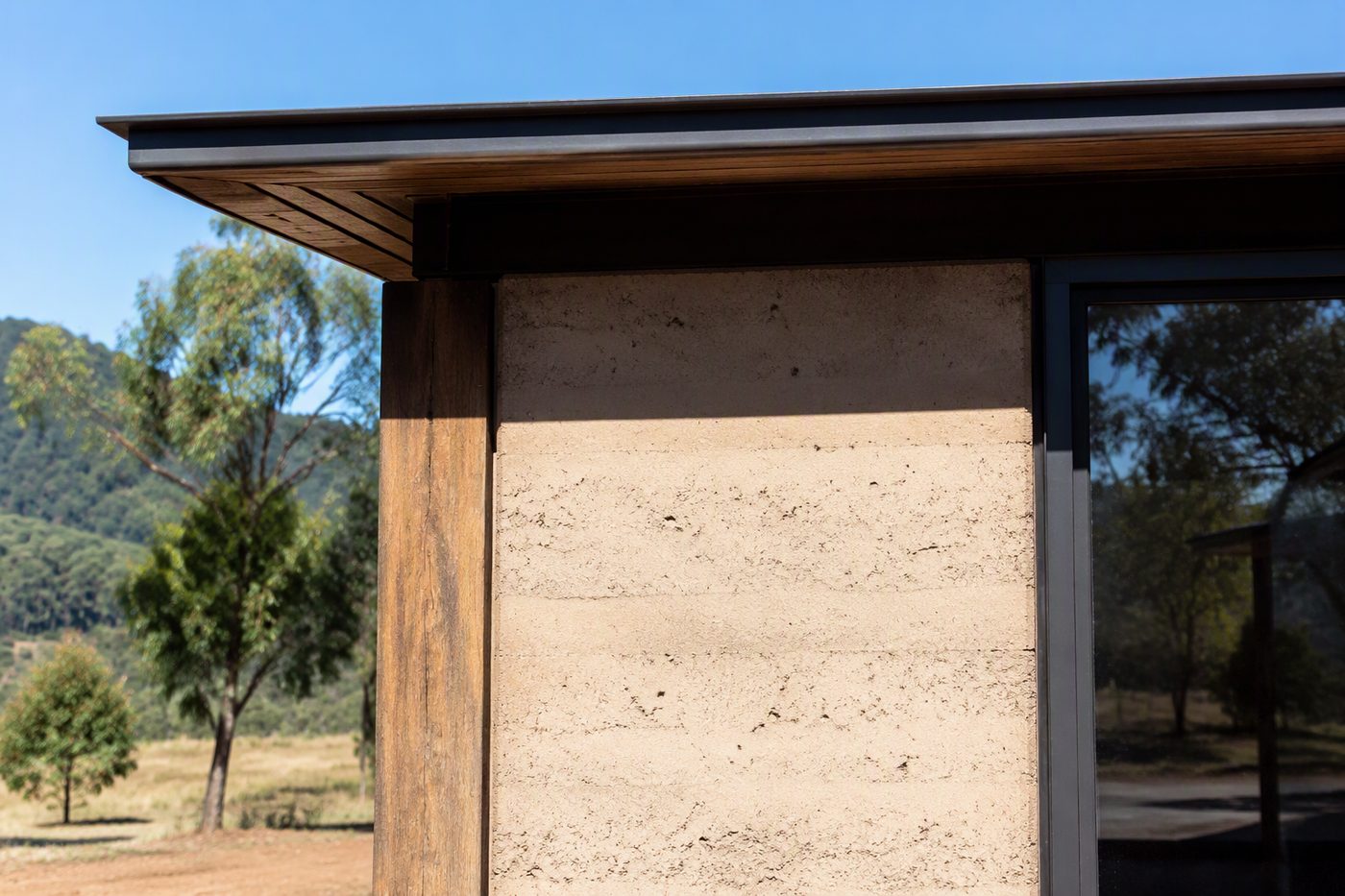
- A block of land ten kilometres from the Coral Sea behaves nothing like a block 200 kilometres inland near Longreach, even if both sit at the same latitude. The Building Code of Australia carves the country into eight climate zones for good reason. Most of the populated Queensland coast falls into Zone 2 (warm humid summer, mild winter) or Zone 5 (warm temperate), while my patch around Barcaldine sits in Zone 3 (hot dry summer, cold winter). A north-facing eave that works on a Yeppoon weekender will cook a shed out past Blackall. Coastal air drags in moisture. Indoor humidity regularly hangs above 70% through February, so cross-ventilation and openable panels 150 mm off the slab matter as much as glass angle. Inland, a January afternoon can push 44°C on the tin before a dry southerly drops it to 18°C by midnight. That 26-degree diurnal swing changes what thermal mass earns its keep. Down on the coast you fight mould and salt corrosion in solar isolators. Out here you fight dust in every finned inverter heatsink and wiring trough. I’ve replaced three coastal Morningstar regulators with rusted terminals because nobody sealed the gland plate—rain and sea mist walked straight in. Orientation advice isn’t transportable. True solar north gives the best winter gain everywhere, but coastal humidity makes afternoon western glass a liability that air conditioning will punish. Inland, a deep west-facing awning with a concrete floor slab 100 mm thick can soak up a low winter sun that’s gone by 5 pm, then bleed warmth back into a bedroom until 10 pm without firing a heater. I’ve measured the internal face of that slab at 12°C on a July morning in Ilfracombe before the sun hit it; by 3 pm it’s 31°C. On the coast the slab never gets cold enough to matter, and you’d be better off putting dollars into shading and ceiling fans with an air movement of at least 9,000 m³/h. Ignoring local climate zones (e.g., coastal vs. inland) means you’ll copy a plan that sits backwards on its block, over-glazed or under-shaded, with thermal mass in the wrong place. A standard truss eave at 450 mm projection won’t fully shade a 2,100 mm high sliding door in Townsville’s summer sun angle, but it works fine at St George. The high U-value double-glazed window unit that takes the edge off a Longreach winter night adds cost without payback in Mackay, where you’re better off with single-glazed louvres and a flyscreen that doesn’t choke airflow. I fit out off-grid battery sheds differently depending on the twenty-kilometre strip between a property line and the first creek crossing—eucalyptus-scented sea breeze in the wiring or gritty inland silence, each one demands a different vent layout and a different row of breakers set aside for the ceiling fans that actually run.
- East glass is an unpaid morning furnace. A single 1800 x 1200 millimetre clear-glass sliding window on an unshaded east wall in Rockhampton will pump roughly 1.4 kilowatts of heat into a bedroom by 8:00 am in December. I know the number because I’ve stood in the paddock with a clamp meter on the air-conditioner circuit watching the compressor ramp to full noise while the sun is barely over the horizon. The irradiance on a vertical east surface that time of year sits around 800 watts per square metre, and standard 3-millimetre clear float has a solar heat gain coefficient of 0.82. The arithmetic is kindergarten stuff: 2.16 square metres times 0.82 times 800 watts. The indoor temperature spikes seven degrees in an hour and the inverter starts pulling 2.2 kilowatts from a battery bank that was supposed to carry the morning loads without firing up the generator. West-facing windows are the same headache in the afternoon when ambient air temperature is already peaking. A 2100 x 1500 double-hung on a west wall with no external shading can admit over 2 kilowatts of solar gain straight into the living area between 3:00 and 5:00 pm. I wired a shed home near Biloela where the owner insisted on a full run of west glass for the sunset view. The first January after handover the lounge sat at 38°C at 4:30 pm with the split-system chewing 15 amps. The fix
- Using low-quality thermal mass materials (e.g., Bunnings thermal mass slabs) is a shortcut that unravels on the first cold night. Those slabs are typically 40 mm thick, around 90 kg per square metre, and often cast with a lower-density mix that barely holds heat. A passive-solar floor in central Queensland needs at least 100 mm of dense concrete, roughly 240 kg/m², to absorb enough energy through a winter day and release it slowly after sunset. In my own shed north of Emerald I poured a 100 mm charcoal-tinted slab with a burnished finish right where the low north sun hits it from 9 am onwards. By late morning the slab is warm under bare feet; it stays warm to touch past 10 pm while the air outside drops to single digits. A neighbour used the 600 x 600 x 40 mm Bunnings pavers laid loose on sand inside a sunroom. They reached
- Not consulting AS/NZS 3823:2012 for compliance
Maintenance Cadence
- Once a year I drag out the extension ladder and a soft-bristle broom just after the winter solstice. From a ground mount in red-dirt country you can lose 12–15 percent of your peak current to a film of bulldust and dried corella droppings that hardens like tile grout. Rain doesn’t touch it. I mix half a cap of truck wash in a 20-litre bucket of tank water, work it with a squeegee on a six-metre telescopic pole, and rinse with the garden hose set to a mist. A 6.6 kW array—seventeen 390 W panels—takes me under an hour. If you can’t do the roof safely, a local solar cleaning crew in a country town will charge eight to twelve dollars a panel, cash. Paying $150 once a year still beats running the generator to claw back the lost harvest. The same calendar entry covers shading devices. A Chinese elm you planted five years ago as a deciduous screen north of the house can punch out a metre of fresh canopy after a wet summer. A twig that barely cleared the eave’s shadow line in July will draw a solid black bar across half a bottom string by the following winter. I walk the yard at solar noon on the shortest day with a 1200 mm spirit level stood vertical on the northern roof edge. Where a branch shadow touches the glass, output drops. A standard 60-cell panel in partial shade can lose more than half its output because bypass diodes only split the panel into three sections. I prune the offender before the watt-hours stack up. If the shade comes from a fixed structure, the fix costs real money—retrofitting microinverters sits around $200–$250 a panel on a small system, so most people learn to live with a relocated string or a chainsaw.
- Bi-annual: Inspect thermal mass for cracks or moisture damage. Twice a year is enough to catch trouble before a wet season turns a hairline into a spalled edge. I run this check in late autumn—right after the last cyclonic rain and before the slab cools down for winter—then again in early spring when the dry air exposes any lingering damp. Walk every exposed edge of the slab, internal brick feature wall, or rammed-earth plinth with a torch held flat against the surface; low-angle light throws a shadow on cracks you’d miss at midday. A 100‑mm‑thick concrete slab in a central‑QLD passive‑solar house will expand and contract by roughly 1.5 mm over a 3‑metre run from a 20‑degree diurnal temperature swing. That movement concentrates at re‑entrant corners or at the base of full‑height window reveals. Any crack wider than 2 mm that stays open after a dry week acts like a thermal bypass—cool air drops into it at night and steals heat the slab was meant to release. If the crack shows a white, fluffy bloom along its shoulders, that’s efflorescence: moisture has been driving through the masonry, carrying salts. The thermal penalty is real. Damp concrete stores about 20‑percent less sensible heat in the first four hours of a winter sun hit, because water takes more energy to raise 1 degree than dry cement paste does. A slab breathing ground moisture through a cracked vapour barrier will sit 4‑5 °C cooler on the surface than a dry one next to it. I found that in a workshop bay where a snapped poly underlay under a 150‑mm slab let capillary moisture wick up; the surface temperature, measured with an infrared gun at 10 am on a July morning, read 13 °C while the dry section half a metre away read 18 °C. The thermal‑mass wall inside the house that didn’t show efflorescence delivered a 10‑hour lag, while the damp one peaked three hours early and fell off by 8 pm. The fix often costs less than a round of pre‑mixed patch‑and‑paint. A 20‑litre drum of penetrating silane‑siloxane water repellent runs about $140 at any large‑format hardware and covers 40–50 m² on moderately porous concrete, depending on how thirsty the slab is. Roll it on after pressure‑washing and drying the surface, not before. For cracks that aren’t structural but let water sit, a two‑part epoxy injection kit—about $35 a cartridge at a trade counter—will glue the crack and stop moisture migration
- Monthly means exactly that. Shove a reminder in your phone for the first Saturday of the month, 6 a.m. Walk the house with a cheap min-max thermometer — the $12 job from the big green shed works fine for years if you keep the outdoor probe out of direct sun. I log the overnight low and yesterday’s peak in a lined notebook kept on the kitchen bench. In a central Queensland shed house with no air-con, the indoor low in August might sit at 6°C, the peak at 24°C, while the same house in late January can run a low of 24°C and a peak of 37°C. Those numbers tell you whether your blind and vent routine needs shifting. Adjustments follow cause and effect, not guesswork. External canvas blinds — the roll-down type with a 50 mm gap from the wall for airflow — get lowered on north-facing openings the moment the sun touches the glass in the morning. If the indoor peak is climbing above 28°C by 2 p.m., the blinds go down earlier next month, or I swap the dark charcoal fabric for white-backed PVC mesh that knocks back 90% of radiant heat. East and west windows get the same treatment, but harder: western glass gets blinding low-angle sun that standard shade cloth struggles with, so I fix 90% block aluminet as a second outer skin in October through March. Ventilation gets a monthly tweak too. I open louvres on the shaded southern wall once the outside air temp drops below the indoor temp at night. In summer that might not happen until midnight, and sometimes the outdoor low stays at 27°C, so I leave the place buttoned up and run the ceiling fans on low rather than dragging in soggy air. In April and September, the night air can be 14°C, so I fling everything wide by 8 p.m. and close it all by 7 a.m. to trap the cool. If I find condensation on window frames in the morning, I open the high-level hopper vents a crack earlier the next night. No magic, just noting one number against another and moving a blind cord or a louvre handle the only direction that makes sense.
Why My Mackay Battery Bank Wouldn't Hold Charge
Solar Panels
Panel Selection
The REC 320W panel is the one I still grab for a shed or a weekender when the customer wants something that will outlast the Colorbond. In the kit form you see advertised at $1,200 to $1,800, you are typically getting the panel itself, a pair of MC4 leads, and sometimes a basic aluminium tilt frame. The panel measures 1675 by 997 millimetres and sits 38 millimetres thick, so it fits neatly between standard roof battens without needing to shift a whole array.
Lightweight N-Type Panels For Queensland
Each one weighs 18.5 kilograms — light enough for a bloke on his own to carry up a ladder without inventing new swear words. What makes it worth the upper end of that price range is the N-type cell construction. There is no light-induced degradation worth talking about, and the annual output loss sits around 0.5% instead of the 0.7% I used to pencil in for older P-type panels. In central Queensland, that means after a decade of 40-degree summers and the odd hailstorm, the voltage at the MPPT input still climbs to where it should be.
Durable Frame And MPPT Regulator
The frame is anodised aluminium with drainage cutouts on the corners, so red dust and condensation do not pool and creep under the glass. I have pulled them off racks after five years and the junction box still reads dry inside. The kit price usually excludes a charge controller. The panel’s open-circuit voltage hovers around 40 volts, so on a 12-volt battery you need an MPPT regulator, not a cheap PWM, or you will fry the bank on the first clear morning.
High Voltage Solar Flex Runs
A single 320-watt panel pushes about 9 amps into a 24-volt system under full sun — enough to run a 90-litre Engel as a freezer and keep a set of LED battens on at night without touching the generator. If you are stringing three in series for a 48-volt off-grid house, the working voltage of around 120 volts DC keeps cable sizing down to 6-millimetre solar flex over a 20-metre run.
Protect Against Lightning Country
Standard practice is to fuse each string at the combiner box with a 15-amp DC breaker, even though the short-circuit current is only 10 amps, because lightning country is a different animal.
Thermal Mass Materials
Bunnings Thermal Mass Slabs (AUD $500–$1,500)
Sun Path App
Sun Path for Android (AUD $10–$20)
Questions I Get About Passive Solar Orientation
North-Facing Orientation: The QLD Rule for Passive Solar
North-facing is ideal, but east/west orientations can be optimized with shading and thermal mass. I’ve wired up plenty of sheds and dongas on blocks where the long axis ran east–west because the driveway or the view dictated it. The main trick is keeping summer sun off the glass without blocking winter gain. A north wall with 600 mm eaves over a standard 2100 mm high sliding door will shade the glass in December when the sun’s at 85° elevation here in central QLD, but let the lower June sun right in.
Horizontal Louvres For East And West Walls
East and west walls cop that low morning and afternoon sun straight on, so eaves alone are useless. I’ve had good results fixing horizontal metal louvres from a local sheetmetal shop set at 30° to vertical, spaced 150 mm apart, mounted 300 mm out from the wall on 50 mm RHS brackets. That blocks summer sun from October to March but lets the winter sun through when the angle’s lower.
Shadecloth And Thermal Mass
Another paddock fix: a 70% shadecloth blind on a manual spring-loaded roller, cost about $280 for a 3.6 m wide bay, pulled down from first light until 10 am on the east side and from 2 pm on the west. Inside, you need thermal mass that’s directly hit by the winter sun. A 100 mm thick concrete slab on ground with 75 mm extruded polystyrene edge insulation will soak up heat all day and release it slowly if you don’t cover the whole thing with rugs.
Low Cost Thermal Mass Hacks
I’ve also seen a bloke stack three 200-litre blue food-grade drums painted matte black behind the north glazing in his shed—crude but the temperature swing dropped by 4 °C overnight for the cost of a few dollars’ worth of pigment. If you’re building a timber-framed house on stumps instead of a slab, run a row of red brick paving inside the lounge room where the winter sun lands; a couple of square metres at 90 cents a brick adds a noticeable buffer.
West-facing windows that cop the afternoon sun need external shading that stops the heat before it hits the glass. An adjustable pergola with deciduous ornamental grape vine works once established, but in the first year you’ll be cursing as you tape up a temporary tarp.
Retrofit West Wall For Cooling
The best money I ever saw spent on a retrofitted west wall was a 5.4 m Iluka-style insulated panel awning with a three-degree fall, open on the sides for airflow, mounted 300 mm above the window head; total materials around $1100 and it dropped the internal wall temperature by 9 °C on a 38 °C afternoon. No amount of tinting or internal blinds can beat keeping the sun
What my 2020 Mareeba cabin passive-solar upgrade set me back
I’ve kept the figure at AUD $5,000–$15,000 because that’s the window I see on the ground in central Queensland, from a modest single-storey weatherboard to a larger insulated shed conversion. The range covers materials and installation for the shade structures, window dressings and ventilation hardware that make an orientation work passively—without cranking the air-con flat out. The low end gets you a 3.6 m x 6 m LaserLite pergola off a north-facing deck, using treated-pine poles, bolted with 14 mm galvanised cupheads and anchored in 600 mm of concrete in sandy loam.
Cost And Build Of Shade Canopy
Materials from a Mackay timber yard last year ran about $3,200: five 100 mm x 100 mm posts, 75 mm purlins, polycarb sheets, roofing screws and stirrups. Two blokes and a post-hole digger put it up in a weekend; a local chippy quoted $1,800 labour. That’s $5,000 for a shade canopy that cuts the summer sun off the glass but lets the lower winter angle through. Add an adjustable external Venetian blind—80 mm aluminium blades in a raw mill finish—across a 2.4 m sliding door and you’ll pay around $750 supply-only from half a dozen online blinds outfits.
Retrofitting Roller Shutters
The cord-and-cleat rig is DIY-able in an afternoon with a cordless drill and 8 mm masonry anchors. The upper end of $15,000 covers serious retrofit if the block is badly oriented. I’ve wired the roller-shutter controllers on a west-facing brick veneer where the owners threw a full 9 m run of insulated aluminium shutters across the back wall. Shutters, motor, mounting channel and spares came to $9,400 from a local supplier in Rockhampton; installation was another $3,800 because the box gutter needed a custom bracket.
Shade Cloth Cuts West Wall Heat
While we were at it, we laced 90% shade cloth over three steel frames on the western fence line, stitched with 3 mm UV-stabilised cord—materials $1,100 at Bunnings, welded frames $1,700 by a mob out at Gracemere. That package delivered a measured 12 °C drop on the internal brick surface facing west, no meter required, just a cheap infrared gun. A well-oriented slab-on-ground with properly sized eaves (say 600 mm on the north, 300 mm on the south, per the NatHERS baseline) might need none of that, leaving the $5,000–$15,000 in the bank.
Water management is part of the orientation budget. A 5° fall on a patio roof and two 90 mm PVC downpipes into a 3,
My DIY Solar Setup on a Rural Central Queensland Block
A: Yes for basic design, but consult professionals for structural changes or AS/NZS compliance.
Servicing my passive solar array
Maintenance
I clean every panel on the house and shed once a year, usually in late September after the westerlies have plastered everything with fine red dust and before the storm season kicks in. The array is ground‑mounted on a frame I welded from 50 mm galvanised RHS, so I can walk along the rows with a soft truck‑wash brush on a 3‑metre extension handle and plain water. I do it at first light while the glass is still cool — hitting a 60 °C panel with bore water shocks the tempered surface and the micro‑cracks start in the bus bars.
Annual Cleaning And Thermal Checks
A single yearly wash on a 5‑kilowatt array in this part of central Queensland typically recovers 8–12 % of peak output that’s been lost to dust, bat droppings, and pollen crust. I log the inverter’s daily yield before and after, and the numbers don’t lie. I walk the thermal mass twice a year, April and October, when the humidity flips. The slab is a 150 mm‑thick insulated‑edge pour with charcoal oxide, running 85 square metres through the living zone.
I check for hairline cracks at the north‑facing door thresholds, any lifting of the skirting‑board caulk, and efflorescence blooming where afternoon storm water might have wicked under the back step. Inside, I pull back the heavy‑duty blockout curtains fully on a clear morning to
Q5: Which AS/NZS standards actually apply to passive solar design?
A: Yes – AS/NZS 3823:2012 provides guidelines for energy-efficient building design.
Conclusion
Twenty-two years of wiring solar and batteries in central QLD has shown me the cheapest kilowatt is the one you never use. Passive solar orientation drops running costs and keeps the house comfortable through the long summers, but I still check the local regs and pull in a designer when the block's tricky. Sort that out early and the power bill shrinks without adding a single panel.
QLD Solar: Licences, Roof Safety and What the Law Actually Says
Twenty-two years of wiring solar, batteries and sheds across central QLD has taught me one thing: stick to AS/NZS standards and your local building codes, or you'll learn the hard way. In Blackall last month I charged $680 to replace a burnt-out inverter the owner installed himself with cable stripped back 40mm too far and no gland on the DC input—moisture tracked in, took out a $900 unit in six months. A licensed sparkie or architect on site before you touch a single cable would have spotted the missing weatherproof gland and undersized conduit in fifteen minutes.
Council Inspections And Wiring Costs
Council up here also flags non-compliant set‑backs and eave overhangs that kill winter sun: a simple site inspection costs around $350–$550 in regional areas, compared to the $3,200 I quoted someone to re‑wire an entire shed because the first build ran a single 16A power circuit when the AS/NZS 3000 demand calculation needed a 32A sub‑main. I’ve pulled apart enough melted wiring and blown inverters to fill a scrap yard—cheap no‑C‑tick MPPT regulators and incorrectly torquered battery lugs are the usual suspects.
Off-Grid Master wears no liability for damage from a botched DIY attempt, so don’t come knocking when it all goes pear-shaped.