
A shed on your block isn't a house. Under the National Construction Code (NCC), a shed is a non-habitable structure, and the moment you intend to sleep in it, cook in it, or call it a residence, the rulebook changes. What follows is the technical pathway from backyard shed to a Class 1a dwelling in Australia: what the code demands, where state rules diverge, and which trades you can't DIY your way around.
Why a Shed Isn't a Dwelling by Default
A shed is built as a Class 10a non-habitable structure. The moment it becomes someone's primary living space, it must be reclassified as a Class 1a dwelling. That reclassification is what triggers council approval, a building permit, and sign-off by a building surveyor or certifier. None of this is optional, and skipping it doesn't just risk a fine — it can invalidate insurance and create real safety hazards.
Reclassification isn't a paperwork shuffle. It means the structure has to satisfy the same performance requirements as a house: ceiling heights, ventilation, waterproofing, termite protection, energy efficiency, and slab suitability. Treat the shed as a shell to be rebuilt, not a room to be dressed up.
Core Requirements at a Glance
The table below summarises the headline compliance items for a Class 1a shed conversion. State and territory overlays can add to this — covered later in the article.
| Requirement | Specification | Standard / Reference |
|---|---|---|
| Reclassification | Class 10a → Class 1a dwelling | NCC |
| Ceiling height (habitable rooms) | 2.4 m minimum | NCC |
| Ceiling height (wet areas / laundries) | 2.1 m minimum | NCC |
| Ventilation (openable area) | ≥ 5% of floor area | NCC Part H4 |
| Natural light | Glazing ≥ 10% of floor area in habitable rooms | NCC Part F4 |
| Waterproofing | Bathrooms and laundries | AS 3740 |
| Smoke alarms | Hard-wired, interconnected | State legislation |
| Termite barrier | Perimeter and any non-steel internals | State / NCC |
| Slab | AS 2870 compliance or engineer sign-off | AS 2870 |
| Damp-proof membrane under slab | Required, permeance ≤ 0.2 MN·s/g | AS 2870 Clause 5.3.3 |
| Energy rating | 7-star NatHERS | NCC 2022 |
| Plumbing / drainage | Licensed plumber to on-site system | State plumbing regs |
| Floor area (practical guide) | ~30 m² for a four-zone fit-out | Practical, not regulatory |
| Sign-off | Building surveyor or certifier | State building regs |
Ceiling Height, Light, and Ventilation
Habitable rooms need a minimum ceiling height of 2.4 metres; wet areas and laundries can drop to 2.1 metres. Many off-the-shelf sheds are pitched at 2.4 m at the eaves with a higher ridge, so the floor plan has to be designed around where the 2.4 m line falls. Built-in robes, mezzanines, and bathroom soffits eat into this allowance fast.
Habitable rooms also need natural light and ventilation, and these are two separate requirements under the NCC. Glazing to habitable rooms must equal at least 10% of the floor area of the room (NCC Part F4). Separately, openable window area must equal at least 5% of the floor area (NCC Part H4). In practice, a 25 m² bedroom/living zone needs roughly 1.25 m² of opening window for ventilation and around 2.5 m² of glazing for natural light. Cross-ventilation is achievable in most shed footprints if windows are placed on opposing walls.
Slab, Footings, and Termites
The slab is the single most common point of failure for conversions. A shed slab is engineered for a shed, not a house. For a Class 1a reclassification, the slab must comply with AS 2870 (Residential Slabs and Footings) or be certified by an engineer as suitable. A damp-proof membrane under the slab is required for habitable construction — many shed slabs were poured without one. The membrane must have a permeance of 0.2 MN·s/g or less in line with AS 2870 Clause 5.3.3; products labelled "vapour barrier" are not necessarily equivalent.
Termite management is non-negotiable in most of Australia. A complying termite barrier is required around the perimeter and around any non-steel internal elements. Steel-framed sheds reduce (but don't eliminate) the scope, because internal stud walls, door frames, and cabinetry can still provide a food source for termites if timber is in contact with the slab.
Frame Type: Steel vs Timber
The two common shed frames play differently:
- Timber-framed sheds are easier to modify, insulate, and customise for internal fit-outs. They need proper termite protection and sealing against moisture, including where the frame meets the slab.
- Steel-framed sheds are strong, lightweight, and resistant to pests and rot. They are less forgiving to cut into for windows, doors, and service penetrations, and thermal bridging through the steel needs to be addressed at the insulation stage.
Neither frame type exempts you from any of the code requirements above.
Insulation, Condensation, and Energy Efficiency
New Class 1a builds — including converted dwellings — must meet 7-star NatHERS under NCC 2022. The thermal envelope has to be designed, not guessed. In Central Queensland conditions, that generally means addressing summer heat gain as the dominant load.
A common failure mode in shed conversions is condensation. The correct detailing for a metal-roofed dwelling in most Australian climates is a vapour-permeable sarking (sd ≤ 1 MN·s/g) on the outside of the bulk insulation, paired with a vapour-permeable internal lining (sd ≤ 0.2 MN·s/g). An internal vapour barrier should not be paired with external vapour-permeable sarking — the combination traps moisture in the insulation cavity against the cool metal skin and produces drips, mould, and damaged linings. Get this pairing right at the design stage; retrofitting is expensive.
Wet Areas, Plumbing, and Services
Bathrooms and laundries must be waterproofed to AS 3740. That's not a paint-on product from the hardware aisle — it's a system of primer, bond breakers, and membranes applied by a licensed waterproofer (in states where the licence is required), and signed off before tiling.
Plumbing and drainage must be connected to the existing on-site system or extended to it by a licensed plumber. This includes the new bathroom, kitchenette, and laundry wastes, plus any stormwater changes from the new roof plumbing. Septic upgrades or absorption trench extensions often surface at this stage.
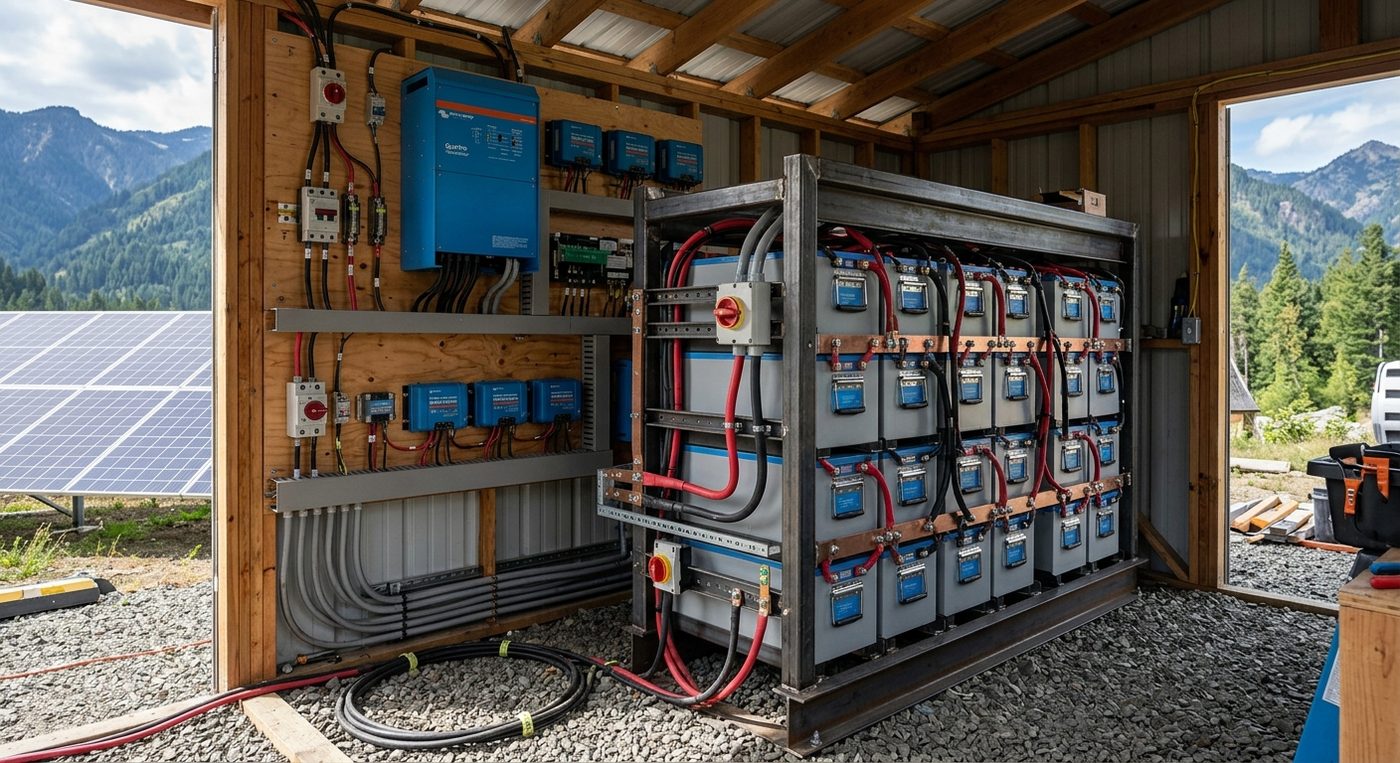
Electrical work must be carried out by a licensed electrician in line with AS/NZS 3000 (the Wiring Rules), which governs installation, maximum demand calculation, MEN earthing, circuit protection, and RCD requirements. Off-grid inverter interconnection, where used, must additionally comply with AS/NZS 4777.2 for inverter equipment and grid-isolation behaviour. The work has to be certified with a Certificate of Electrical Safety.
Smoke alarms must be hard-wired and interconnected in line with relevant state legislation. Photoelectric, interconnected alarms on each storey and in each sleeping zone is the typical minimum.
Floor Area and Layout
The NCC does not prescribe a minimum floor area for a Class 1a dwelling. The practical floor area depends on what you're fitting in. A single multi-purpose room of around 20 m² can be made to work as a studio, but fitting four distinct zones — sleeping, kitchenette, bathroom, and living — alongside the 2.4 m ceiling heights, 5% ventilation, 10% glazing, and circulation paths more realistically starts at around 30–35 m². Below that, compromises start eating into storage, circulation, and the ability to meet the ventilation and ceiling-height rules in every zone simultaneously.
Council Approval and State Variation
Rules for shed-to-dwelling conversions diverge significantly between states including Victoria, Queensland, New South Wales, and Tasmania. The Class 1a framework is national, but the application process, owner-builder thresholds, siting setbacks, bushfire overlays, and septic approval pathways are state-specific.
Owner-builder thresholds in each state are set by the value of the work, not by the reclassification process itself. In Queensland, for example, an Owner Builder Permit from the QBCC is required where the value of the work exceeds $25,000 — a cost-based test that is independent of whether the project involves a reclassification. In NSW, a complying development (CDC) pathway for a new Class 1a dwelling inside an existing shed is rarely available where reclassification or a change of use is involved; a full Development Application (DA) and Construction Certificate (CC) pathway is normally required. In Victoria, the relevant building surveyor handles the application directly. Always confirm requirements with your local council before ordering materials.
Safety: When to Call a Licensed Professional
This section is not a suggestion list — it's the line between a dwelling and a liability.
Call a licensed professional when:
- Reclassifying to Class 1a. A building surveyor or certifier must formally sign off. This is a legal requirement, not a courtesy.
- Assessing the existing structure. Assess the structural integrity of an existing shed before committing to a conversion. Spans, connections, bracing, and slab thickness all need verification.
- Confirming slab suitability. Slab suitability must be confirmed against AS 2870 or by a structural engineer.
- Waterproofing wet areas. Bathrooms and laundries must be waterproofed to AS 3740 by a competent installer, and the work needs certification in the build file.
- Smoke alarm installation. Hard-wired, interconnected smoke alarms must be installed per state legislation by a licensed electrician.
- Plumbing and drainage. All plumbing and drainage work must be carried out by a licensed plumber, including any septic or aerobic treatment system changes.
- Electrical work. Any 230 V / 50 Hz wiring, switchboard changes, or inverter integration must be done by a licensed electrician with a Certificate of Electrical Safety, in line with AS/NZS 3000 and (for inverters) AS/NZS 4777.2.
Owner-builders can't self-certify a Class 1a reclassification. The certifier signs the occupancy permit, and that signature sits on the public record.
Cost Drivers (No Specific Figures)
The fact sheet doesn't include verified cost numbers, so the pricing commentary stays general. The main cost drivers are predictable:
1. Certifier, engineering, and council fees — small dollar value, but they gate the entire project.
2. Slab remediation or replacement — the largest single variable. A non-compliant slab often has to come up.
3. Insulation, glazing, and sarking — the difference between a shed and a 7-star home.
4. Wet-area build — waterproofing, tiling, plumbing, fittings.
5. Electrical upgrade — switchboard, RCDs, dedicated circuits, smoke alarms.
6. Services connection or septic upgrade — site-dependent and frequently underestimated.
Materials and labour vary by region and by the state overlay, so any published "average cost" should be treated as marketing, not data.
FAQ
Can I legally live in a shed without converting it?
No. A shed is a non-habitable structure under the NCC, and using it as a dwelling without reclassification to a Class 1a is not compliant regardless of state.
What's the minimum ceiling height for a habitable room?
2.4 metres. Wet areas and laundries can drop to 2.1 metres.
Does every shed slab need to come up?
Not always. The slab must comply with AS 2870 or be certified by an engineer as suitable for a Class 1a dwelling. The answer depends on age, thickness, reinforcement, the presence and permeance of the damp-proof membrane, and ground conditions.
Do the rules differ between states?
Yes. Victoria, Queensland, New South Wales, and Tasmania all run their own approval pathways on top of the national Class 1a framework. Owner-builder thresholds are cost-based, and reclassification typically requires a full DA or equivalent consent rather than a CDC. Council pre-lodgement advice is worth the cost.
What size shed do I need for a workable conversion?
There is no NCC floor-area minimum for Class 1a. A four-zone fit-out (sleeping, kitchenette, bathroom, and living) realistically needs around 30–35 m²; a single multi-purpose room can be made to work in around 20 m², but only by sacrificing distinct zones.
Who signs off the conversion?
A building surveyor or certifier. Without that formal sign-off, the structure remains a non-habitable Class 10a building on paper regardless of what's inside it.
Sources
- https://shedblog.com.au/how-to-convert-a-shed-into-a-tiny-home-a-complete-beginners-guide/
- https://www.draftee.com.au/convert-shed-to-dwelling-2026-australia-state-guide/
Worth a watch: SHED HOUSE BUILD- Internal fit out to completion. · Aus Adventure
Frequently asked questions
Do I need council approval to convert a shed into a house in Australia?
Short answer — yes, in most cases you do. Converting a shed to a habitable dwelling means it has to meet the same building standards as a house, and I cover a real example in the council knockback section where a bloke got hit with a demolition order mid-build because he didn't get development consent first. Skip the approvals and the council can make you pull the whole thing down.
How much does it cost to convert a shed to a home in Australia?
It costs more than the kits and brochures lead you to believe. I've broken down where the money actually goes in the 2026 costs section, and there's a separate bit on what the brochures won't tell you — which is most of it. Lining, insulation, services and approvals are where the budget blows out, not the shed kit itself.
Why is my shed conversion ceiling dripping with water?
That's almost certainly condensation, not a roof leak. I worked on a Mornington cabin where water poured off the ceiling all winter because insulation alone isn't enough — you need the right build-up and ventilation to let moisture escape. Get that wrong and you'll be mopping the floor every cold morning.
Do I need to trench power, water and waste to the shed?
Yes, and it's a bigger job than most people expect. I cover the full trenching run in the article — depth, the fall you need for waste, and where the money goes. You can usually do the digging yourself to save a bit, but the electrical and plumbing connections have to be done by licensed tradies and signed off.