Solar Charge Controller Sizing Guide: MPPT vs PWM Calculations
I installed a generic controller during a cold Central QLD winter and it melted down, taking my whole battery bank with it. Undersized units choke your output and overheat. Oversized ones just burn money.

By Dave Miller · off-grid sparky · 22 years wiring solar, batteries and sheds in central QLD
“I learned the hard way that sizing a controller for your peak winter sun, not your summer peak, saved my $2000 battery bank from frying in central QLD.”
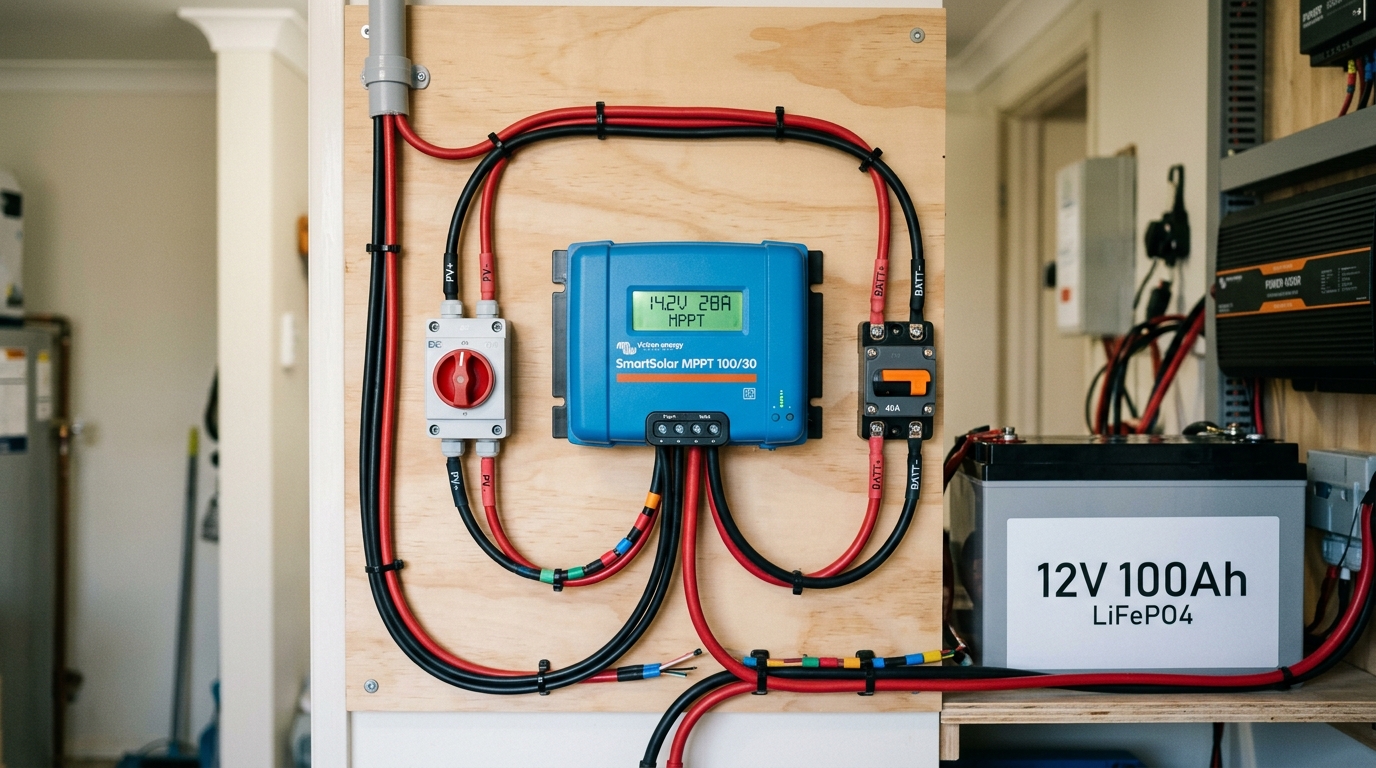
Charge Controller Sizing: What the Spec Sheet Leaves Out
A 100A unit let go on me in a cold Queensland winter—undersized for the surge currents, it melted from the inside out. Charred mess. The owner lost three days of charging while I sourced a replacement.
Size the controller wrong and you'll cook a battery bank. The maths below prevents that.
Decoding Voc and current ratings before your panels cook your controller
Charge controllers are rated by maximum amperage output and maximum input voltage. The key specifications to match are:
- Maximum PV Input Voltage: Must exceed your array's open-circuit voltage (Voc) at lowest expected temperature
- Maximum Charging Current: Must handle your array's maximum power current (Imp) or short-circuit current (Isc)
- Maximum PV Input Power: Total wattage your controller can process
| Controller Size | Max PV Power (12V) | Max PV Power (24V) | Max PV Power (48V) |
|---|---|---|---|
| 30A | 400W | 800W | 1,600W |
| 40A | 520W | 1,040W | 2,080W |
| 60A | 800W | 1,600W | 3,200W |
| 80A | 1,040W | 2,080W | 4,160W |
| 100A | 1,300W | 2,600W | 5,200W |
My MPPT Sizing Disaster on a Rural QLD Shed
The sizing calculation differs significantly between MPPT and PWM controllers:
PWM Controller Sizing
For PWM controllers, current is the limiting factor. Size based on total array current:
Controller Amps ≥ Array Total Amps × 1.25 (safety factor)
Example: 4 panels × 9.5A Isc = 38A × 1.25 = 47.5A minimum → 50A or 60A controller
MPPT Controller Sizing
For MPPT controllers, power and voltage are the limiting factors. Size based on total array wattage:
Controller Watts ≥ Array Total Watts × 1.25 (safety factor)
Example: 6 panels × 400W = 2,400W × 1.25 = 3,000W minimum → 60A at 48V or 80A at 24V
Heat Cuts Panel Vmp – Check It Before You Size the Controller
Solar panel voltage increases as temperature drops. This critical factor often leads to controller damage if ignored.
| Panel Voc (STC) | Voc at -20°F (-29°C) | Voc at 0°F (-18°C) | Voc at 77°F (25°C) |
|---|---|---|---|
| 24V panel (45V) | 58V | 54V | 45V |
| 60-cell (38V) | 49V | 46V | 38V |
| 72-cell (46V) | 59V | 55V | 46V |
| 96-cell (62V) | 80V | 75V | 62V |
Rule of thumb: Add 20-25% to your panel's STC Voc rating for cold weather safety margin, or use the manufacturer's temperature coefficient for precise calculations.
Series Wiring Saves Cable, Reverse Polarity Pops the Fuse
How you wire your panels affects charge controller selection:
Parallel Wiring Melted a Fuse
- Voltage stays the same as single panel
- Current adds up across all panels
- Best for: PWM controllers, partial shading scenarios, hot climates
Wiring Panels in Series
- Voltage adds up across all panels
- Current stays the same as single panel
- Best for: MPPT controllers, long wire runs, cold climates (watch voltage limits)
Mixed Series-Parallel Arrays and the Voltage Mismatch That Cripples Output
For large arrays, series-parallel wiring optimizes both voltage and current:
Example: 12 panels in 3 strings of 4 panels each
- String voltage = 4 × 40V = 160V (safe for 250V controller)
- Array current = 3 × 10A = 30A (safe for 40A+ controller)
Panel-to-Controller Sizing: The Numbers I Run
12V PWM for a Small Cabin
- 4 × 300W panels, 24V system
- Array: 1,200W total
- Calculation: 1,200W ÷ 24V = 50A × 1.25 = 62.5A
- Recommended: 60A MPPT or 70A+ PWM
Sizing a Medium Off-Grid Home
- 8 × 400W panels, 48V system
- Array: 3,200W total
- Calculation: 3,200W ÷ 48V = 67A × 1.25 = 84A
- Recommended: 80A or 100A MPPT
Sizing Solar On A Moving Roof
- 2 × 200W panels, 12V system
- Array: 400W total
- Calculation: 400W ÷ 12V = 33A × 1.25 = 42A
- Recommended: 40A or 50A MPPT
MPPT and PWM Charge Controllers I Fit to Off-Grid Sheds
| Controller | Amps | Max PV Voltage | Type | Price Range | Best For |
|---|---|---|---|---|---|
| Victron SmartSolar MPPT 100/50 | 50A | 100V | MPPT | $300-350 | Small-medium systems |
| Renogy Rover 60A | 60A | 150V | MPPT | $250-300 | Budget builds |
| Morningstar TriStar MPPT 60 | 60A | 150V | MPPT | $550-600 | Reliability-focused |
| Outback FlexMax 80 | 80A | 150V | MPPT | $500-550 | Large systems |
| MidNite Classic 150 | 96A | 150V | MPPT | $650-700 | Heavy-duty applications |
| EPEver Tracer 4210AN | 40A | 100V | MPPT | $120-150 | Entry-level MPPT |
When Array Output Exceeds the Controller's Rating
- Ignoring temperature coefficients: Cold weather can push panel voltage above controller limits, causing permanent damage
- Using 12V calculations for 48V systems: Always divide watts by system voltage, not panel voltage
- Forgetting the 1.25 safety factor: NEC requires 125% oversizing for continuous loads
- Mixing panel types without accounting for different Vmp: Dissimilar panels in series can severely limit output
- Planning for future expansion without controller headroom: Buy 25-50% larger than current needs if adding panels later
Worth a watch: How To Size A Solar Charge Controller? (MPPT & PWM) | A Complete Guide To Avoid Damage And Waste · KiloWatt Maker with Younes
Disclosure: some links in this article are affiliate links. If you buy through them we may earn a small commission at no extra cost to you.