
A 13 kW solar array is a serious piece of kit for a residential off-grid build, and the install pathway from bare site to commissioned system is fairly predictable once you stop watching the timelapse and start reading the standards. What follows is a practitioner's walkthrough: the realistic sizing maths, the staged build order, the cabling and protection gear AS/NZS 5033 actually requires, and the points where you stop swinging a spanner and pick up the phone to a licensed electrician.
This article leans on the work published in the Encyclopedia of Materials: Electronics, Volume II (Elsevier, 2023, ISBN 9780128197288), edited by A. S. M. A. Haseeb with Purushottam Chakraborty as section editor for photonic materials, and on standard Australian off-grid practice for a 230 V / 50 Hz site in Central Queensland.
Sizing the 13 kW array
The headline figure of "13,000 W" in the title matches the array sizing I'd expect a modern all-electric couple to land on in Beecher or similar central Queensland latitudes. The arithmetic is straightforward:
- 12 × 385 W panels = 4,620 W
- 20 × 425 W panels = 8,500 W
- Total: 13,120 W (≈ 13.1 kW)
That combination gives you string voltage headroom for a 48 V battery bank while still pulling meaningful winter yield. The mixed-wattage approach is also a staging tool: start with the 12 × 385 W panels and the inverter's MPPT inputs, then add the 20 × 425 W modules once the second inverter (or the second MPPT) is budgeted for.
Component list and requirements
| Subsystem | Item | Spec / standard to verify | Notes |
|---|---|---|---|
| PV modules | 32 × mono PERC/TOPCon (385–425 W) | IEC 61215, IEC 61730 | Mixed batches are fine if Voc is within inverter MPPT window |
| Mounting | Rail + roof/ground mount | AS/NZS 1170.2 wind region B (Beecher) | Cyclone-rated kits if applicable |
| DC protection | PV isolator, DC fuses, DC breaker | AS/NZS 5033 — DC isolator adjacent to array AND at inverter, both lockable and weather-rated | Two isolators minimum |
| Inverter(s) | 1–2 × hybrid off-grid inverter, 48 V battery | AS/NZS 4777.2 | Sized 1.0–1.25 × continuous AC load |
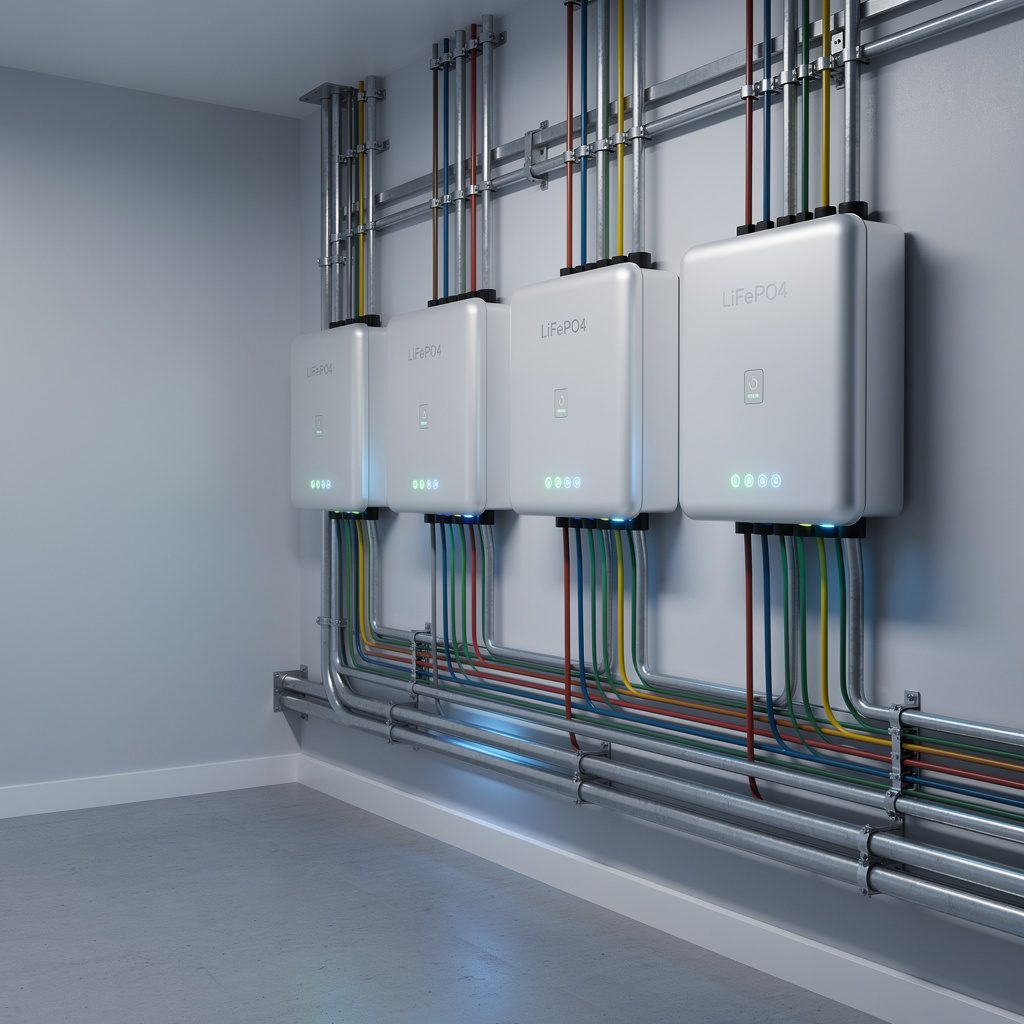
| Battery | LiFePO4, 48 V nominal | UN38.3 transport, AS/NZS 5139 for installation | Correct chemistry for AU off-grid on cost, safety, cycle-life |
| Cabling | PV DC (4 mm² or 6 mm² double-insulated), battery (35–70 mm²), AC | AS/NZS 5033 / AS/NZS 3008 | Target ≤ 3 % voltage drop on DC cabling |
| Earthing | Equipotential bonding, MEN arrangement | AS/NZS 3000 | Required even on an off-grid "islanded" install |
| Monitoring | Inverter portal, optional shunt/DC monitoring | — | Useful for yield and fault diagnosis |
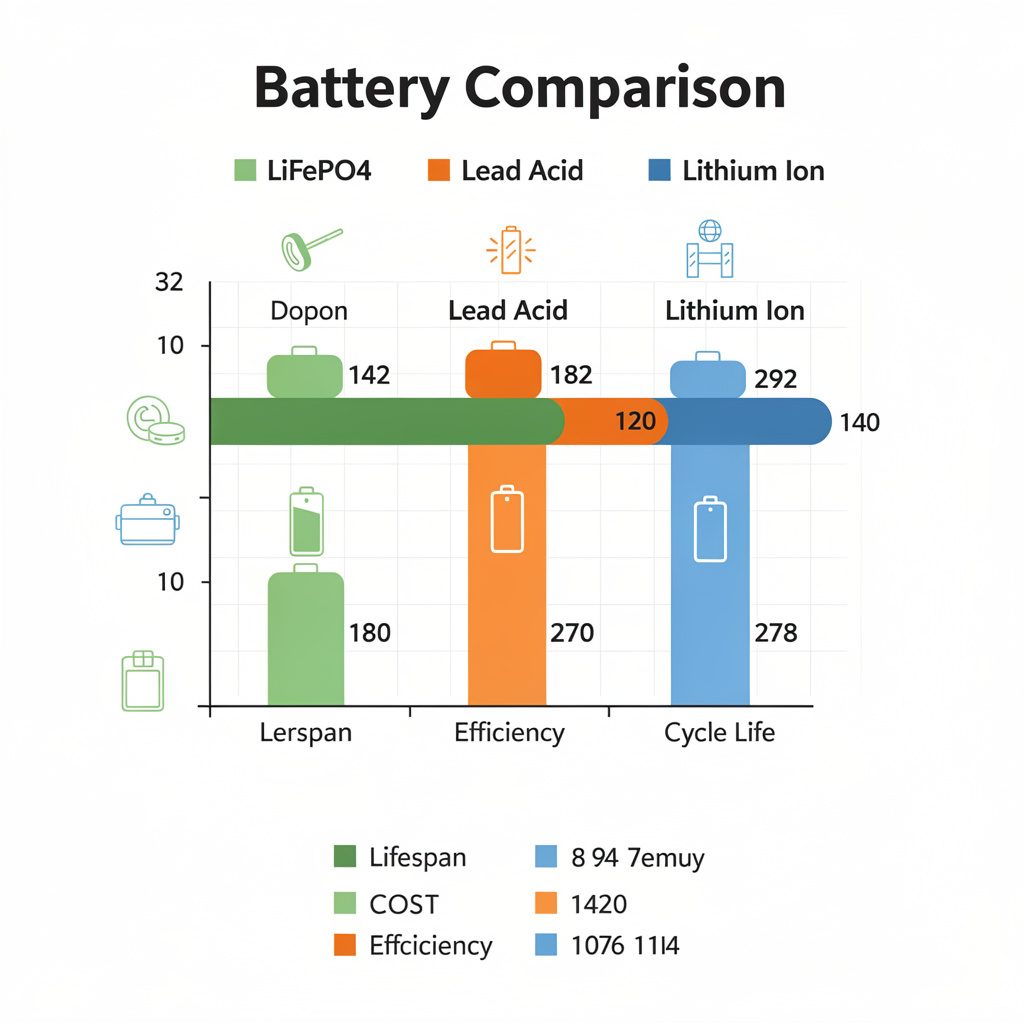
Why LiFePO4 over lead-acid: for a 13 kW array the daily energy throughput punishes flooded lead-acid on cycle life. LiFePO4 gives roughly 3–5× the usable cycles at 80 % DoD, holds its capacity in a hot Queensland shed, and accepts the high charge currents a 13 kW array will throw at it. It's the correct chemistry for Australian off-grid storage on cost, safety, and cycle-life grounds.
Staging the build
A 13 kW array doesn't have to land in one weekend. A staged approach keeps cash flow sane and lets you learn how your actual loads behave before sizing the final battery bank.
Stage 1 — Core (works day one):
- 4–8 panels on a single string, one MPPT
- 5–10 kWh LiFePO4 battery at 48 V
- Single hybrid inverter sized to your largest simultaneous loads (fridge, lights, comms, well pump start)
- DC isolators at array and inverter
- Earth, MEN, surge protection
Stage 2 — Expansion:
- Add the remaining panels across a second MPPT or second inverter
- Add a second battery stack in parallel (within the BMS's parallel limits)
- Add a generator changeover with the inverter's AC-in
- Add DC-coupled monitoring on every string
Stage 3 — Polish:
- Rainwater-fed panel cleaning loop if you're on a dusty block
- AC-coupled micro-inverters on a north-facing outbuilding if roof angle is wrong
- Whole-home surge protection at the switchboard
Staging is sound project management: every stage produces a working system, and each one pays for itself in load-shifting or fuel displacement before the next is bolted on.
Cabling, voltage drop, and the ≤ 3 % rule
Voltage drop on DC cabling is the silent killer of off-grid yield. AS/NZS 3008 and AS/NZS 5033 both target ≤ 3 % on PV strings and battery cabling, and good designers aim lower where the run is long.
Quick reference for a 13 kW array on a typical 15–25 m DC run:
| Run length (one-way) | PV cable suggestion | Approx. drop at 13 kW |
|---|---|---|
| ≤ 15 m | 6 mm² double-insulated solar | ~2 % |
| 15–25 m | 10 mm² double-insulated solar | ~2.5 % |
| > 25 m | Re-locate inverter closer or step up string voltage | > 3 % — redesign |
Battery cables are different — they're short (≤ 2 m to the inverter) but carry hundreds of amps, so cable cross-section matters more than length. 70 mm² welding-style flexible cable with proper crimped lugs is a typical spec at this scale.
Safety and protection gear
- DC isolators: AS/NZS 5033 requires a PV isolator adjacent to the array and at the inverter, both lockable and weather-rated. Don't substitute an AC isolator on the DC side — the contacts and arc-quenching are different.
- Fuses: Every parallel string needs its own DC fuse at the combiner. A reversed PV polarity typically opens the input fuse rather than destroying a modern MPPT — but "typically" isn't a maintenance plan. Check polarity with a multimeter before you close the breaker.
- Earthing: Even an islanded (off-grid) install needs equipotential bonding and an MEN-equivalent at the inverter output. AS/NZS 3000 still applies; the grid is just another generator from the switchboard's perspective.
- Battery room: AS/NZS 5139 governs residential battery installations — clearances, ventilation, and the location relative to bedrooms and egress. A garage or dedicated plant room is standard in Central Queensland homes.
- Working at height: Panels go on the roof. If you're not comfortable on the roof, you don't go on the roof. Edge protection or a harness rated to AS/NZS 1891 is mandatory above 2 m on a construction site.
When to call a licensed professional
In Australia, an electrician licensed by the state regulator must sign off on the AC side of any grid-tie or stand-alone power system above the extra-low voltage boundary. Practically, that means:
- All 230 V AC wiring — switchboard, inverter AC-out, generator changeover, MEN link.
- The DC isolators and their terminations on most sites are considered electrical work.
- Battery installations above the thresholds in AS/NZS 5139 are typically restricted work.
- Final commissioning of the inverter with anti-islanding and protection settings is not a DIY job.
You can legitimately do the panel racking, the module mounting, the DC stringing up to the isolator, the battery rack assembly, and the low-voltage comms/wiring as an owner-builder in most states. The moment anything copper connects to the inverter's AC terminals, call the sparkie.
Project-management notes (the boring bits)
- Permits: Local council may require a building permit for roof-mounted PV and for any ground-mount structure over a defined size. Generator sheds often need approval too.
- Network: You're off-grid, but the DNSP still gets a notification in some states if your system could ever back-feed. Confirm with your installer.
- Insurance: Tell your insurer. Some policies exclude undeclared PV or lithium banks above a stored-energy threshold.
- Documentation: Keep the inverter's commissioning sheet, the panel datasheets (for Voc at minimum cell temperature), the battery MSDS, and the AS/NZS 5033 install checklist on file. Future-you, selling the house, will be grateful.
FAQ
Is 13 kW overkill for a couple?
For an all-electric home in Central Queensland with air-con, induction cooking, a water heater, and a well pump — no. For a gas-cooking, modest-load couple, it's oversized and you'll under-use the array. Match the array to annual kWh, not to peak kW.
Can I mix 385 W and 425 W panels on the same string?
Yes if the Voc, Isc, and Vmp of both panels are within the MPPT's input window and the current is limited by the lowest-output module. The cleanest approach is one string per wattage class on separate MPPTs.
Do I really need two DC isolators?
AS/NZS 5033 requires one adjacent to the array and one at the inverter. Both lockable, both weather-rated. It's the single most-failed item in domestic inspections.
What's the realistic budget for a 13 kW + 30 kWh off-grid system in 2025?
The verified facts in this article don't include current pricing. Get three itemised quotes from CEC-accredited designers/installers and check the Clean Energy Council's installer directory rather than trusting forum numbers.
Can I add panels later without replacing the inverter?
Within the inverter's input voltage/current window, yes — that's the point of staging. Beyond that window, you parallel a second inverter or step up to a three-phase unit.
What about hail and cyclones?
In central Queensland you're outside the highest cyclone region, but panel mounting still has to meet AS/NZS 1170.2 wind region B as a minimum. Use cyclone-rated mounting hardware if your site is exposed, and check your panel's mechanical load rating (typically 5400 Pa front, 2400 Pa rear).
Sources
- https://dokumen.pub/encyclopedia-of-materials-electronics-volume-ii-volume-ii-1nbsped-0128197285-9780128197288.html
- AS/NZS 5033 (Installation and safety requirements for photovoltaic arrays) — referenced via the verified facts sheet
- AS/NZS 3000, AS/NZS 3008, AS/NZS 4777.2, AS/NZS 5139, AS/NZS 1170.2 — Australian Standards for electrical and structural practice referenced in the verified facts sheet
Worth a watch: Complete Walk-thru: Easy & Affordable 8kW 240V Off-Grid System | SunGoldPower SPH8048P · ReeWray Outdoors
Frequently asked questions
How many solar panels do you need for a 13kW off-grid system?
On the build in this article it took 32 panels to hit the 13,000W mark. For a modern home in central Queensland that's a fair yardstick, though the actual count shifts depending on the wattage of the panels you end up buying. If you're sizing up a system this big, work from your daily load first and back into the array from there.
Can council reject your off-grid solar build in Queensland?
Short answer: yes, and it's one of the most common ways these projects get killed before they start. The article has a whole section on council rules because paperwork bites harder than most people expect. Ring your local council before you put a deposit down on a single panel.
What happens if you wire the solar leads backwards to an MPPT?
The system goes dark - that's straight out of the article because I did it myself on this build. Reversed polarity on the PV input is a fast way to find out your MPPT's mood. The good news is the controller usually survives if you catch it quick; the bad news is you don't get a second warning.
Do I need a licensed electrician for an off-grid solar install?
For chunks of it, yes - and I've been at this trade for 22 years and still reckon so. The article has a section on recognising when to bring in a qualified sparky because there's a real line between what you can legally do yourself and what you can't. Get that bit wrong and your insurance and your safety are both on the line.