By Jenny Mills· rural nurse & homesteader · health, safety, law and the paperwork of going bush
“After the third spark set my hay bales smoking, I learned that a 5mm gap between the workbench and the shed is the only safe distance for welding off-grid.”
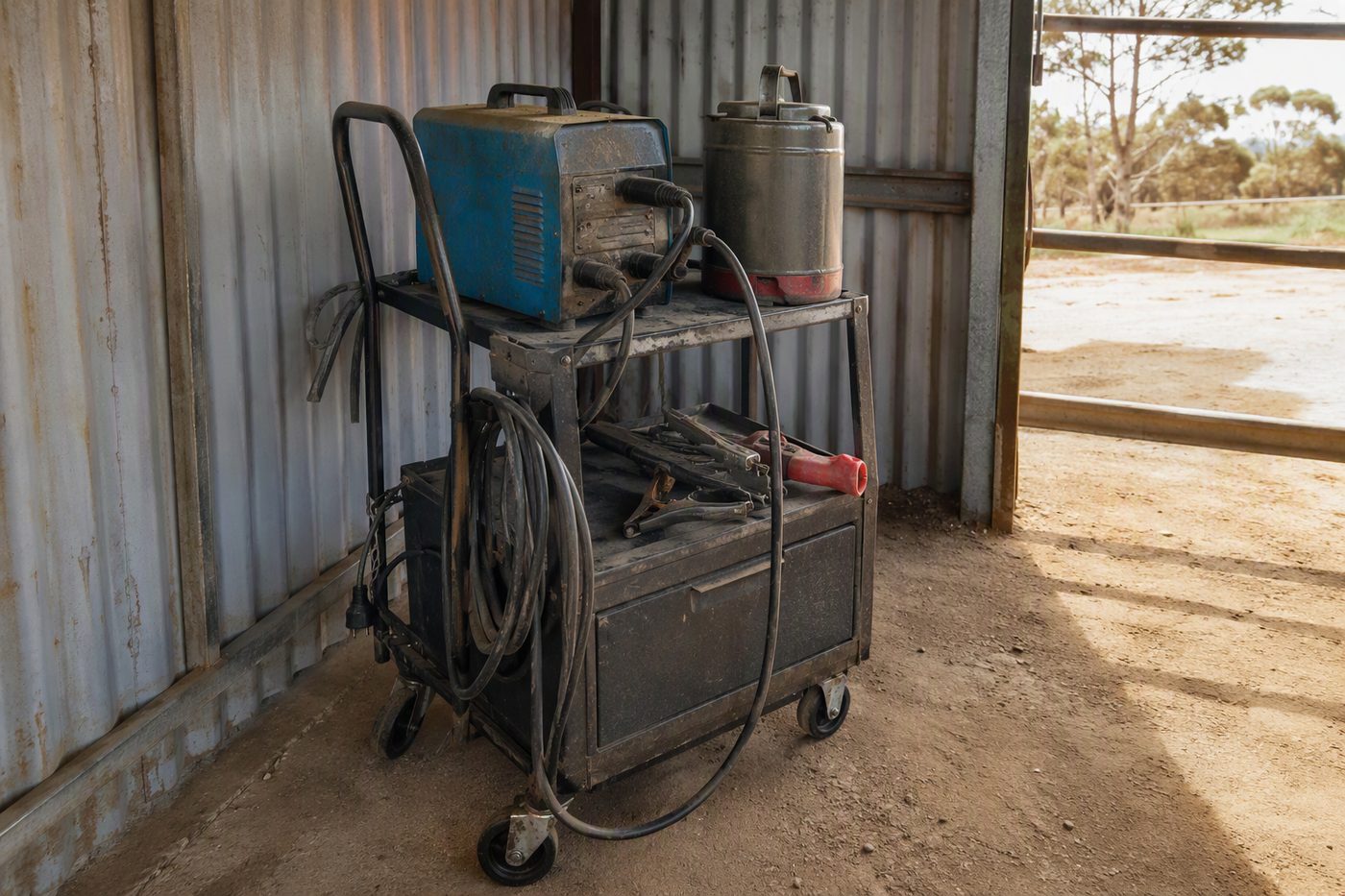
Running a stick welder from a generator on a remote block isn't exotic anymore — it's basic shed economics. Get the generator sizing right, get the duty cycle right, and the rest is electrode selection and electrode discipline. This guide covers what actually matters when you're welding off-grid at 230V/50Hz in Central Queensland: how to size a generator to a 140A stick machine, what duty cycle means in practice, and the safety boundaries you don't cross without a sparkie.
Specs at a glance: 140A stick on a generator
Parameter
Minimum recommendation
Notes
Welding output
140A stick (MMA)
Common, practical range for general farm/shed work
Open-circuit voltage (OCV)
~60–80V DC
Typical for inverter stick machines
Generator running watts
6,000–8,000 W
Recommended output for stick welding with a 3.2 mm rod
Generator peak watts
~8,000–11,000 W
Add 20–30% above running watts for motor/alternator inrush
Frequency
50 Hz
Australian mains standard
Voltage
230 V
Single-phase Australian standard
Duty cycle target
≥ 60% at peak output
Prevents thermal overload during extended welding
Generator THD
Low (clean sine wave) for inverter welders
Transformer welders tolerate higher THD
The wattage maths is simple: volts × amps = watts. For an 8,500 W running load, expect to need roughly 11,000 W peak to start the generator's engine and alternator together. A 20–30% buffer above running watts is standard practice.
Choosing the right generator type
Not every generator plays nicely with every welder. The two failure modes are dirty power killing electronics, and insufficient peak wattage causing the generator to stall on arc strike.
Transformer welders (older, heavier units) are tolerant of high total harmonic distortion (THD) and will run on nearly any modern generator. They're the safe default if your generator is a conventional AVR set.
Inverter welders (IGBT/MOSFET-based, including most modern 140A stick machines) require clean sine-wave power. Inverter generators are the match here. Using a cheap or standard generator on an inverter welder can damage the sensitive electronics — this is a well-documented failure mode and the main reason off-grid welders blow control boards.
Engine-driven welder generators combine a combustion engine with an alternator specifically wound for welding. They maintain stable voltage under load, which is why they're standard on remote mining, agricultural and construction sites where mains power isn't an option.
Understanding duty cycle
Duty cycle is the single number most off-grid welders misread. A generator rated "200A at 30% duty cycle" means it will deliver 200A for 3 minutes out of every 10, then must cool down for the remaining 7. Push past it and the unit trips on thermal overload.
The rule of thumb: higher amperage output = lower duty cycle, and vice versa. If you're running 140A stick continuously across a long seam, you need a generator with at least 60% duty cycle at that output, otherwise you'll be stopping every few minutes to let the machine breathe.
For a 140A stick machine in normal farm use (intermittent beads, not production welding), a 60% duty cycle at the rated output is the practical floor.
Altitude and ambient derating
Generators lose power as altitude increases. A standard rule of thumb is to account for 3.5% power loss for every 305 m above sea level. Beecher sits at modest elevation in Central Queensland, so this is rarely a problem locally — but anyone welding on the Tablelands, in southern NSW highlands, or in the Victorian high country needs to oversize the generator accordingly.
Heat derating works the same direction. A generator rated in a 25 °C workshop will deliver less in a 40 °C Queensland summer under direct sun.
Noise considerations
Generators used in residential or near-residential areas should stay under 75 dBA as a working standard. Inverter generators typically sit well under this; traditional open-frame sets often don't. If you're running extended stick welding near a boundary fence or house, the noise rating matters as much as the wattage rating.
Electrodes for off-grid stick welding
Stick (MMA) is the right process for off-grid work because it doesn't need shielding gas, doesn't need a spool gun, and runs from a basic DC output. Two electrodes cover most Australian structural and farm work:
Power flow for off-grid welding: solar and battery feed an inverter sized for the welder's surge draw.
E6010 — deep penetration, all-position, DC only. The traditional "pipe and structural" rod. Likes dirty or slightly rusty steel.
E7016 — low-hydrogen, excellent for critical structural work, especially where the parent metal needs to stay tough. Requires DC and a dry rod.
Storage matters more than most operators realise. Low-hydrogen rods (E7016, E7018) absorb moisture from humid Central Queensland air. Damp rods porosity up the weld. Keep rods in a sealed container, a rod oven, or at minimum a dry box with desiccant. Re-dry damp rods in an oven at the manufacturer's specified temperature before use.
Generator sizing by welding process
If you're sizing a generator for multiple processes rather than just 140A stick, the wattage requirement scales quickly:
Process
Recommended generator output
Light MIG (120V input)
3,000–4,500 W
Stick, 3.2 mm rod
6,000–8,000 W
Professional AC/DC TIG
8,000–10,000 W
Heavy MIG (240V input)
10,000+ W
Multi-process capability
11,000+ W
A 140A stick machine running 3.2 mm rods sits squarely in the 6,000–8,000 W running / 8,000–11,000 W peak bracket.
Multi-process and DC/AC switching
Most modern welding machines support MIG, TIG and stick from the one inverter platform, though older or specialty machines may need an accessory for full TIG/MIG functionality. If you want one machine that handles everything off-grid, plan the generator for the highest-draw process — which is usually AC/DC TIG or heavy MIG — not the lowest.
Most engine-powered generators offer DC and AC output options, though some entry-level sets only supply one type. For stick welding you want DC; for running site tools you want AC. Confirm both are present before buying.
When to call a licensed professional
Stick welding on a generator is owner-operator territory. The following are not:
Fixed 230V wiring for a welder outlet in a shed — must be installed by a licensed electrician to AS/NZS 3000 and inspected before energising. A generator-fed outlet doesn't bypass this.
Generator changeover switches that interface with a mains-connected solar/battery system. A licensed sparkie must wire any cross-wiring that could back-feed the mains or interact with an inverter.
Solar/battery integration for running a welder from a hybrid off-grid system. Battery inverters have specific welder-load compatibility constraints; sizing and connection is professional work.
Structural welding to AS/NZS 1554 or AS 4100 for load-bearing members, trailer chassis, vehicle modifications, or anything requiring certification. A qualified welding supervisor or engineer signs off on procedure and welder qualification.
Field setup tips
Wind screens or flux-cored wire are the two fixes for outdoor MIG gas shielding. Stick welding has no shielding gas problem in wind — another reason it's the default off-grid process.
Run the generator at operating temperature before striking an arc. Cold engines deliver less stable voltage and may stall on the first strike.
Use heavier gauge leads (50 mm² or larger) for long generator-to-welder cable runs to avoid voltage drop that confuses inverter machines.
Ground the work clamp directly to the workpiece, not to the generator frame. Return-path resistance is the most common cause of poor arc stability off-grid.
FAQ
What size generator do I need for a 140A stick welder?
A 6,000–8,000 W running / 8,000–11,000 W peak unit is the standard recommendation for 140A stick with 3.2 mm rods.
Can I run an inverter stick welder from a conventional generator?
Not reliably. Inverter welders need clean sine-wave power. A conventional AVR generator with high THD can damage the welder's electronics. Use an inverter generator or a transformer welder.
What duty cycle do I need?
At least 60% at your working amperage. Higher output = lower duty cycle, so check the rating at the amps you'll actually weld at, not the headline maximum.
Is stick or MIG better off-grid?
Stick. No shielding gas, no spool gun, simpler setup, more tolerant of dirty or slightly rusty steel, and runs happily in wind. MIG is possible off-grid with a large enough generator and wind protection, but it's not the default choice.
Do altitude and heat derate a generator?
Yes. Plan for roughly 3.5% power loss per 305 m above sea level, plus additional derating for ambient temperatures above 25 °C.
What about solar/battery systems running a welder?
Battery-based inverters have specific welder-load requirements and aren't universally compatible. A licensed off-grid electrician should size and connect any system intended to run welding loads — this isn't a DIY setup.
⚠️ SAFETY WARNING: Working with electrical systems, structural modifications, or gas installations carries inherent risks. If you are not confident in your abilities, always engage a licensed professional.
He tests a MIG welder on a 12 V solar array, showing the voltage sag and the minimum battery capacity you need to keep the inverter from shutting down, which is exactly the practical info you need for an Australian off‑grid setup.— Jenny Mills