By Fiona Gallagher · permaculture designer · food, animals and preservation on 12 acres in Tassie
“After losing my first six hives to the Tasmanian winter, I finally learned that a queen needs warmth, not just sugar water.”
My first hive in Tasmania starved out halfway through a wet autumn. The bees were gone, the frames were clean, and the mistake was mine. Beekeeping off-grid here isn't about fancy gear. It's about reading the season, not the manual.
By Fiona Gallagher · permaculture designer · food, animals and preservation on 12 acres in Tassie
“After losing my first six hives to the Tasmanian winter, I finally learned that a queen needs warmth, not just sugar water.”
Beekeeping on a Central Queensland property looks romantic from the verandah — until the first colony collapses because you inspected too often, fed the wrong syrup, or set the hive in the only patch of full afternoon sun. Most beginner failures aren't dramatic. They're a slow accumulation of small oversights: undersized boxes, missed swarm cells, untreated varroa, and a calendar of inspections that doesn't match the climate.
This is the practical list I wish someone had handed me before I picked up a smoker. It covers the equipment pitfalls, the timing traps, the location mistakes, and the disease vectors that quietly kill colonies in their first year.
| Parameter | Specification / Target | Why it matters |
|---|---|---|
| Hive style | Langstroth (standard 8- or 10-frame box) | Interchangeable parts, widely available in AU |
| Bee space (gap between frames) | ~9.5 mm (3/8 in) | Queens won't build burr comb in this gap; bees won't fill it either |
| Inspection cadence (active season) | Every 7–10 days | Catch swarm cells, queen issues, and food stores early |
| Maximum disturbance interval | No more than once every 1–2 weeks | Each opening disrupts brood-nest temperature and humidity |
| Target first-year survival | ~70% of hives | Wild survival is roughly one in three; managed colonies should do better |
| Spring feed (build-up) | 1:1 white sugar syrup (by weight or volume) | Stimulates brood rearing when nectar is scarce |
| Autumn feed (stores) | 2:1 white sugar syrup | Rapidly fills frames for winter survival |
| Hive orientation | Morning sun, afternoon shade | Early flight warmth, afternoon heat relief |
| Frame inspection time | ~5 seconds per frame side | Practiced eye spots the queen without slowing the job |
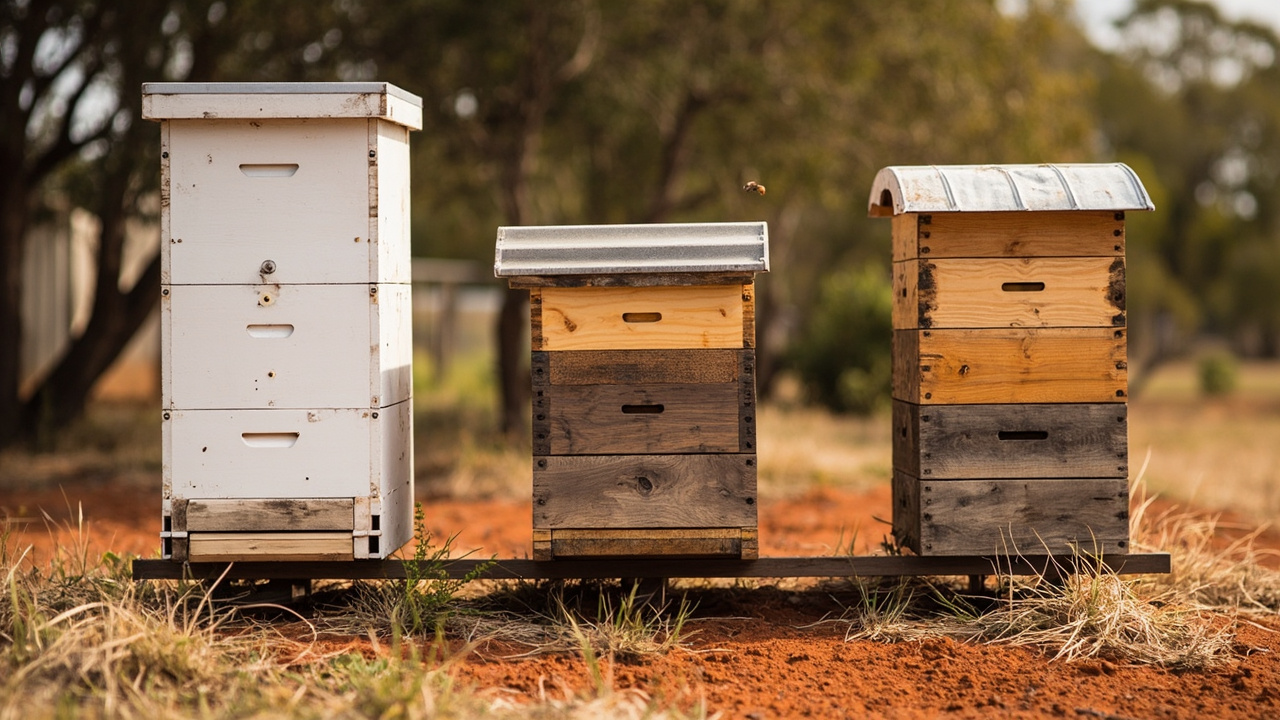
The classic first-year trap. You build (or buy) a single brood box, paint it, set it up beautifully, install your bees — and three weeks later the colony is booming, frames are wall-to-wall brood, and the bees are beard-hanging because they have nowhere to go.
What goes wrong: Langstroth hives are modular by design. A strong spring flow in Central Queensland can have a colony outgrowing its single box within a month. Without spare supers on hand, you'll be improvising during peak swarming season — exactly when you shouldn't be running to the hardware store.
Fix: Have at least one extra super (with frames and foundation) painted, assembled, and stored ready to deploy before the bees arrive. Pre-paint all supers with exterior-grade paint — at least two coats on exposed wood. In my experience, the colonies that thrive are the ones whose keepers planned a full stack of boxes ahead of time, not the ones scrambling to bolt together pine at 6 p.m. with bees in the trees.
One hive is twice as hard to manage as two. If that colony fails — queenless, mite collapse, starvation — you have no backup. If it thrives, you have no resources to borrow: no brood frames to reinforce a struggling split, no nurse bees to bolster a weak queen, no spare queen cells to salvage.
A single-colony beekeeper also can't compare. Two side-by-side hives teach you more in a season than any book: one might be hygienic and calm, the other defensive and swarm-prone — same conditions, same genetics, different outcomes. That comparison data is gold for the next decision you make.
Recommendation: Start with two colonies minimum. Three is better.
Bee site selection is permanent. Once the bees orient to a spot, moving the hive more than a metre or two at a time sends foragers into chaos. Get it right the first time.
What goes wrong:
Fix: Aim for morning sun and afternoon shade, level ground with good drainage, a windbreak of trees or a hedge on the prevailing side, and at least 3–4 km of forage radius free of heavy spraying. Urban and grass-dominated blocks can be food deserts for bees — productivity and honey yield both suffer when there's nothing but lawn within foraging distance.
I get it. New beekeepers want to look. Every day.
But inspections are stressful for the colony. They disturb the carefully controlled atmospheric conditions inside the hive — temperature, humidity, pheromone balance. Every opening resets that balance and costs the bees energy to restore.
Cadence target: During the active season (spring through autumn in Central Queensland), inspect every 7–10 days. Never more often than once per week. Never less often than once every two weeks during a flow.
Technique matters:
If you genuinely can't help yourself, look into observation hives with side windows — they let you peek without opening the colony.
Swarming in Australia typically peaks in spring (October–November in Central Queensland). Failing to manage swarming can result in the loss of a significant portion of the colony — sometimes the queen, often half the workforce — and what remains is a weakened hive that won't produce a surplus.
What to look for: Queen cells are peanut-shaped — distinct from the cup-shaped normal queen cups. Once you see capped or charged swarm cells along the bottom of frames, you have days, not weeks.
Standard responses (depending on your goal):
Feeding isn't complicated, but the ratio matters:
Don't feed honey from unknown sources. Feeding honey from unknown sources can introduce diseases to a colony — American foulbrood spores can survive in honey for decades. If you must feed honey, only use it from your own disease-free hives.
New colonies — especially packages — have no food stores and require sugar syrup feeding to build strength. A three-pound package dropped onto empty foundation without feed will starve within days.
Varroa destructor is now present across most of Australia, and Central Queensland is no exception. If varroa mite treatments, feeding, or robber/predator control are not done on time, colonies can be killed or starve.
Approach: Use integrated pest management (IPM) — a combination of chemical and non-chemical methods. Rotate treatments to prevent resistance. Common IPM tools include:
Whatever you choose, monitor before treating. Treating without counting is guessing, and guessing costs money and bee lives.
Hive entrances should be reduced in winter with an entrance reducer to prevent drafts and keep out rodents. A standard Langstroth entrance is far too large for a small winter cluster to defend against mice, ants, and robber bees from neighbouring colonies.
Fit the reducer as soon as the autumn flow ends and the population starts to drop. In Central Queensland, "winter" is mild, but the colony still contracts and a small entrance is much easier to defend.
Beekeepers should maintain detailed records of inspection dates, observations, treatments, and actions taken. Without records, you can't spot trends: which hive is queenless every spring, which treatment worked, when the swarm dates shift year on year.
Minimum record per inspection:
A cheap notebook works. A spreadsheet works better. Whatever you'll actually use.
Beekeeping itself is largely an unlicensed activity in Queensland, but some jobs are best left to certified operators:
How many hives should a beginner start with?
At least two. Starting with just one colony makes beekeeping more difficult because resources cannot be borrowed from another hive in a crisis, and you lose the side-by-side learning that two colonies provide.
How often should I inspect?
Every 7–10 days during the active season. Hives should be opened no more than once every one to two weeks to minimize disturbance.
What syrup ratio should I use?
A 1:1 sugar syrup solution in spring to stimulate build-up, and a 2:1 solution in autumn to pack stores. Only use white sugar — never honey from unknown sources.
Where should I place my hive?
Morning sun and afternoon shade, level ground with good drainage, wind protection, and away from pesticide sources. Bees usually choose shade-over-full-sun when given a choice.
When does swarming happen in Central Queensland?
Swarming typically peaks in spring — October to November in this region. Watch for peanut-shaped queen cells along the bottom of frames.
What's the realistic survival rate for a beginner's hives?
Aim for a 70% hive survival rate. Only about one in three hives naturally survives in the wild, so a managed first-year target around 70% is a reasonable benchmark.
Worth a watch: How to START BEEKEEPING! Inexpensive and Sustainable · OFF GRID with DOUG & STACY