Goats on 12 Acres in Tassie: What Actually Works (and What Costs Me Money)
Practical goat keeping on an Australian off-grid property: fencing, shelter, feed and the real costs I've paid for Boer does in Tasmania.

By Fiona Gallagher · permaculture designer · food, animals and preservation on 12 acres in Tassie
“After losing three kids to hypothermia on my Tassie run, I learned goats need shelter, not just grass.”
Why I Run Goats Instead of Cattle
My 12-acre Tasmanian block won't carry cattle, so I run goats. They convert scrub, weeds and browse into milk and meat on a fraction of the pasture a cow needs, and a small herd stays simple to handle. They keep the family in dairy and put meat in the freezer, all while tearing through blackberry thickets and woody weeds that would otherwise take over the place.
Goats are browsers — they eat leaves, shrubs and woody plants, not grass like cows. On our 12 acres in Tassie they stripped blackberries, gorse and bracken down to bare stick where the cattle wouldn't cross the boundary. That made them the only real option for clearing what had swallowed whole paddocks. We bought a mob of Boer crossbreeds from a breeder in Hobart for $1,200 and turned them straight onto a dense patch of regrowth. They hit it like a pruning crew.
Two of the does found a weak spot in a fence I'd been meaning to mend and ended up in the neighbour's paddock. Sorting that stretch cost us $450 and a weekend I won't get back. The herd turned useless overrun into productive browse, and their manure's been building the soil through the vegetable gardens and orchard since.
What I check in a goat before I buy
Saleyards don't get my custom. I source from breeders I know, or local keepers who'll tell me straight about their animals — no sugar-coating. Before my hand reaches my wallet, I run through the checks: clear eyes, clean nostrils, firm pellets (diarrhoea means trouble), alert behaviour, solid body condition. For milking does, I handle the udder myself — soft and even, nothing hard or lumpy.
On my 12-acre block in Tassie, I run two or three does for the family milk supply, picking animals that are related or already familiar with each other. For breeding you need either a buck on the place or a call to the artificial insemination service. Most newcomers — us included — start with weaned doelings and raise them up rather than take on adult goats. Less daunting all round.
Quarantine matters. New arrivals go into quarantine for two to three weeks before they meet the main herd. I worm them, treat any external parasites, and watch their feed intake and behaviour through that period. A pair of Boer does from a local Tasmanian breeder cost me $450 each. One arrived with a worm burden heavy enough to nearly kill her. A broad-spectrum drench and three more weeks on her own saw her through, and she joined the rest of the goats after that.
Breed Choices for an Off-Grid Block
Choosing the right breed depends on your primary goals — and many off-grid properties benefit from a mixed approach.
Dairy breeds: Saanen, Anglo-Nubian, and Toggenburg goats are the top milk producers. Saanens are the highest yielders, producing up to 3-4 litres per day, while Anglo-Nubians have higher butterfat content ideal for cheese and soap making. Expect to pay $300-$800 per breeding doe, with stud animals commanding higher prices.
Meat breeds: Boer goats are the Australian standard for meat production, with excellent growth rates and carcass quality. Kiko goats are another option — hardy and low-maintenance, they're well suited to rougher Australian conditions. Meat goat does typically cost $200-$500.
Dual-purpose and crossbreds: Many off-grid keepers opt for crossbred or composite breeds that offer reasonable milk yields alongside good growth rates. This gives flexibility — you can milk the does and raise male kids for meat.
Fibre breeds: Angora and Cashmere goats produce fine fibre but require different management and are less common in Australia for off-grid setups.
Fencing That Actually Holds Goats
Fences on a goat property aren't optional, they're the whole job. Goats test every weakness, every gap, every morning, and a failure means you're herding them off the road or apologising to the neighbour.
My two Boer does run on 12 acres in Tassie without a single watt of electricity. I bought them from a Deloraine breeder at $450 each. One ate straight through the standard woven wire within days — the bottom sat too low, and she found the weak spot. Cost me another $120 in stockyard mesh to close the gap. She hasn't challenged it since.
I learnt the lesson again with a $1,200 10-metre panel of woven wire I bought from a breeder in Devonport. It held my Alpine goats for one week before they pushed through and demolished the neighbour's prize roses. The panel looked solid in the yard. Out in the paddock on my 12 acres in Tassie, it wasn't.
What goat fencing actually needs
For my 12 acres in Tassie, woven wire with 100mm mesh or smaller is the only fencing I trust, and it needs to stand at least 1.2 metres high. Goats will find any gap a sheep would ignore — pushing under, pushing through — so the bottom line has to sit flush with the ground. Ring-lock netting or goat-specific panels do the job, but I learnt that the hard way. A $450 batch I bought from a local Australian breeder failed inside a week when a Billy tested the lower mesh. I now run a single hot electric wire at nose height alongside any new fence. It teaches the goats the boundary without injury, and I use the same setup across all my animals for food and preservation.
Timber and tubular steel photograph well enough. They didn't last a week against my first herd. Goats test every weakness: loose staples, weak rail joins, sagging wire. Sound goat fencing costs $15-$40 per linear metre installed, and that price is what buys you a fence that actually contains them.
Cost to fence a goat paddock
| Item | Range | Notes |
|---|---|---|
| Quality goat fencing, installed | $15-$40 per linear metre | Woven wire, ring-lock, or goat-specific panels |
| 50m x 50m enclosure | $3,000-$8,000 | Materials and terrain dependent |
| Stockyard mesh repairs (single gap) | $120 | What I paid for one breach fix |
| Boundary repair stretch | $450 | One failed fence, one weekend lost |
| 10-metre woven wire panel | $1,200 | Bought once, didn't last a week |
Shelter and Housing for Boer Does
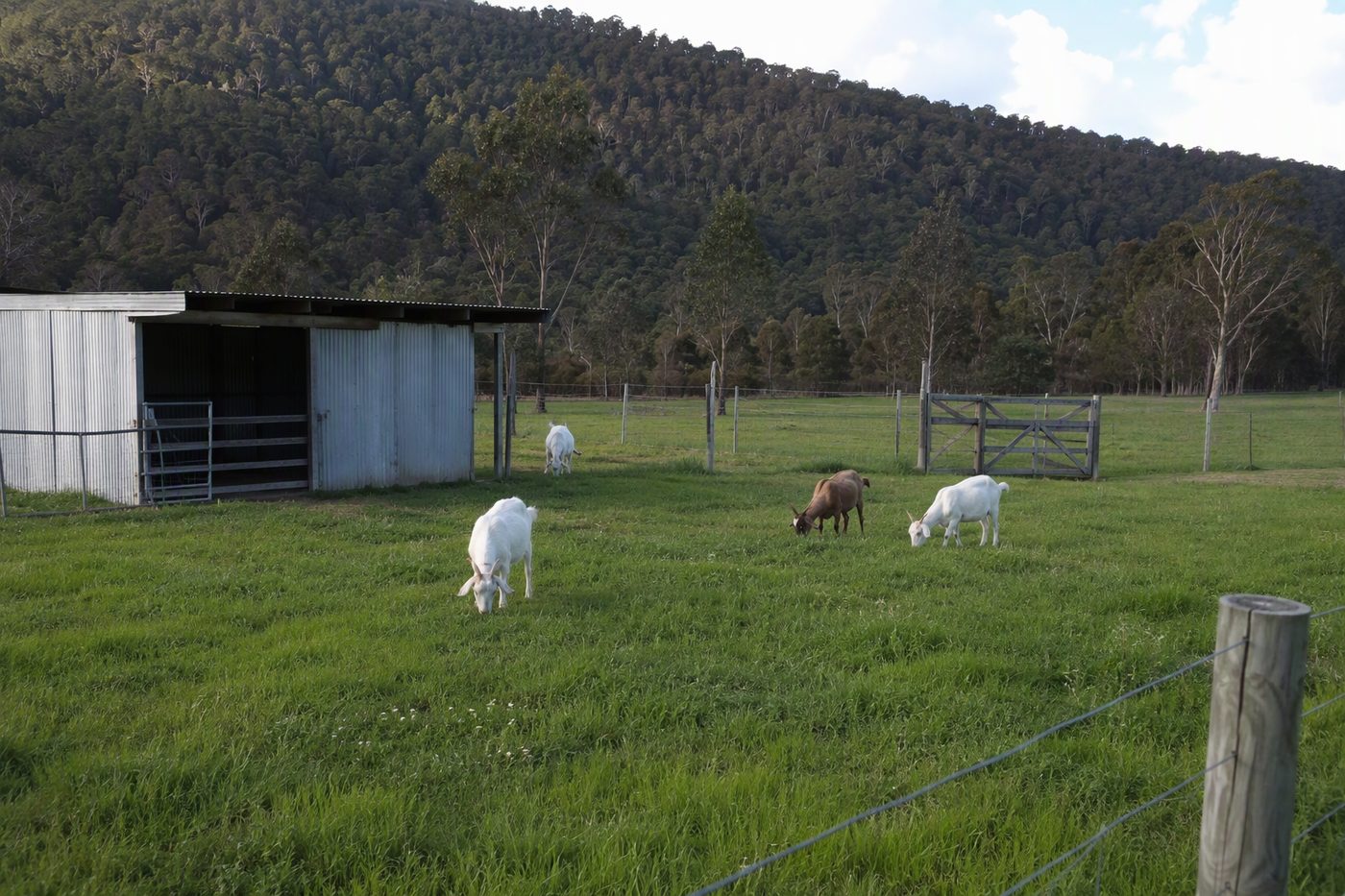
My goats shelter in a basic three-sided shed — a pole barn, really — facing north. The solid walls and roof keep the rain and wind off them, and the open front pulls a breeze through when summer cranks up. I work on 1.5–2 m² per adult inside. Less than that and they're jammed in shoulder to shoulder; they need enough room to lie down and move about without climbing over each other.
Goats won't lie on cold, wet ground, full stop. I've learnt to give mine a dry, draft-free shed with raised timber platforms, and the difference in their condition shows. Good ventilation matters as much as shelter though, because stale air breeds respiratory problems faster than the cold does. Down here in Tassie, we stack straw or wood shavings deep through the colder months, and I rework the shed layout each summer to catch shade and cross-breezes. Goats don't handle prolonged heat well either, so airflow when it warms up is non-negotiable.
Cost to build a goat shed
| Build type | Cost | Capacity |
|---|---|---|
| Salvaged materials, owner-built | $500-$1,500 | 4-6 animals |
| Purchased kit shelter | $800-$2,500 | 4-6 animals |
Feed, Browse and the Winter Ration
I run a small herd of goats across my 12 acres in Tassie, mostly to chew through the brush, leaves, woody weeds and herbaceous plants other livestock won't touch. Once the dry summer sets in, I top them up with supplementary feed. A while back I bought two Boer does from a breeder outside Launceston, $850 a head. Three days later, a heavy ram of mine crashed into the electric netting, buckled the line, and the does were out before I knew it. Cost me $120 in replacement posts and wire before the whole herd was back behind proper fence.
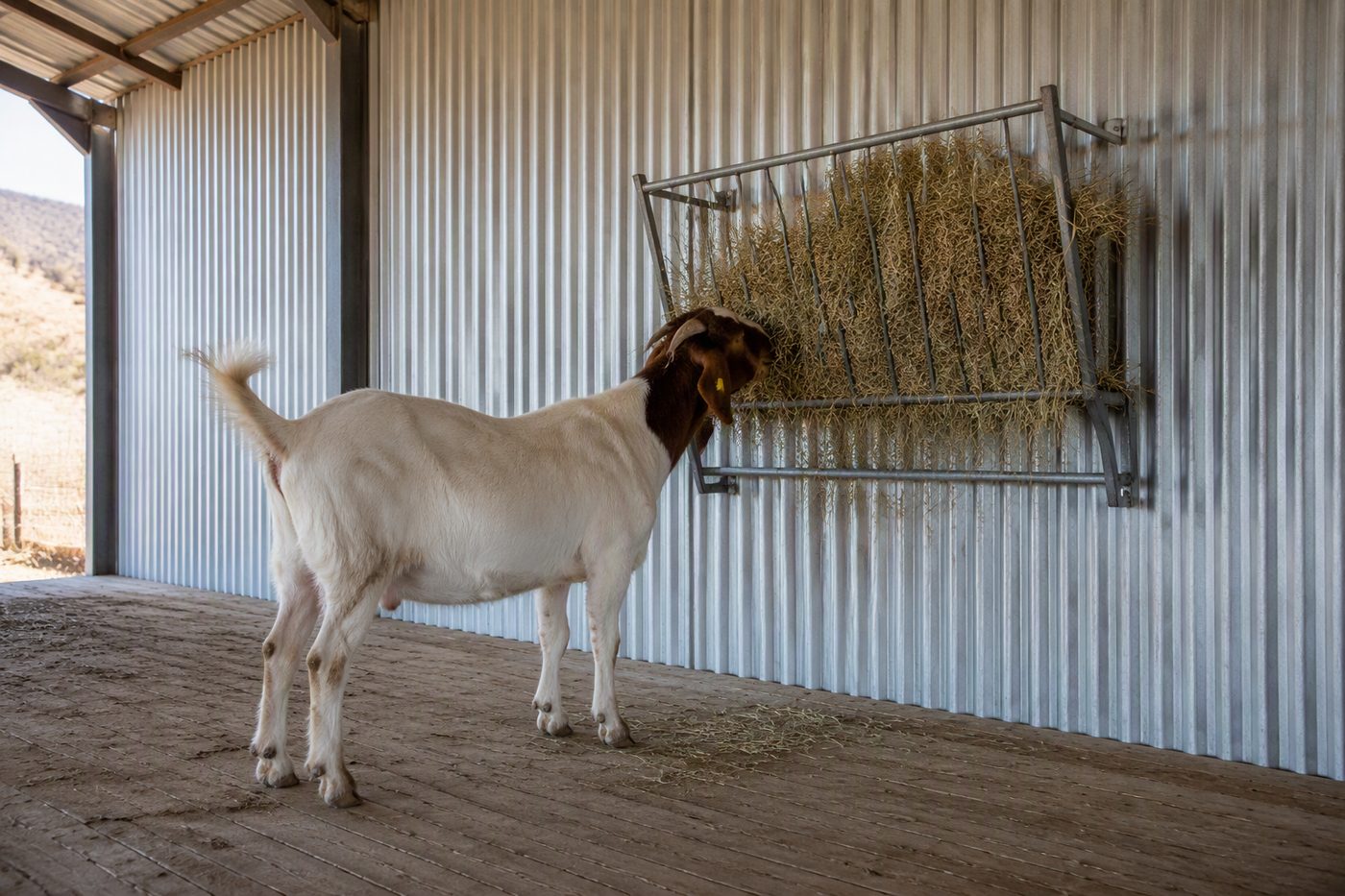
Meadow hay and lucerne stay stacked near the shed through winter and the dry spells. I feed whole oats, barley, and goat pellets to the milking does and growing kids — a handful in the palm works as a training bribe, though I keep the grain ration tight. Push too hard and you'll have a goat with digestive drama on your hands before the bucket's back on the hook. Hay anchors every feed, browse fills in whatever's in season, and a modest grain allowance tops things up for the does still in milk.
Copper and selenium
Copper deficiency will catch you out if you ignore it. Goats need a goat-specific copper oxide bolus — never assume you can share with the sheep, because sheep can't handle the copper load. Selenium matters just as much across most of Australia, and I mix it straight into the ration. I order bulk copper oxide boluses from a Devonport breeder at $45 a bag and only dose the herd when the deficiency shows itself. Before you start, ring your local vet and ask about soil and forage deficiencies in your area.
Daily Routine on the Block
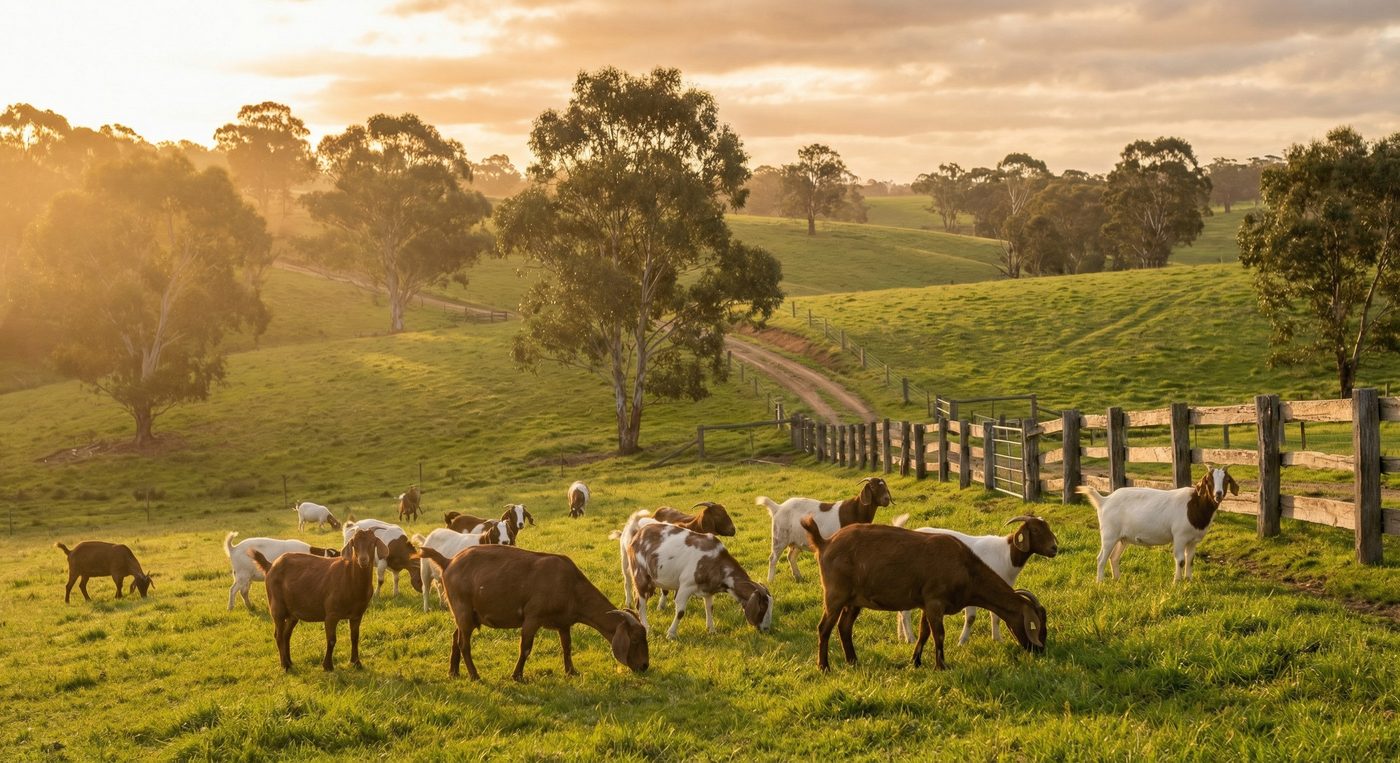
Up first: the twelve acres on foot, here in Tassie. Water topped, hay counted out, grain only when the plan calls for it, then eyes and hands over every goat. Milking runs twice a day, about twelve hours apart. Hooves get a once-over and trim weekly. Every few days I push the herd onto fresh browse or pasture — keeps the milk up and the parasite load down.
How I milk
I milk on a raised stand with a head gate to keep the doe still. Clean, dry, no mud on the udder. I wipe it down with warm water and dry it off before I put the bucket on. Milk goes straight into a stainless container, then I run it through a fine sieve into glass jars. Keeps 3–5 days cold in the fridge. Anything I can't use in that window gets frozen, cheesed, or turned into yoghurt or soap.
Health: Hooves, Worms and What I Keep in the Shed
Goats are relatively hardy when managed well, but a few health issues are worth knowing about.
Worms and parasites: Internal parasites (particularly Barber's Pole worm) are a major concern in warm, wet conditions. Implement a regular drenching program and rotate pastures to break parasite cycles. Faecal egg counts help target treatments effectively.
Hoof care: Hooves need trimming every 6-10 weeks to prevent lameness and foot rot, especially on softer, wetter soils. A sharp hoof knife and a firm holding position make this straightforward.
Vaccinations: Core vaccinations include Clostridial diseases (5-in-1 or 7-in-1 vaccines) and, in areas with risk, Q fever. Your vet can advise on a local schedule.
Ketosis and metabolic disease: Late-pregnancy and early-lactation does are prone to metabolic issues. Proper nutrition during these periods is critical.
What a Goat Actually Costs
| Category | Price range | Notes |
|---|---|---|
| Breeding does | $150-$800 | By breed, age, breeding history |
| Bucks | $150-$500 | Stud animals command higher prices |
| Weanlings and yearlings | $100-$300 | Cheaper way to start |
| Dairy breeding doe (typical) | $300-$800 | Saanen, Anglo-Nubian, Toggenburg |
| Meat goat doe (typical) | $200-$500 | Boer, Kiko |
| Ongoing feed and vet per goat per year | $200-$500 | Region and season dependent |
Council, Tags and the Paperwork
Most Australian councils require livestock registration for goats, with NLIS (National Livestock Identification System) tagging mandatory for sheep and goats in most states. Check your state Department of Agriculture requirements before purchasing.
The Mistakes I'd Skip If I Started Again
Fencing cost me more for goats than it ever did for sheep, and the goats pay it back. Two Boer does, $450 each, from a Devonport breeder — no fuss, no dramas. Within weeks they had scrub turning into milk and meat across my 12 acres in Tassie. The new electric netting held through the first storm, finally.
Phone your council and ring around a few established Tassie goat keepers before you buy. I didn't bother. Bought three Boer does from a Deloraine breeder for $1,200, and my temporary electric fence gave way under their weight. Cost me two weeks of rounding up escaped goats and another $450 on new posts and mesh. The early planning would have been free.
Worth a watch: Beginner’s Guide to Dairy Goats on Small Acreage + Fresh Butter and Cream · Ali's Organic Garden & Homestead
Frequently asked questions
Are goats really worth keeping on a small Aussie property?
Goats earn their keep on a small property, no question. They give you milk, meat and fibre, and they'll mow down rough pasture and weeds a cow won't bother with. They do need proper fencing and at least one mate because they're herd animals, so don't go in thinking they're free lunch.
What should I check before buying a goat?
I always start with the eyes, coat and feet — runny eyes, a patchy coat or scabby hooves are red flags. Ask the seller about footrot history and recent drenching. A quiet goat that lets you handle it is usually a better bet than a skittish one, especially if you want milk.
What does it actually cost to keep goats off-grid?
Feed, fencing and the vet are the three ongoing costs and they add up faster than most people expect. Hay, fencing that actually holds a goat, and a vet call when something goes pear-shaped can blow the budget quickly. The "What Feed, Fencing and the Vet Actually Cost Me" section of the article breaks down my real numbers.
How do I know when to call the vet for a goat?
If a goat's down and won't get up, off its feed for more than a day, or bleeding where I can't stop it, I'm on the phone straight away. Same goes for bloat that doesn't ease or a labour that's gone on too long without progress. Knowing when to admit defeat is half the job — pride costs goats their lives.
Disclosure: some links in this article are affiliate links. If you buy through them we may earn a small commission at no extra cost to you.