By Fiona Gallagher · permaculture designer · food, animals and preservation on 12 acres in Tassie
“After losing 40% of my winter carrots to unmulched frost, I now bury them three feet deep under straw for a guaranteed harvest.”
By Fiona Gallagher · permaculture designer · food, animals and preservation on 12 acres in Tassie
“After losing 40% of my winter carrots to unmulched frost, I now bury them three feet deep under straw for a guaranteed harvest.”
Off-grid harvesting on a Central Queensland block means capturing two resources the bush hands you for free: water from the sky and the ground, and sunlight for power. Both have to be designed as systems, not gadgets. Below is what the specs, regulations, and field experience actually support for Australian conditions.
Rainwater harvesting is the simplest starting point. You collect runoff from the roof, divert the first dirty flush, and store the rest in food-grade tanks. The roof is your catchment; the tank is your buffer; the first flush diverter is what keeps the buffer from going off.
The principle is straightforward. A first flush diverter routes the initial volume of rain (which carries leaves, dust, bird droppings, and metal residues from the roof) to waste before the cleaner water enters the tank. Downstream, you filter and (if intended for drinking) treat the water before use. Tank material matters: food-grade polyethylene or lined steel prevents leaching and keeps the stored water safe for household and garden use.
A practical sizing rule for this region: one millimetre of rain on one square metre of roof yields roughly one litre of water. A 200 m² roof in a 50 mm storm drops around 10,000 L into your tanks. That math is what makes tank sizing honest rather than aspirational.
Where the roof cannot keep up, water bores tap into underground aquifers and provide a steadier supply for showers, gardens, and livestock. The trade-off is that bore water is not automatically potable. It may carry dissolved minerals (iron, manganese, hardness salts) and, depending on geology and depth, bacterial contamination. The rule of thumb here: test before you drink, and treat based on the result.
Common treatment chains in Australia:
Many off-grid bore setups pair the pump with solar PV to keep operation independent of the grid. Match pump duty (L/day and total dynamic head) to your tank storage so you're not cycling the pump to death on a sunny day with nowhere to put the water.
Ponds collect rainwater and runoff and can be used for garden watering, aquaculture, or wildlife habitat. They also need monitoring: stagnation drives algae blooms and mosquito breeding. In Central Queensland heat, expect evaporation to claim several millimetres a day from an open pond surface in summer; a floating cover or shade cloth cut loses meaningfully.
If you're relying on a pond for anything more than landscape value, plan for aeration (solar fountain or windmill) and consider stocking with native fish that eat mosquito larvae. Untreated pond water is not for drinking.
Off-grid power means the home is completely disconnected from the electricity network. There is no retailer backup and no mains to cover low-solar periods. The homeowner is responsible for every shortfall: low solar production in winter, battery replacement, inverter faults, and backup generation.
For remote properties where grid connection is uneconomic, that trade can make sense. For a suburban block, it almost never does on dollars alone; the case has to be made on resilience, lifestyle, or site constraints.
An off-grid power system is a stand-alone system that produces electricity autonomously, typically fed by renewables such as solar, wind, or hydro. Common components include:
Sizing is the bit where most off-grid dreams meet reality. Air conditioning load is typically the largest variable in sizing an off-grid system: it scales with unit size, hours of use, and number of units running simultaneously. Undercounting air conditioning, electric cooking, or water pumps is a common and costly mistake; retrofitting extra battery and panel capacity after the shed is built costs real money.
A typical Australian off-grid family home running one or two air conditioners for a few hours a day generally needs:
| Build/Use Case | Battery Capacity | Solar Array | Inverter Size |
|---|---|---|---|
| Tiny home, caravan, cabin | 5–14 kWh | Proportional to load | 2–3 kW typical |
| Family home with 1–2 AC units, a few hours/day | 14–24 kWh | 5–9 kW | 5–8 kW |
| Acreage with multiple buildings | 30 kWh+ | 10 kW+ | 8 kW+ (often paralleled) |
Rule: fully off-grid systems should include a 20% capacity buffer above calculated needs. Grid-connected systems don't carry that full buffer because the grid is the buffer; you do not have that luxury off-grid. Build the buffer in on day one.
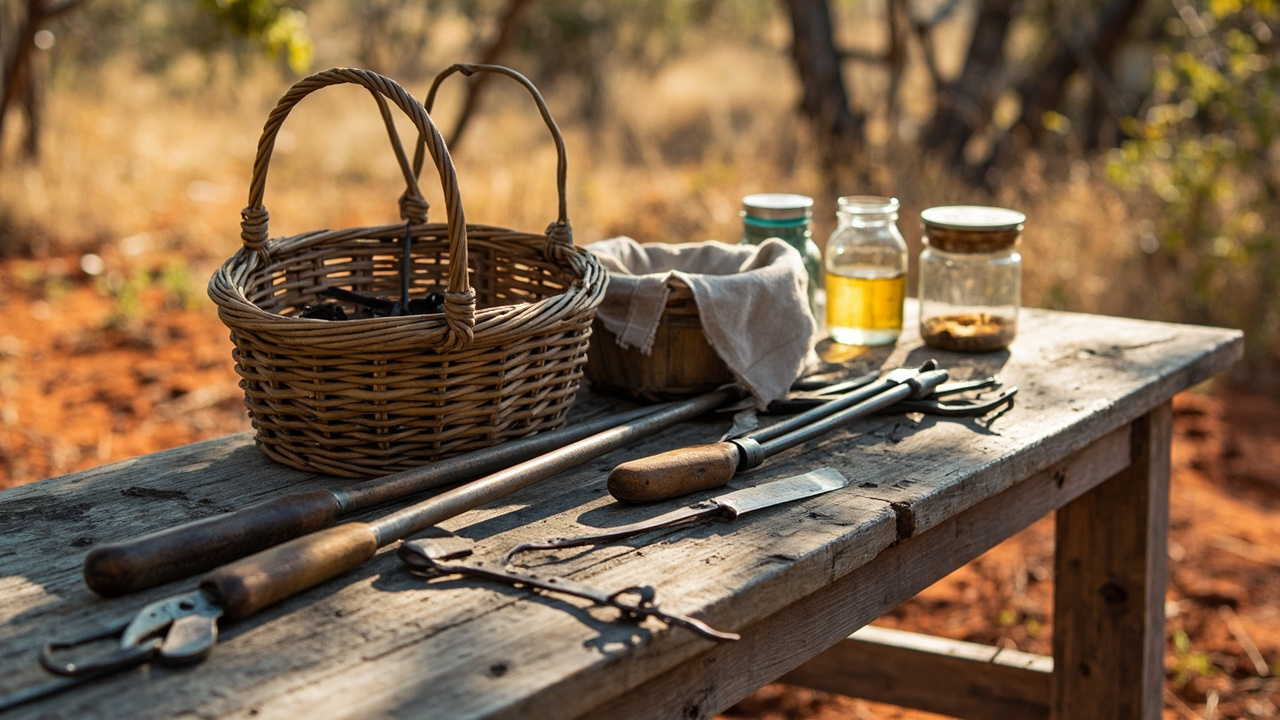
For hand tools and harvest gear on a hot Australian block, durability beats novelty. Steel hand tools hold up better than plastic in sustained UV and heat; keep edges sharp; oil moving parts; store out of direct sun. Sharp secateurs and loppers cut cleaner, heal faster on the plant, and strain your hands less.
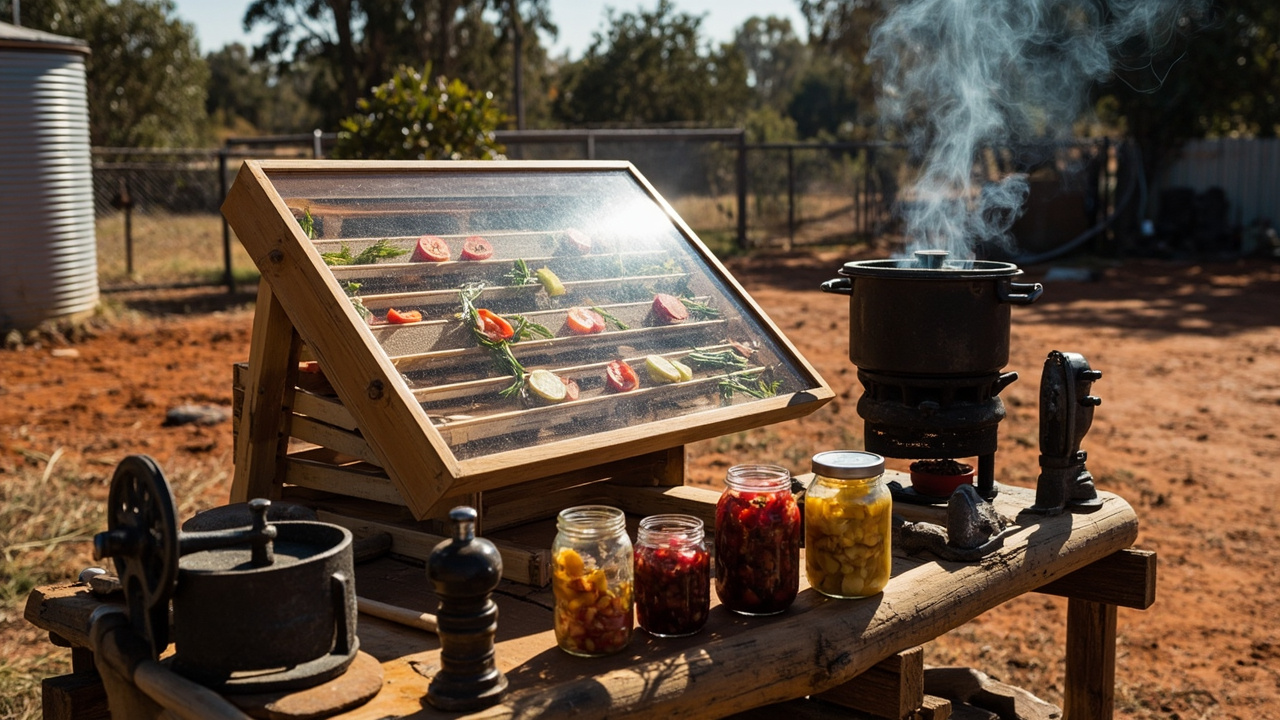
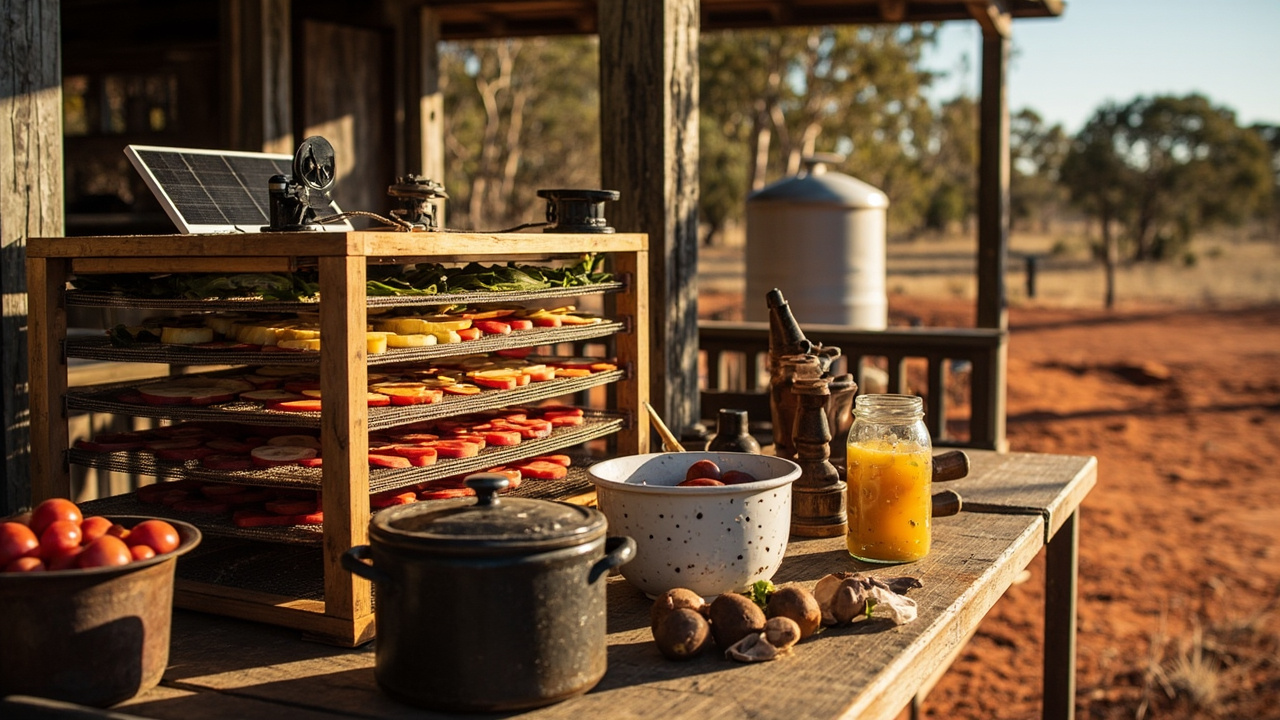
For produce storage after harvest: dry, cool, dark, and ventilated. Moisture is what brings mould; airflow is what prevents it. Hard-skinned fruit (pumpkins, melons) cure better in shade than sun. Leafy greens want refrigeration within an hour of picking.
This is where off-grid work stops being DIY. Some jobs are legally and practically licensed work in Australia. Call a licensed professional when:
A licensed sparky won't just make it legal; they'll size cable runs, breaker ratings, and earthing to the standard, which is what keeps the system from becoming a fire risk in five years. Note that on the DC side, the battery negative in a floating off-grid system is typically not the safety earth. AC protective earth and DC negative are distinct conductors: bonding them where the inverter or standard does not call for it can create unintended fault paths and trip RCDs. Any decision to bond DC negative to earth must follow AS/NZS 3000 and the inverter manufacturer's instructions, not DIY assumption.
Do I need a bore if I have good roof catchment?
Not always. In a reliable-rainfall area with large roof area and tank storage sized for the dry season, rainwater can cover household demand. Bores become attractive when roof catchment is small, rainfall is unreliable, or you have livestock or large garden demand.
Is rainwater safe to drink without treatment?
Roof-collected rainwater is generally safe for household use, but many authorities recommend filtration and disinfection (UV or fine filtration) before drinking, especially after long dry periods when tank water has sat for months.
How often should I test bore water?
At minimum annually, and after any flood event or noticeable change in taste, colour, or odour. More frequent testing (twice yearly) is common for bores near agriculture or septic systems.
Can I run air conditioning fully off-grid?
Yes, but it dominates the system. A single typical split system running a few hours a day in Queensland summer can account for the majority of household energy use. Sizing the battery bank and solar array to cover AC is what separates a working off-grid home from one that quietly fails every February.
What's the single biggest sizing mistake?
Underestimating air conditioning and cooking load. People design for lights, fridges, and electronics, then add an AC unit and discover the battery bank collapses by mid-afternoon.
Is lithium-ion always the right battery choice?
For most modern off-grid homes, LiFePO4 is the default recommendation: stable chemistry, long cycle life, and straightforward 48 V-class stacking with an off-the-shelf BMS. Lead-acid still has a place in low-budget or high-surge applications, but the $/kWh-over-lifetime math has shifted firmly toward lithium. Repurposed EV packs, typically NMC in modules like those from a Nissan Leaf, are a separate case. They can work, but they are thermally sensitive, run at higher cell voltages than LFP, and require a properly matched BMS, cell-level voltage and temperature monitoring, and deliberate thermal management. If that engineering is not done, the result is a fire risk, not a budget saving.
Worth a watch: Complete Off-Grid Water System | Rainwater Harvesting + Pump Installation · The Mountain Wizard