Stop wasting money. This is the straight-up truth about charge controllers for your off-grid setup in Australia. No fluff, no marketing nonsense.
Stop wasting money. This is the straight-up truth about charge controllers for your off-grid setup in Australia. No fluff, no marketing nonsense.
Side-by-side PWM vs MPPT comparison with a sizing rule of thumb.
Efficiency: The Cold, Hard Numbers
MPPT is not just "better" – it's a different animal. PWM just throttles your panels like a cheap tap. MPPT actively squeezes out more power, especially when it's cold or cloudy (which we get in Tasmania, the Snowy Mountains, or even Sydney in winter).
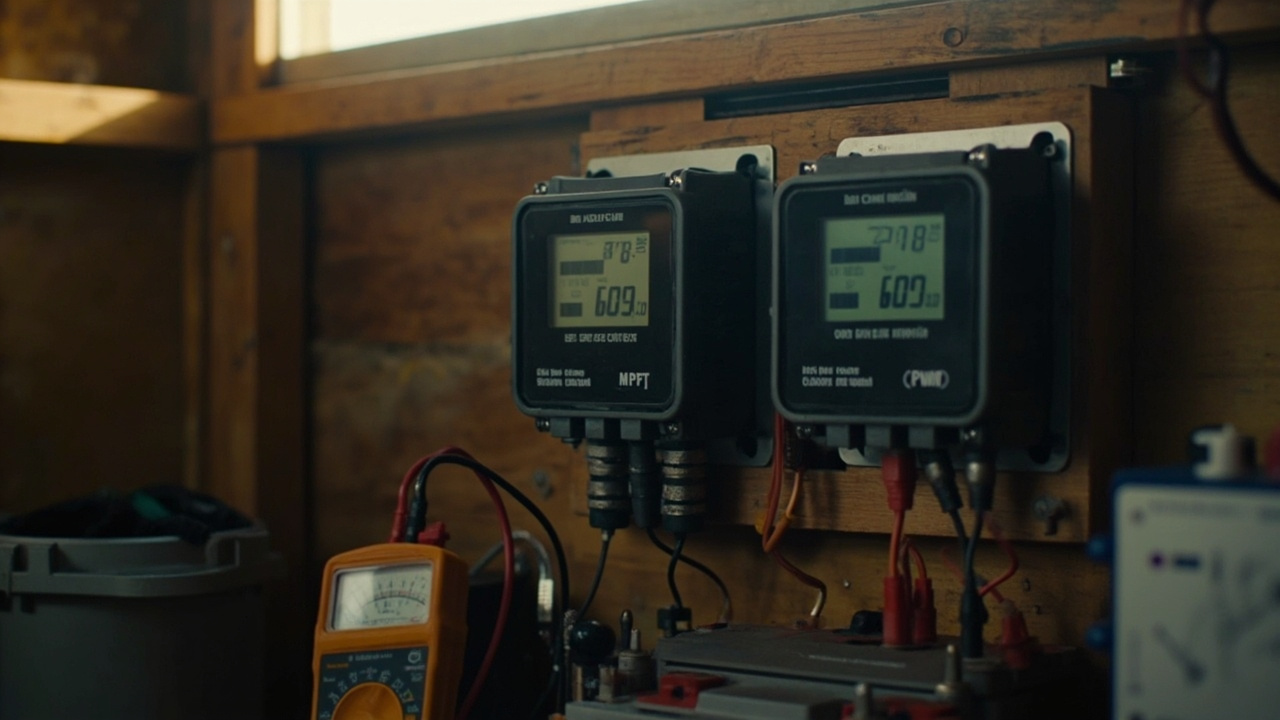
Side‑by‑side solar controllers showing real output differences.
MPPT efficiency: 95-98% (even in low light). PWM efficiency: 70-85% (drops hard when sun isn't blazing).
Example: On a cloudy day in Cairns, MPPT pulls 25-30% more juice from your panels than PWM. That's 25-30% more power for your fridge, lights, or pump. You'll feel it.
When MPPT Wins (And When It's a Waste of Cash)
Get MPPT if:
You've got a system over 200W (or 12V system over 10A).
You're in a place with variable weather (i.e., most of Australia).
You want to future-proof your setup (adding panels later? MPPT handles it).
You're running a 24V or 48V battery bank (PWM won't cut it).
Stick with PWM if:
You've got a tiny setup: 50-100W (e.g., caravan, small shed).
You're on a tight budget and won't add panels later.
You're running a 12V system with a single small panel (e.g., 50W).
Don't be cheap on anything over 200W. You'll regret it when your battery dies on a rainy day.
Sizing: Don't Mess This Up
Forget "wattage" alone. Check your panel's Vmp (voltage at max power) and Imax (current).
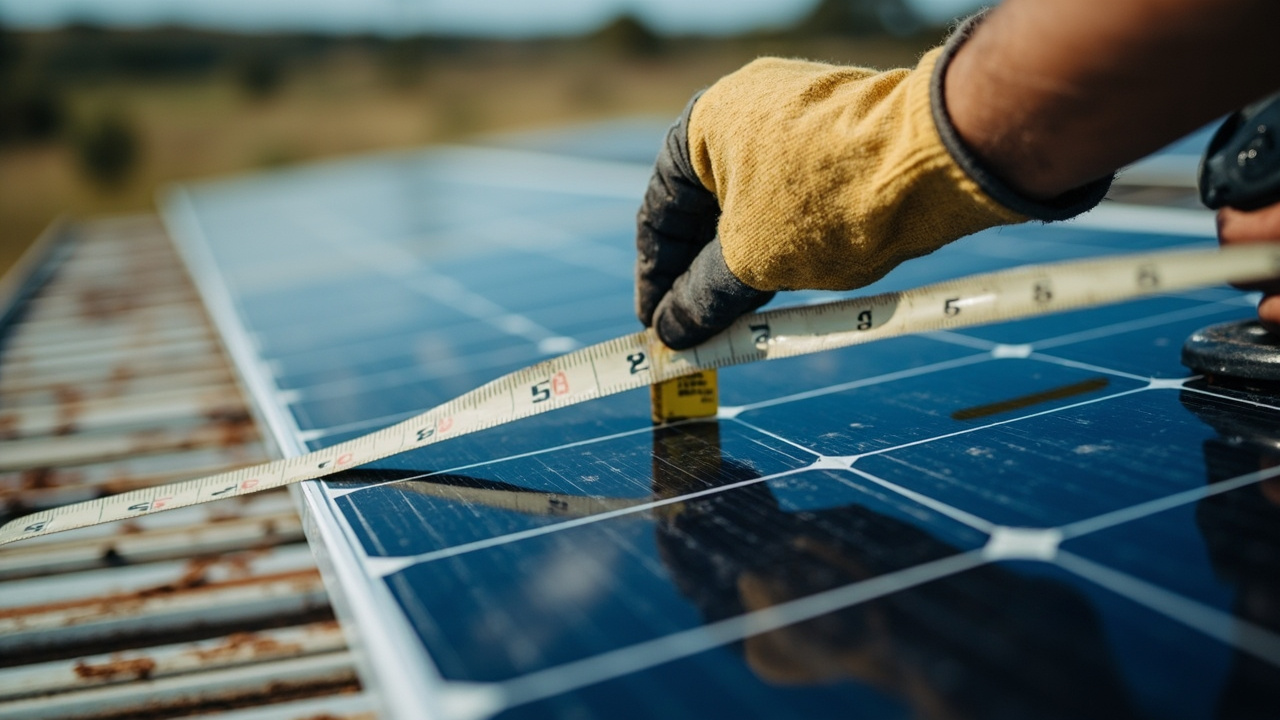
Solar panel with tape measure showing size reference.
For PWM:
Panel Vmp must be 1.5x your battery voltage. For a 12V battery? Panel Vmp must be 18V+. If your panel's Vmp is 17V? PWM will choke it. You'll get 30% less power.
For MPPT:
Panel Vmp can be higher (up to 100V+). It steps it down to your battery voltage. So a 24V panel on a 12V battery? MPPT handles it. PWM won't.
Rule of thumb: Max panel wattage = (Battery voltage × Controller amps) × 1.2. For a 12V system with a 20A MPPT? Max panel wattage = (12 × 20) × 1.2 = 288W. Get a 300W panel? You're good.
Australian Practical Tips (No BS)
Don't buy a 12V PWM for a 24V battery bank. It'll fry. Check your battery bank voltage first.
MPPT controllers need more wiring. They handle higher voltages. Use thicker cables if your panels are 300W+.
Check max input voltage. Cheap MPPTs max out at 60V. If you have a 300W panel (Vmp ~36V), you need a controller rated for 60V+ (e.g., 100V). Otherwise, it'll shut down on sunny days.
Forget "cheap" MPPTs under $150. They're unreliable. Stick to brands that work in Australian conditions.
Australian Suppliers & Pricing (indicative prices)
Here's what you'll actually pay in Australia:
PWM Controllers (12V Only)
• Jaycar: 10A PWM ($45) – good for 120W max (e.g., 100W panel).
• Supercheap Auto: 20A PWM ($55) – 240W max. Cheap, but only for tiny setups.
MPPT Controllers (12V/24V/48V)
• Victron SmartSolar 100/20 ($380) – industry standard. Handles 100V input. Works in all Aussie conditions.
• Epever Tristar 30A ($220) – budget MPPT. Good for 300-400W systems. Check reviews – some have firmware issues.
• Renogy 100/30 ($280) – solid, simple. Good for 400W systems.
Price reality: MPPT costs $100-$200 more than PWM. But for a 300W system, it gives you 75-90W extra power daily. That's like getting a free panel. Pay for it.
The Bottom Line
If you're serious about off-grid in Australia, get MPPT. For anything over 200W, it's not optional. PWM is for when you're running a 50W panel on a caravan and don't care about power. Stop wasting money on the wrong controller. Your battery bank will thank you.
⚠️ SAFETY WARNING: Working with electrical systems, structural modifications, or gas installations carries inherent risks. If you are not confident in your abilities, always engage a licensed professional.
He walks through a real example of sizing a charge controller for a 200 W panel and points out the mistake of pairing a PWM with a high‑voltage string, which directly mirrors the sizing details I cover in the guide.— Dave Miller
When to Call a Professional
While many off-grid projects are achievable as DIY, certain situations require licensed professionals:
Electrical work beyond basic 12V DC additions — requires a licensed electrician
Structural modifications to buildings or load-bearing elements
Gas line installation or modification
Solar array installations above safe voltage thresholds
Any work that affects the structural integrity of your property
Always check local regulations and obtain necessary permits before commencing work.