By Dave Miller · off-grid sparky · 22 years wiring solar, batteries and sheds in central QLD
“After frying three 12V inverters in a single summer, I switched to 48V and finally kept my lights on during a Queensland heatwave.”
By Dave Miller · off-grid sparky · 22 years wiring solar, batteries and sheds in central QLD
“After frying three 12V inverters in a single summer, I switched to 48V and finally kept my lights on during a Queensland heatwave.”
Choosing between 12V and 48V for an off-grid build is one of those decisions that locks in consequences from day one: cable size, inverter sizing, what loads you can actually run, and how much copper you bury. In Central Queensland, where summer roof temperatures push panels hard and distance between the array, battery shed, and house adds up fast, the voltage choice tends to make or break a system before it even goes live.
Here's what the maths and component limits actually say, stripped of marketing.
Power is voltage multiplied by current. Same wattage, different voltage, different current. That single relationship drives every cable, fuse, and breaker decision in the rest of this article.
Current at that level demands enormous cable, oversized fuses, and the whole system runs hot under load. Higher voltage reduces current, cable size, voltage drop, and heat for larger solar systems. That's the entire reason 48V exists as an off-grid standard.
Using a 3,000W continuous load as the benchmark (a realistic figure for a modest off-grid house running a decent inverter), the differences between 12V, 24V, and 48V are stark:
| Voltage | Current @ 3,000W | Copper Cable | Fuse / Breaker | DC Wire Loss |
|---|---|---|---|---|
| 12V | ~250A | 70 mm² (~$49–82/m) | 300A Class T | 4–6% |
| 24V | ~125A | 35 mm² | 150A | 2–3% |
| 48V | ~62A | 16 mm² | 80A | 1–2% |
Sources: Savolture, Explorist.life
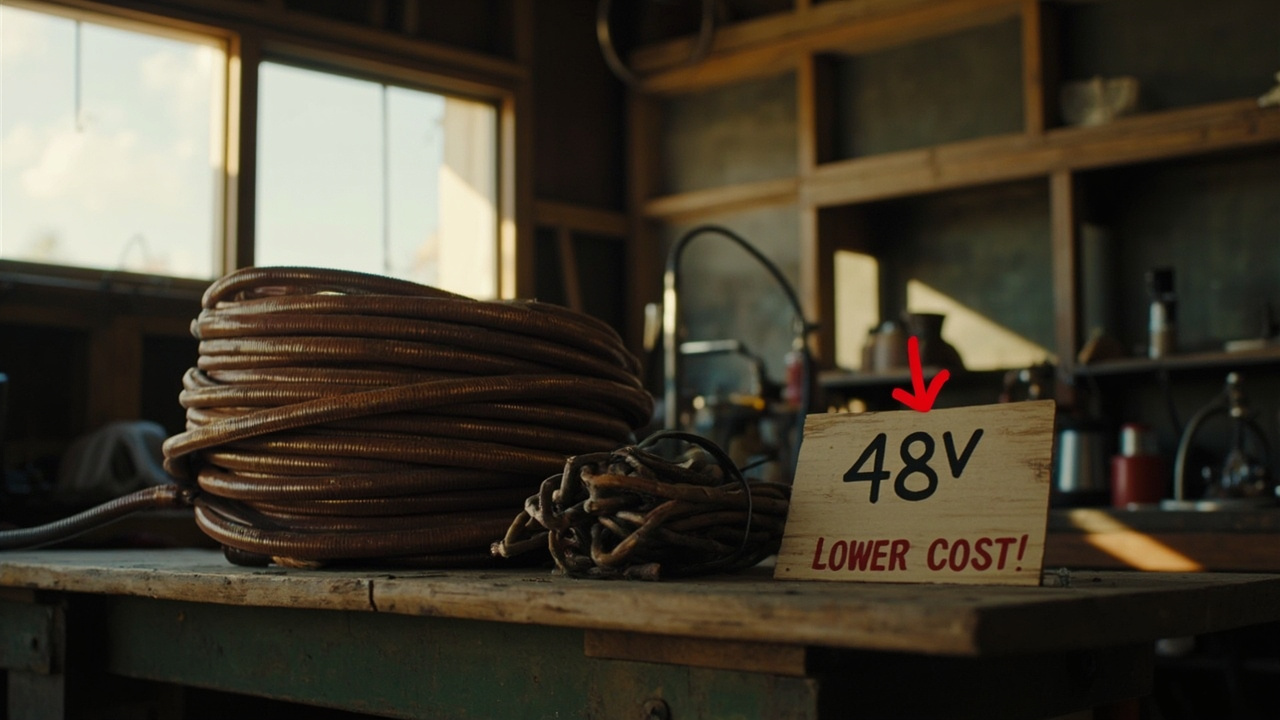
Two things jump out. First, the cable size drops dramatically as voltage rises — 70 mm² copper is genuinely difficult to work with, bend, and terminate, while 16 mm² is a one-handed job. Second, 48V systems use copper that costs roughly 1/8th the price per metre compared to the 12V equivalent, which is not trivial when a 15 m run from battery shed to inverter room can swallow 30 m of cable.
A 3,000W 12V inverter requires 120 mm² (4/0) wire, while a 5,000W 12V inverter requires two sets of 120 mm² (4/0) wire for both positive and negative runs. At 24V or 48V, smaller and more manageable wire sizes such as 50 mm² (1/0) can be used for larger systems.
Voltage isn't a religion; it's a tool matched to load. The rule of thumb from the research:
Source: Savolture
Smaller systems (up to ~3,000W) can often stay at 12V; medium systems (~5,000W) are best at 24V or 48V; large systems (10,000+ watts or off-grid homes) should almost always be 48V.
For stationary off-grid homes and cabins, 48V is almost always recommended because it integrates easily with residential breaker panels and reduces wire size requirements.
Voltage affects how much solar you can land on a single charge controller. The 100A class — which covers most mid-size MPPT units — has a hard ceiling based on battery voltage:
Source: Explorist.life
A 12V system can handle about 1,450W of solar on a single 100A charge controller, a 24V system up to 2,900W, and a 48V system up to 5,800W. Run a 6kW array on a 12V bank and you're forced into parallel charge controllers — more boxes, more wiring, more failure points.
48V battery banks can be built by wiring four 12V batteries in series. It's not exotic; the configuration is the same as a 12V bank, just doubled twice. System voltage refers to the voltage of the entire battery bank, not just individual batteries.
One thing worth knowing: Victron offers 12V and 24V DC-to-DC chargers but not 48V options; Sterling is mentioned as a 48V alternative. If a build relies on alternator charging from a vehicle or generator with DC-DC charging, that constraint matters.
The research describes 48V as the 2026 default for systems that are not specifically RV or marine. That tracks with what's arriving on shelves — most residential-scale LFP banks, most hybrid inverters in the 5–15kW range, and most modern charge controllers are designed around a 48V bus.
For a stationary Australian off-grid install — cabin, shed house, or full residence — the practical case for 48V is straightforward:
1. Wire costs and sizes are dramatically lower.
2. I²R losses in cables are 1–2% rather than 4–6%.
3. A 48V battery bank integrates directly with a 230V/50Hz inverter feeding a standard residential breaker panel.
4. Expansion headroom: adding another 5kWh LFP block at 48V doesn't require re-architecting the system.
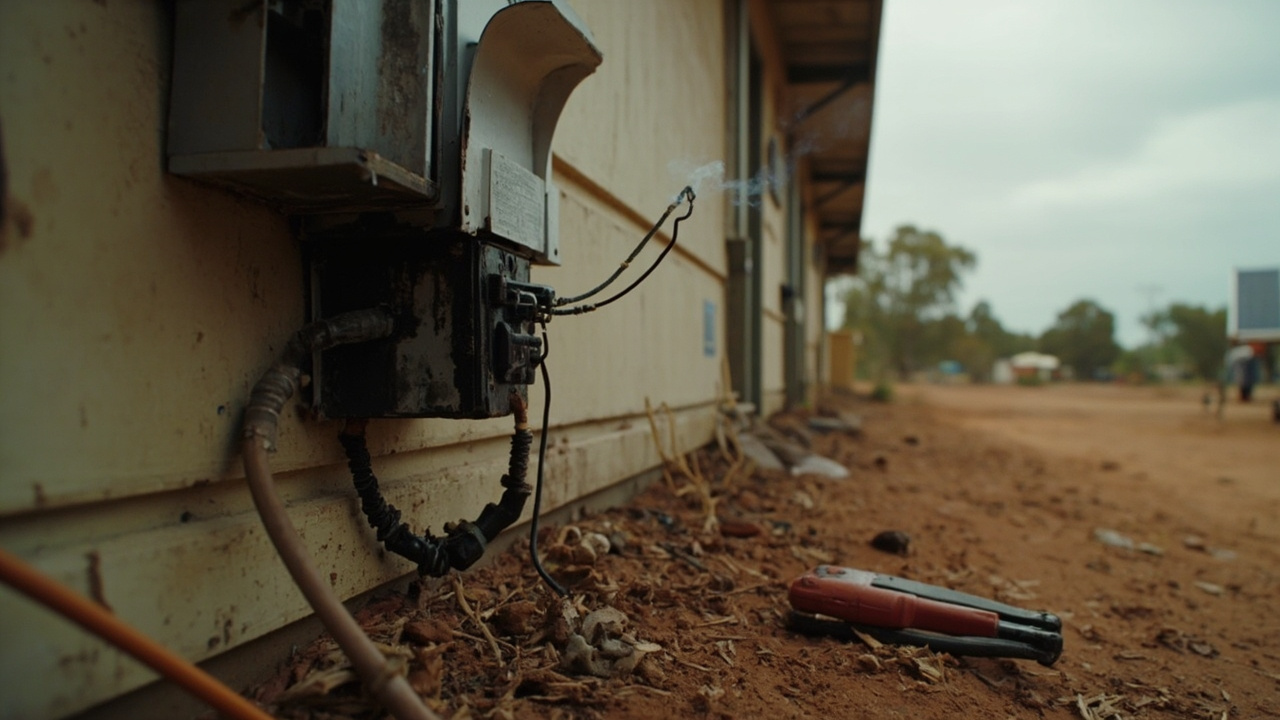
Higher current at lower voltages generates more heat and energy loss; for any system above 1,500W continuous, higher voltages are recommended to reduce fire and efficiency risks.
Specific situations where a licensed Australian electrician (and where battery work is concerned, an accredited installer under CEC guidelines) should be on the job:
One colourful aside: a 12V system pulling 250A through 70 mm² (2/0) cable gets warm enough to notice. At 48V, the same 3,000W barely warms the insulation. The physics doesn't care about opinions.
Q: Can I run an air conditioner off a 12V system?
A: Technically yes, but you'll be in the impractical range fast. A typical 2.5kW split system pulls ~3,000W at the inverter, which at 12V is 250A through 70 mm² (2/0) cable with 4–6% losses. It works, but it's the worst-case match for 12V. Most off-grid A/C installs in Australia use 48V for this reason.
Q: Is 24V a sensible middle ground?
A: It is for 1,500–3,000W systems — tiny homes, larger marine, off-grid sheds. The research describes 24V as increasingly skipped rather than obsolete. If you're building a fixed residence with growth in mind, 48V gives you more headroom.
Q: Can I mix 12V and 48V in the same system?
A: Yes, via DC-DC converters. Most modern 48V off-grid systems run a small 12V bus for lights, fans, and electronics. It's cheaper to run a 48V battery and step down for 12V loads than the other way around.
Q: Do I need special equipment for 48V that doesn't exist for 12V?
A: Most modern inverters, charge controllers, and LFP batteries are available in 48V. The research notes one exception: Victron offers 12V and 24V DC-to-DC chargers but not 48V options; Sterling is mentioned as a 48V alternative.
Q: How much solar can I run on each voltage?
A: On a single 100A charge controller: 12V tops out at ~1,450W, 24V at ~2,900W, and 48V at ~5,800W. Beyond those limits, you need parallel controllers.
Q: Is 48V more dangerous than 12V?
A: In an off-grid context, 48V is still classified as extra-low voltage (ELV) under most Australian standards — below the 50V AC / 120V DC threshold typically considered dangerous. The real safety concern at any voltage is current, and 48V systems carry a quarter of the current of a 12V system at the same power. Properly fused and wired, 48V is safer in practice than 12V for high-power builds because there's less heat and fewer fire-starting fault currents.
Worth a watch: 12V vs 48V Cable Heat Test — Thermal Camera Shows the Truth at 2000W · solar circuit 360