
I've been preserving food in Central Queensland long enough to know that most of what spoils in a household isn't a refrigeration problem — it's a planning problem. A standalone chest freezer burns through roughly $100–$150 of running cost a year, and the average household only keeps around three days to a week of food on hand (Insteading). If the grid drops or the diesel runs out, that buffer evaporates fast. The five methods below cover what actually works in Australian conditions, what each one costs to get started, and where the real failure points sit.
Method 1 — Boiling-Water and Pressure Canning
Heat plus an airtight seal is the underlying principle. Get both right and the food stays shelf-stable for months without power (OffGrid Masterplan).
Canning splits into two distinct disciplines:
- Boiling-water canning — for high-acid foods: fruits, pickles, tomatoes with added acid, and most jam/preserve recipes.
- Pressure canning — for low-acid foods: vegetables, legumes, corn, soups, and meats. These must reach 116 °C internal temperature to reliably kill Clostridium botulinum spores.
A starting kit (water-bath canner or stovetop pressure canner, jar lifter, lid wand, bubble remover, and a starter pack of jars and lids) generally lands somewhere above $150 once you include the consumables. The cost climbs from there as you add a second canner size, replacement lids (single-use), and a spare sealing gasket.
Maintenance that actually matters:
- Replace canner pressure gauges and sealing gaskets on a schedule — these are the two components that fail silently and undermine the whole process.
- Inspect jars for nicks and cracks before each use. A compromised jar fails the seal.
- Use new lids every run. Rings (bands) can be reused.
Subtropical wrinkle: If you're inland or at altitude, standard recipes written for temperate climates may under-process. Verify adjusted boiling-water processing times for your elevation before relying on a recipe (OffGrid Masterplan safety notes).
Method 2 — Dehydrating (Electric and Solar)
Drying removes the moisture bacteria and mould need to grow, and works for herbs, fruits, and meats (OffGrid Masterplan). Done right, dried food stores in sealed containers for a year or more without refrigeration.
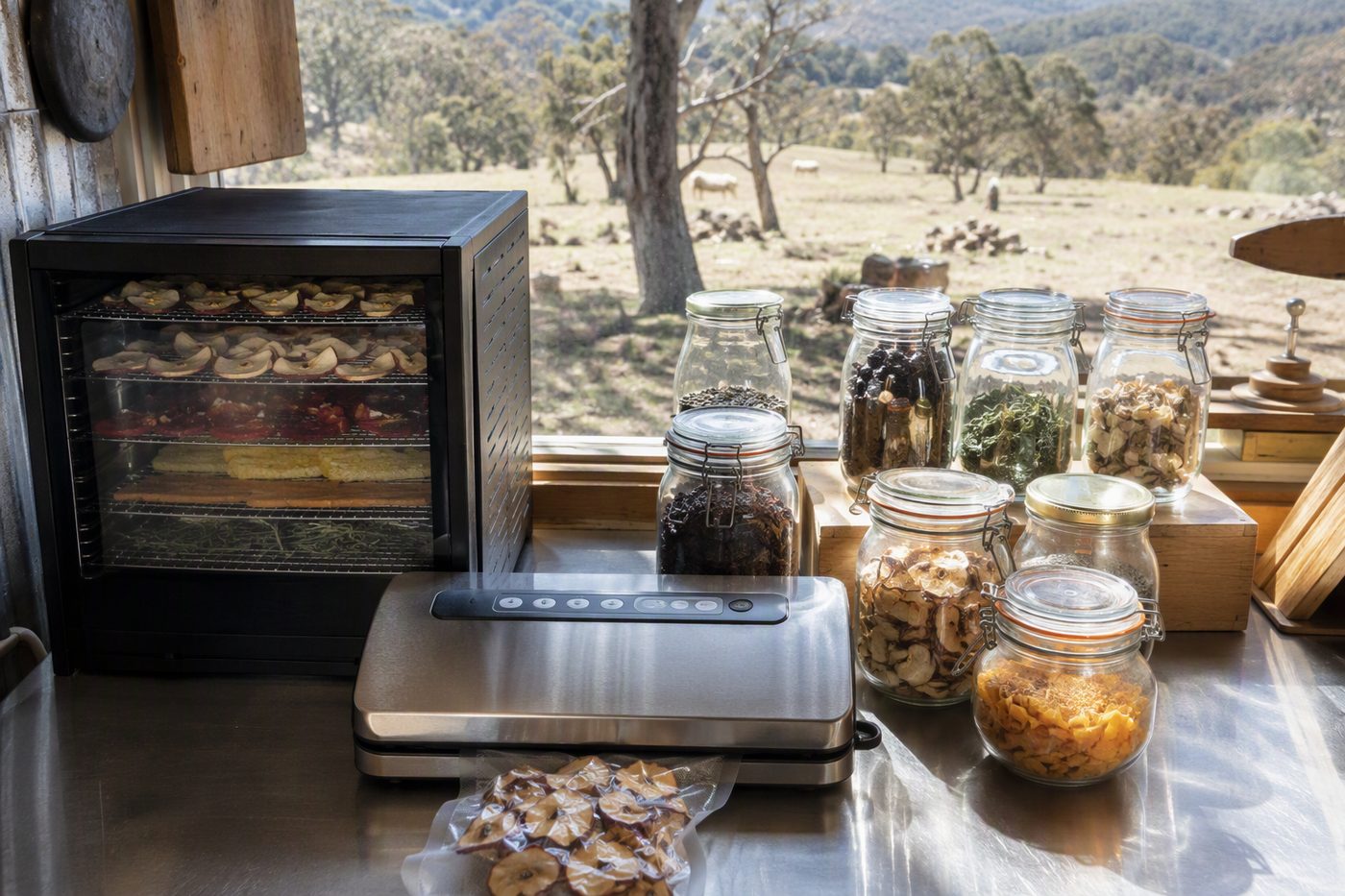
Electric dehydrator: A thermostat-controlled domestic dehydrator is the reliable choice. A 6–9 tray unit with a temperature range down to roughly 40–70 °C runs on standard 230V/50Hz mains and is straightforward to run off a small inverter off-grid. Expect to start around the lower end of the budget.
Solar dehydrator: Passive solar dehydrators work in dry climates, but in humid coastal or tropical zones they're unreliable for fruit leathers and anything thicker than herbs — moisture just sits in the food. Active solar dehydrators with a small low-wattage fan mitigate this. Build cost varies; you can run one cheaply if you have the timber and mesh on-site, but the humid-climate penalty is real.
A colourful aside: I once tried sun-drying mango slices in a Queensland wet-season week — the dehydrator wasn't optional. The fruit just laughed.
| Spec / Requirement | Value |
|---|---|
| Best applications | Herbs, fruit leather, jerky, tomato halves |
| Target final moisture | Below ~20% for fruit, below ~10% for jerky |
| Storage condition | Cool, dark, airtight (vacuum-sealed or jarred with desiccant) |
| Power draw (electric, 6-tray) | ~250–500W while running |
| Aussie humidity risk | High for passive solar; use electric or active solar |
Method 3 — Fermenting
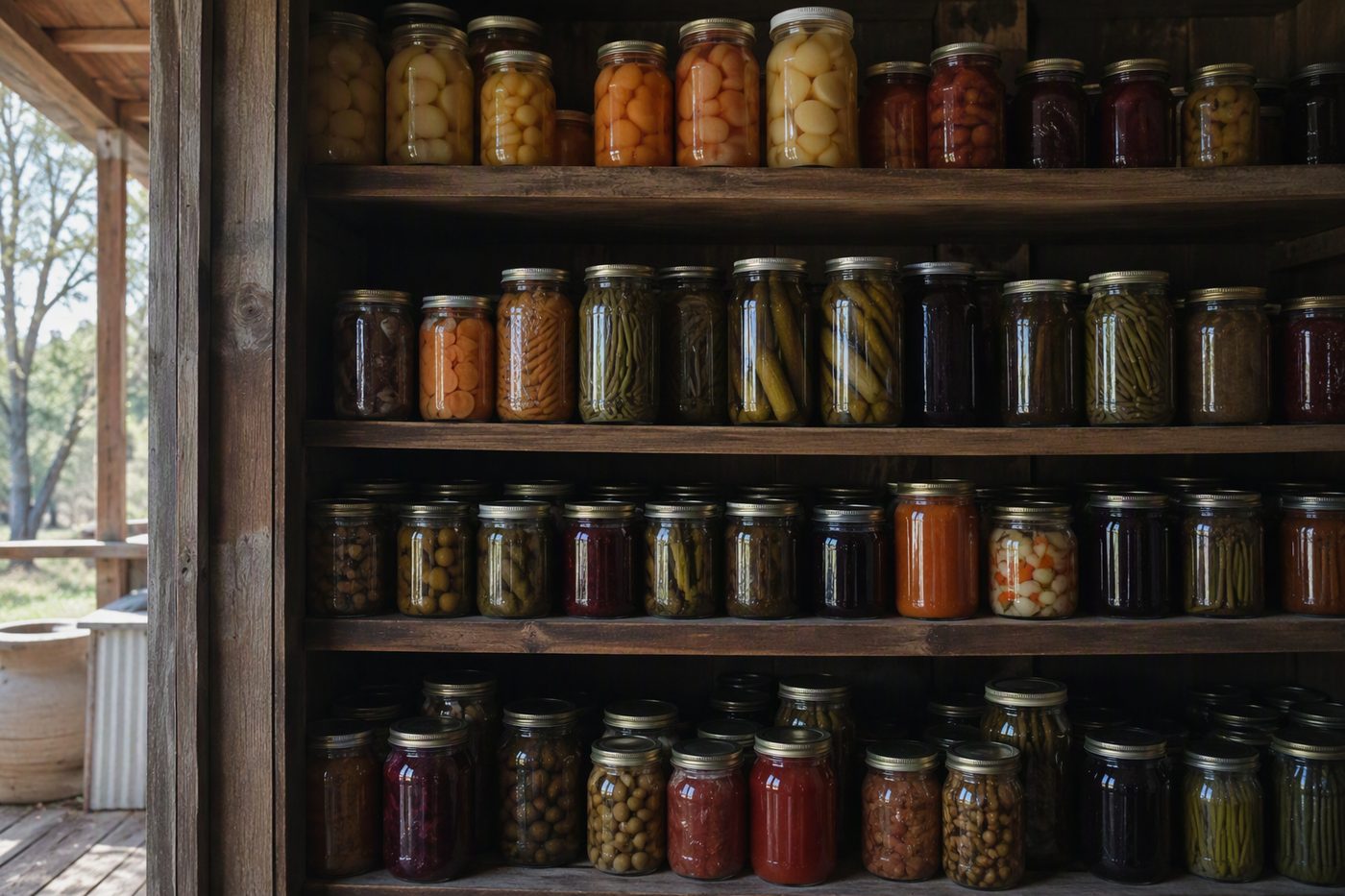
Fermentation preserves through lactic acid produced by beneficial bacteria — no heat required, no power required. Sauerkraut, kimchi, lacto-fermented pickles, and salt-brined vegetables all fall into this category. Once fermented and sealed, the produce is shelf-stable in a cool store; once opened, refrigeration helps but isn't strictly necessary if the jar is consumed within a reasonable window.
Australian resources for fermenting and broader preservation include the work of practitioners such as Megan Radaich, who began community courses in Western Australia in early 2012 after a year of daily preserving in mid-2013, and who has been preserving since 2002 (foodpreserving.org).
Why fermenting matters off-grid: It uses no electricity, no fuel, and turns cheap or excess vegetables into a long-keeping staple. It's the lowest-cost method on this list after drying.
Failures to avoid:
- Insufficient salt — the lactobacilli need it to outcompete spoilage organisms.
- Unsealed or loosely sealed vessels — oxidation and surface mould.
- Not burping gas-producing ferments (kimchi, sourdough-adjacent ferments) or using an airlock.
Method 4 — Root Cellaring and Cool Storage
A root cellar keeps spuds, carrots, and onions through the cooler months when soil temperature is held at 10 °C or below (OffGrid Masterplan). In practice, anything that mimics a root cellar works: a buried half-drum, an insulated garage corner, a well-ventilated shed with sand pits, or a purpose-built underground space.
The keys are:
- Temperature stability — below 10 °C is the goal for most roots; cooler still for apples and pears.
- High humidity for roots (~85–95%) — prevents shrivelling. Different from fruit storage.
- Ventilation — moving air removes ethylene and excess moisture.
- Darkness — light triggers sprouting and greening in potatoes (solanine risk).
- Separation — apples and pears give off ethylene that spoils stored vegetables.
Cool, ventilated, shaded storage slows dormancy break in root vegetables and is the single most cost-effective preservation method per kilogram stored. The capital cost is the structure; the running cost is zero.
Method 5 — Vacuum Sealing and Frozen Storage
Vacuum sealing alone removes the air that drives oxidation and freezer burn, extending shelf life significantly (OffGrid Masterplan). Used with a chest freezer it becomes the most versatile short-to-medium-term storage method available — but it is the only method on this list that depends entirely on a running compressor.
If you plan to rely on a freezer off-grid:
- Size your solar/battery system to cover the freezer's daily draw plus overnight and cloudy-day margin.
- Have a backup plan for extended outages: thermal mass (full freezer holds cold longer), dry ice where accessible, or a transfer to a neighbour's grid-powered freezer.
- Vacuum-seal everything in advance. The seal is what gives frozen food a 12-month+ life instead of the 3-month life of poorly wrapped produce.
If your freezer is the only preservation you're relying on and the grid is intermittent, the failure mode is the same as having three days of food on hand.
Specs and Requirements at a Glance
| Method | Approx. Start Cost | Power Required | Skill Level | Best For |
|---|---|---|---|---|
| Boiling-water canning | From $150 | Mains or gas stove | Beginner | Fruits, jams, pickles, tomatoes |
| Pressure canning | $200+ | Mains or gas stove | Intermediate | Vegetables, legumes, meat, soup |
| Dehydrating (electric) | $150–$400 | 230V/50Hz (inverter-friendly) | Beginner | Herbs, fruit, jerky |
| Solar dehydrating | $50–$300 (DIY higher) | None | Beginner to intermediate | Herbs, thin-sliced fruit (dry climates) |
| Fermenting | <$50 | None | Beginner | Cabbage, root veg, hot sauces |
| Root cellaring | $100–$1,000+ | None | Intermediate (if building) | Potatoes, onions, carrots, apples |
| Vacuum sealing + freezing | $200+ | 230V/50Hz (continuous) | Beginner | Meat, prepared meals, fruit |
Numbers above are starting points only; specific prices vary by retailer and are not verified in the source material.
Safety — When to Call a Licensed Professional
Preservation work itself rarely needs a trady, but the supporting infrastructure does.
- AC mains electrical (230V/50Hz) — any new wiring, dedicated outlets for freezers or dehydrators on existing circuits, or work on your switchboard requires a licensed electrician in Australia.
- Gas — any work on LPG or natural gas lines, regulators, or appliances requires a licensed gas fitter.
- Structural — building a permanent root cellar, buried bunker, or modifying a building's structure typically requires council approval and may require an engineer.
- Solar / battery systems — higher-voltage solar arrays (above the threshold defined in your state) require licensed installers and CEC accreditation in Australia.
Cutting corners on any of the above risks voiding insurance, failing a council inspection, or creating an electrical or gas hazard (OffGrid Masterplan safety notes).
Food-safety non-negotiables:
- Low-acid foods must be pressure-canned; cutting corners on acidity or pressure can allow Clostridium botulinum to survive (OffGrid Masterplan safety notes).
- Use a reliable, tested canning guide for low-acid foods such as corn, beans, and meats — don't extrapolate from fruit recipes (Insteading safety notes).
- Check local council and state regulations before any structural, gas, electrical, or solar work.
FAQ
What is the easiest method for a complete beginner?
Start with boiling-water canning of acidic fruits (the same starting point recommended in the Insteading article) or with simple lacto-fermentation of cabbage. Both are forgiving, use minimal equipment, and don't involve lethal failure modes.
Do I need a pressure canner if I only preserve fruit?
No. Acidic fruits can be safely processed in a boiling-water canner at 100 °C because the acidity inhibits C. botulinum. The moment you want to can vegetables, legumes, soups, or meat, you need a pressure canner.
Can I run a dehydrator off solar?
Yes — a 6–9 tray domestic dehydrator typically draws 250–500W while running. A modest inverter and battery bank will cover it. The catch is runtime: a dehydrator runs for 6–12 hours per batch, which is a real load on a small off-grid system.
How long does vacuum-sealed frozen food actually last?
Compared to a few months for poorly wrapped frozen food, vacuum-sealed frozen food typically lasts a year or more depending on the product. The vacuum seal is the part that extends the life — the freezer just keeps it cold.
Is fermenting safe in the Queensland heat?
Ferments tolerate a wide temperature range, but the wild swings and high ambient heat of a tropical climate accelerate it unpredictably. A cool, shaded spot is essential, and tasting frequently during the early days is the safety check. If something smells off, don't eat it.
Do I really need a root cellar in Australia?
For most of Australia, a properly designed cool store or even a buried, insulated drum achieves the same result. The principle — stable cool temperature, high humidity for roots, ventilation, and darkness — matters more than the structure.
Sources
- http://www.foodpreserving.org/
- https://www.offgridmasterplan.com/article-archive/preserving
- https://insteading.com/blog/off-grid-food-preservation/