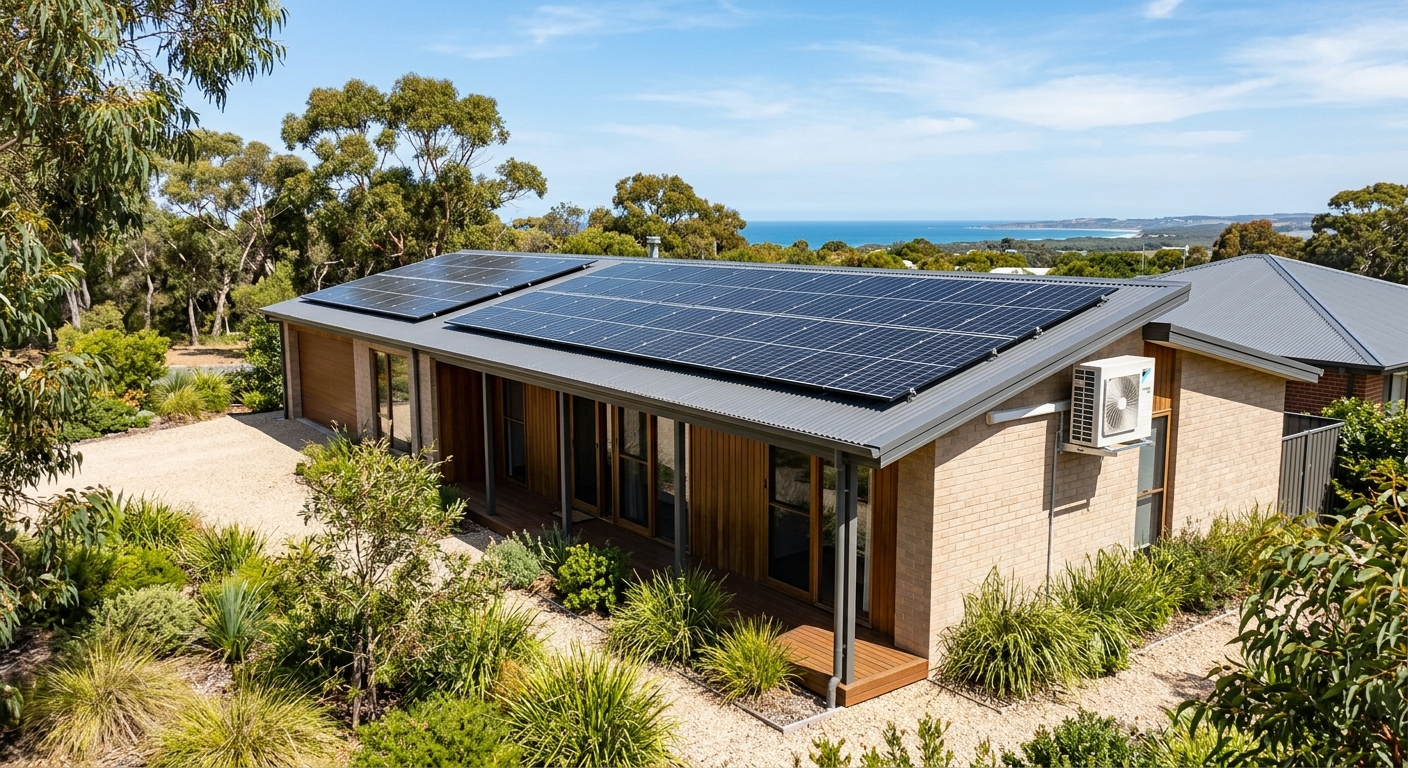
Running air conditioning off solar in an Australian off-grid setup is not a fantasy, but the numbers, the gear, and the climate all have to line up. This article lays out what's actually involved: how a "solar air conditioner" is defined, what the loads look like, how to size the system, and where the common pitfalls sit. Every figure here traces to verified sources.
What "Solar Air Conditioner" Actually Means
The term gets thrown around loosely, but in practice it covers three distinct configurations:
1. Grid-tied AC with solar offset — standard split-system or portable AC running on mains power, with rooftop PV reducing the bill. This is not off-grid.
2. Hybrid solar AC — a unit designed to use solar PV directly when available and switch to grid power otherwise. Useful for reducing daytime grid draw but still grid-dependent.
3. True off-grid AC — panels, batteries, and an inverter (or a DC-direct unit) supplying the compressor without any grid connection.
Most off-grid Solar ACDC customers, according to the manufacturer's own documentation, run a hybrid pattern: AC on solar through the day, switching to their existing power system at night to avoid flattening the batteries.
AC Loads: What the Compressor Actually Draws
Real-world draw figures for typical residential units:
- Small AC units: 500–1,000 W
- Mini-splits: around 900 W
- Larger whole-of-home units: 3,000 W and up
A quick working example from the verified data: a 900 W mini-split running 6 hours per day consumes about 5.4 kWh/day. That's a single appliance pulling more than half the daily production of a modest off-grid solar array in shoulder seasons.
The single most expensive common sizing mistake in off-grid design is leaving an appliance — usually AC, electric cooking, or a water pump — out of the load calculation. If the AC isn't on the spreadsheet, the system will be undersized and the batteries will chronically underperform.
System Sizing for Off-Grid Cooling
Solar Array Sizing
Using the same 900 W mini-split example, the calculation works out as:
> 5.4 kWh ÷ (5 peak sun hours × 0.75 system efficiency) ≈ 1.4 kW of solar
The 0.75 efficiency factor accounts for real-world losses: panel angle, shading, inverter losses, and seasonal variation. Don't budget for STC-rated panel output — budget for what arrives at the compressor terminals on a 38 °C Central Queensland afternoon in February.
For typical Australian family off-grid homes running one or two ACs a few hours per day, LiFePO4 OZ's sizing guide recommends 5–9 kW of solar paired with a 5–8 kW inverter. Tiny homes, caravans, or cabins typically need 5–14 kWh of battery; acreage with multiple buildings usually needs 30 kWh or more.
Battery Sizing
Battery storage requirements depend on how many nights of cooling you want without sun:
- 1 night of cooling: roughly 3–5 kWh
- 2 nights: roughly 6–10 kWh
For typical Australian family off-grid homes running AC, LiFePO4 OZ recommends 14–24 kWh of battery storage.
The standard practice is to include a 20% buffer in off-grid system sizing. Grid-connected systems don't need the battery to carry 100% of the load; off-grid systems do. When choosing between two sizes, the conventional wisdom (echoed by LiFePO4 OZ) is to go up one tier — retrofitting later costs three to four times more than oversizing initially.
Managing Depth of Discharge (DoD)
LiFePO4 chemistry tolerates deeper discharges than lead-acid, but battery lifespan still benefits from avoiding regular deep cycles. Keep daily discharge comfortably under the manufacturer's recommended DoD, and the bank will last years longer.
DC-Direct Solar AC: Cutting Out the Inverter
The interesting wrinkle in the Australian market is units that accept raw DC from PV panels directly. Solar ACDC manufactures solar air conditioners (and solar heat pump hot water and pool heaters) for on-grid, off-grid, residential, and commercial customers. Their off-grid DC48V range targets remote telecom stations, container houses, motor homes, remote locations, boating, and island locations.
The key claim: these units are fully DC and can accept direct variable DC power from PV panels even without grid power, eliminating the need for batteries, inverters, and charge controllers. They have an auto-start function that turns the unit on when morning power is sufficient and off in the afternoon when sunlight drops.
If the spec holds, that's a significant simplification: no inverter losses on the AC compressor circuit, no round-trip battery losses, and no charge controller. The catch is runtime — a DC-direct unit only runs when the sun is up, so it's effectively a daytime cooling solution.
Climate: Why Central Queensland Is a Stress Test
Mediterranean climates such as Portugal and Spain have strong sun, cool nights, and high solar potential for cooling — daytime solar production peaks align with cooling demand, and overnight temperatures drop enough to let the building purge heat naturally.
Hot and humid Australian conditions invert that logic. The compressor runs longer, overnight temperatures stay elevated, and there's no natural cooling window. The same AC unit that handles a 24 m² mobile home comfortably in a dry climate will struggle in a humid Queensland build-up. Plan for larger panels, larger batteries, and shorter expected daily runtime per kWh of storage.
The original Quinta system cited in the source material produces around 4,600 W at peak in summer and runs AC in a 24 m² mobile home — useful as a reference point, but not directly transferable to a larger or less insulated Australian dwelling.
Insulation First: The Cheapest kWh
No amount of solar fixes a building that leaks cool air. Insulation is critical for reducing cooling load — it's the most cost-effective upgrade available before sizing any electrical gear. Seal gaps around doors and windows, shade west-facing glass, and consider roof insulation rated for Australian conditions (R-3.0 or higher for the roof in most climate zones).
Pairing AC with ceiling fans reduces AC runtime significantly. Fans cost almost nothing to run and let you set the thermostat 2–3 °C higher without comfort loss.
DC-Direct vs. Conventional Off-Grid: Trade-offs
| Feature | DC-Direct Solar AC | Conventional Off-Grid (Panels + Batteries + Inverter) |
|---|
| Runtime | Daylight only (with auto-start) | 24/7, subject to battery capacity |
| Batteries required | No | Yes |
| Inverter required | No | Yes |
| Night cooling | No (unless hybrid switch) | Yes, sized to battery bank |
| Efficiency losses | Minimal (no inverter stage) | Inverter + battery round-trip losses |
| Best for | Telecom, remote cabins, daytime-use dwellings | Residential off-grid homes |
When to Call a Licensed Professional
Solar AC systems involve high DC voltages, mains AC, and (when batteries are present) stored energy capable of causing serious shock or fire. Installation should be performed by a licensed electrician and follow local electrical codes.
Specifically, bring in a licensed sparkie for:
- Any mains-AC wiring, including inverter AC output circuits and switchboard work.
- Battery bank installation — lithium banks require correct cable sizing, fusing, and BMS configuration.
- DC string design above 48V — touch-safe isn't the same as actually safe.
- Hybrid switchover gear — interlocked switching between solar-only, battery, and backup sources is not a DIY job.
- Compliance and sign-off — required for insurance and for any grid reconnection later.
Batteries should not be deeply discharged beyond manufacturer specifications. Mismatched cells, undersized cabling, and missing fusing are the usual failure modes in DIY battery banks.
Frequently Asked Questions
Can a standard split-system AC run off solar in Australia?
Yes, but only via an inverter drawing from a battery bank, or directly from the grid during daytime with PV offset. A standard AC is not DC-compatible and won't accept raw panel output.
How many solar panels do I need to run an air conditioner off-grid?
For a 900 W mini-split running 6 hours/day, around 1.4 kW of panels under good conditions. For whole-of-home cooling, the typical Australian off-grid range is 5–9 kW of solar.
Do I need batteries for a solar air conditioner?
Only if you want night-time cooling. DC-direct units can run panels-only during daylight; conventional off-grid systems need batteries sized to your overnight cooling demand — 14–24 kWh is typical for a family home running one or two ACs.
What size battery do I need for off-grid air conditioning in Australia?
1 night of cooling needs roughly 3–5 kWh; 2 nights needs 6–10 kWh. For typical Australian family off-grid homes with AC, LiFePO4 OZ recommends 14–24 kWh.
Is a DC solar air conditioner worth it?
If cooling is needed during daylight only — remote work sheds, telecom huts, daytime-occupied cabins — DC-direct units eliminate inverter and battery losses and simplify the system. For residential off-grid homes needing overnight cooling, a conventional battery-backed setup is the standard approach.
What's the most common off-grid sizing mistake?
Leaving AC, electric cooking, or a water pump out of the load calculation. Undersizing is the single most expensive common error, and retrofitting later costs three to four times more than oversizing from the start.
Sources
- https://www.toughkraut.com/post/solar-air-conditioner-off-grid
- https://solaracdc.com.au/
- https://lifepo4oz.com/pages/off-grid-system-sizing-guide