Off-Grid Terracing: Your Practical Guide for Australian Slopes
Stop losing soil and water on your steep block. We cut through the fluff and give you straight-Australian advice on building terraces that work.
By Jenny Mills· rural nurse & homesteader · health, safety, law and the paperwork of going bush
“My first terracing effort collapsed after three days of rain, wasting two hundred dollars in timber and proving that Australian slopes demand drainage before digging.”
Terracing isn't just for rice paddies in Asia. On a sloping Australian property, a well-built terrace system controls runoff, holds topsoil where you need it, and gives you usable ground on grades that would otherwise wash out after the first decent storm. This article covers the types, the specs that matter, the safety limits, and the questions I'm asked most often here in Central Queensland.
What Terracing Actually Does
Terracing rearranges sloping land into a series of ridged platforms. Construction involves cutting and filling: topsoil is excavated and moved to form level farmed areas separated by ridges. The primary purpose is straightforward — decrease the velocity of water flowing down the slope and prevent soil erosion. On steeper ground, the platforms become step-like; on gentler or wavy land, terraces can be almost level without major earthworks.
Two functions follow from that one purpose, and both matter off-grid:
Erosion control. By slowing runoff, terraces reduce the energy that strips topsoil. Sediment that would otherwise end up in your dam or creek stays on the hillside.
Water distribution. Water that doesn't soak in on the upper terrace spills to the next one down. Spread across multiple levels, a single heavy storm becomes a slow soak rather than a sheet-flow event.
Terracing Types: Which One Fits Your Slope
The facts sheet groups terrace types two ways — by shape and by system. Both matter when you're planning.
By Shape
Type
Best Suited To
Notes
Broad-base
Gentle slopes, up to 8% grade
Embraces the full slope width; suitable where machinery needs to cross. Equipment moves between terraces via designated passages — crossing the ridges is not permitted.
Grassed back-slope (perennial)
Moderate slopes
Back slope is sown to permanent grass and not cultivated; the main farmed area is levelled using soil moved from downhill.
Narrow-base (perennial)
Steeper slopes
Permanent vegetation covers both front and back slopes; the steepest of the three types and requires less earth movement than broad-base. Alignment depends on slope steepness and soil type, and it is not suitable on land prone to sliding.
By System
Three systems are commonly referenced:
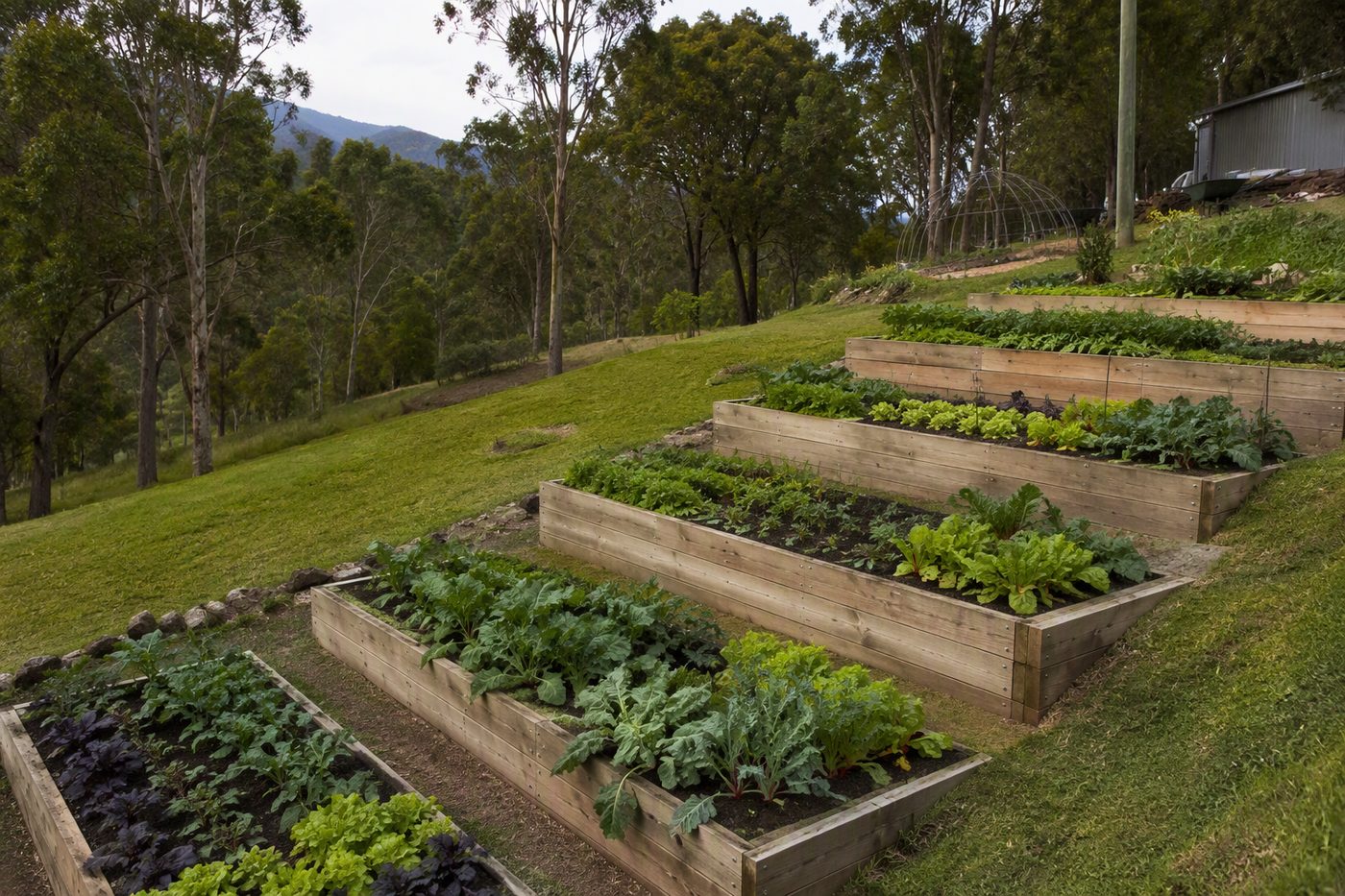
Bench. Step-like platforms across the slope. Flat or near-flat, regularly arranged. Labour-heavy to build and disturbs soil intensively. Bench slopes can be earth, perennial-vegetated, or stone-faced. Most common where water retention is the goal (rice is the classic example). Not suitable for waterlogging-sensitive crops, land prone to sliding, or areas with frequent heavy rainfall.
Contour. Follows the relief contour, made up of point rows and grassed waterways.
Parallel. A variant used where machinery width dictates straight, parallel runs rather than true contour curves.
For most Australian off-grid properties on moderately sloping country, broad-base on gentler grades and narrow-base on steeper ones are the realistic starting points. Grassed back-slope sits in between and is often the easiest to maintain because the structural face is permanently vegetated.
Site Assessment Before You Cut
Terracing failures are almost always planning failures. Before any machine work:
Map the slope. Walk it after rain. Note where water concentrates, where erosion is already active, and where the soil is visibly unstable. Slopes that show old slip scars or seeping subsoil are not candidates for narrow-base without engineering input.
Identify soil type. Clay holds shape; sandy loam doesn't. Narrow-base alignment depends on both slope steepness and soil type, and is unsuitable on land prone to sliding.
Check the rainfall pattern. In Central Queensland and similar climates with intense storm bursts, channel capacity matters. As a sizing rule of thumb drawn from the verified facts, properly engineered terraces are usually designed to handle a 10-year storm without being overtopped. If you can't size to that benchmark, hire someone who can.
Plan access. Broad-base layouts need designated passages between terraces. Decide where machinery enters and exits before you build, not after.
Locate existing vegetation. Native grass cover on back-slopes is your best long-term armour. Keep what you've got where you can.
Construction Sequence
A standard broad-base or grassed back-slope build goes roughly like this:
1. Survey and stake. Mark the contour line for each terrace. On a curved slope, the spacing narrows as the grade steepens.
2. Cut the channel. Excavate along the contour to form a shallow channel that will intercept and slow runoff.
3. Build the ridge. Use the excavated material to form a ridge down-slope of it. Height of the terrace ridge should be checked periodically, especially on older or rebuilt systems — low spots should be rehabilitated by adding soil and re-establishing grass cover.
4. Move topsoil. Strip and stockpile topsoil from the cut area, then respread it across the levelled farmed platform. Subsoil doesn't grow much; topsoil does.
5. Stabilise. Sow the back-slope and ridge to perennial grass immediately. Bare earth on a slope is an erosion event waiting to happen.
6. Install drainage. Stand drainage pipes or grassed waterways at the ends to carry collected water safely off the system without creating new scour points.
Maintenance: What to Watch Year to Year
Terraces are not build-once-and-forget. Two failure modes show up repeatedly:
Sediment build-up in the channel. Excessive up-slope erosion deposits sediment in the terrace channel, which dramatically lowers water storage capacity. Light deposits can be scraped out by hand; heavy build-up usually needs a contractor with a small excavator.
Buried stand pipes. Sediment can bury a stand drainage pipe. If the terrace was originally designed with allowance for some sediment build-up, the standing drainage pipe can simply be extended upward to restore freeboard. If it wasn't, the pipe may need to be re-set or the channel re-engineered.
Beyond those two:
Inspect after every major storm. Walk the full system, look for low sections in ridges, scour holes at outlets, and any sign of pipe blockage.
Keep grass cover dense on back-slopes and ridges. Bare patches get colonised by weeds first and gullies second.
Don't cultivate across a ridge. If your terrace type requires machinery to cross, it must be via a designated passage — broad-base layouts in particular prohibit crossing the ridges.
Common Mistakes
Starting too big. Begin with one or two terraces on the most problematic slope. Learn how your soil handles storms before you cut the whole hill.
Skipping the grass. A terrace without perennial cover on its structural faces is a temporary earthwork, not a structure.
Ignoring outlets. Every terrace needs a safe place for water to leave. Without planned outlets, water makes its own — usually through the weakest point of your ridge.
Under-sizing channels. If you can't commit to building to a 10-year storm standard, accept that you'll be rebuilding more often.
Crossing ridges with machinery. On broad-base layouts this is explicitly not allowed; the ridge is doing structural work.
When to Call a Licensed Professional
Some terracing work is straightforward earthmoving. Some isn't. Bring in a licensed or suitably qualified professional when:
The slope shows signs of past or current instability (slip scars, spring lines, cracking at the crest).
You're terracing near a dwelling, a dam wall, a septic system, or a property boundary where a failure could cause damage or a dispute.
You're building on land prone to sliding — narrow-base terracing is explicitly unsuitable here without engineering input.
The channel or ridge needs to handle flows beyond what you can confidently size yourself. As a benchmark, properly constructed terraces are usually engineered to handle a 10-year storm without being overtopping; if your design can't meet that, it's worth paying for a design that can.
Local council or state regulations require permits or engineering certification. In Queensland, earthworks of significant volume, or works near waterways, can trigger approval requirements — check with your local council before starting.
Safety Notes
Slope stability trumps everything. A failed terrace on a steep slope can take buildings, fences, and access tracks with it.
Machinery on slopes is dangerous. Operators need experience on grades; a dozer or excavator on a wet slope is a serious hazard.
Stormwater concentrates. Outlet points discharge at velocities capable of eroding unprotected ground downstream. Armour them with rock, grass, or both.
Underground services. Dial Before You Dig (1100 in Australia) before any excavation. Terraces cut across paddocks where services may be unmapped or forgotten.
FAQ
What slope is too steep for DIY terracing?
There's no single line, but broad-base layouts are documented as suitable on slopes up to 8%. Beyond that, narrow-base or bench systems apply, and alignment becomes more dependent on slope steepness and soil type. If in doubt, get an assessment.
Can I terrace a slope that already shows signs of slipping?
The facts sheet flags narrow-base as not suitable on land prone to sliding. Bench terracing is also unsuitable on lands prone to sliding. If your slope is actively moving, terracing is the wrong intervention until the underlying instability is addressed by a geotechnical engineer.
Do I need to terrace the whole slope at once?
No — and you shouldn't. Start with the most erosion-prone section and expand once you understand how your soil and rainfall pattern interact with the built system.
How long does a terrace last?
With periodic inspection, sediment removal, and grass cover maintenance, decades. Older terraces may have been affected by past tillage operations, so the height of the terrace ridge should be checked and low spots rehabilitated by adding soil and re-establishing grass cover.
What's the cheapest type to build?
Narrow-base requires less earth movement than broad-base, which makes it cheaper in machine time on suitable sites — but it's the steepest terracing type and not universally applicable. The cheapest option is the one that suits your slope and soil without needing to be rebuilt.
Do terraces work in heavy storm climates like coastal Queensland?
Yes, but bench terraces are not suitable in areas with frequent rainfall because of waterlogging risk. Contour and broad-base systems cope better with high-rainfall environments, but channel sizing becomes critical.
In this video Curtis Stone demonstrates how to lay out contoured vegetable beds and keyline furrows on a steep slope, giving you a visual guide for applying the terrace design principles in the guide. He also covers plant selection and spacing for erosion control, which is exactly what you need to know when converting a sloping block into productive ground.— Jenny Mills