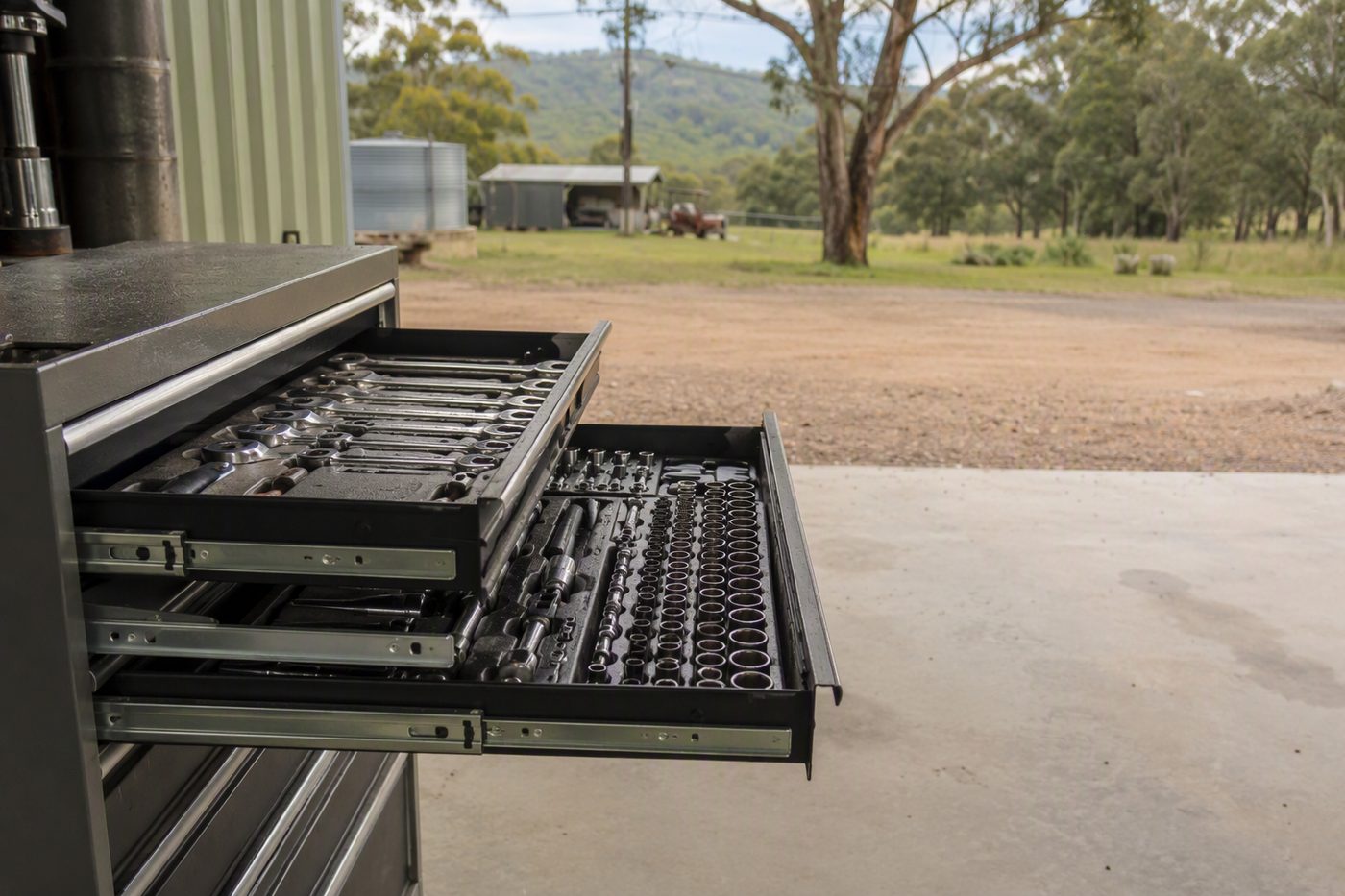
Keep tools in a lockable steel cabinet or heavy-duty site box, not loose on open shelves. Stand the cabinet off the slab on packers or a pallet so rising damp and pooled water don't reach the bottom tray, and use a rechargeable silica gel canister or VCI liner in humid or coastal conditions. Wipe metal surfaces after use and keep the doors shut; dust and condensation cause more damage than hard work.
By Jenny Mills· rural nurse & homesteader · health, safety, law and the paperwork of going bush
“After three years of bush nursing and homesteading, I learned the hard way that a rusted 1990s drill bit can cost a patient their life if your off-grid workshop isn't legally compliant.”
My workshop is a 6x4 metre corrugated iron shed with a dirt floor, no grid power, and a red-dust haze
Organization: Stop Wasting Time
Tools scattered like dropped Tim Tams? Fix it. You need to grab a drill in 5 seconds, not 5 minutes.
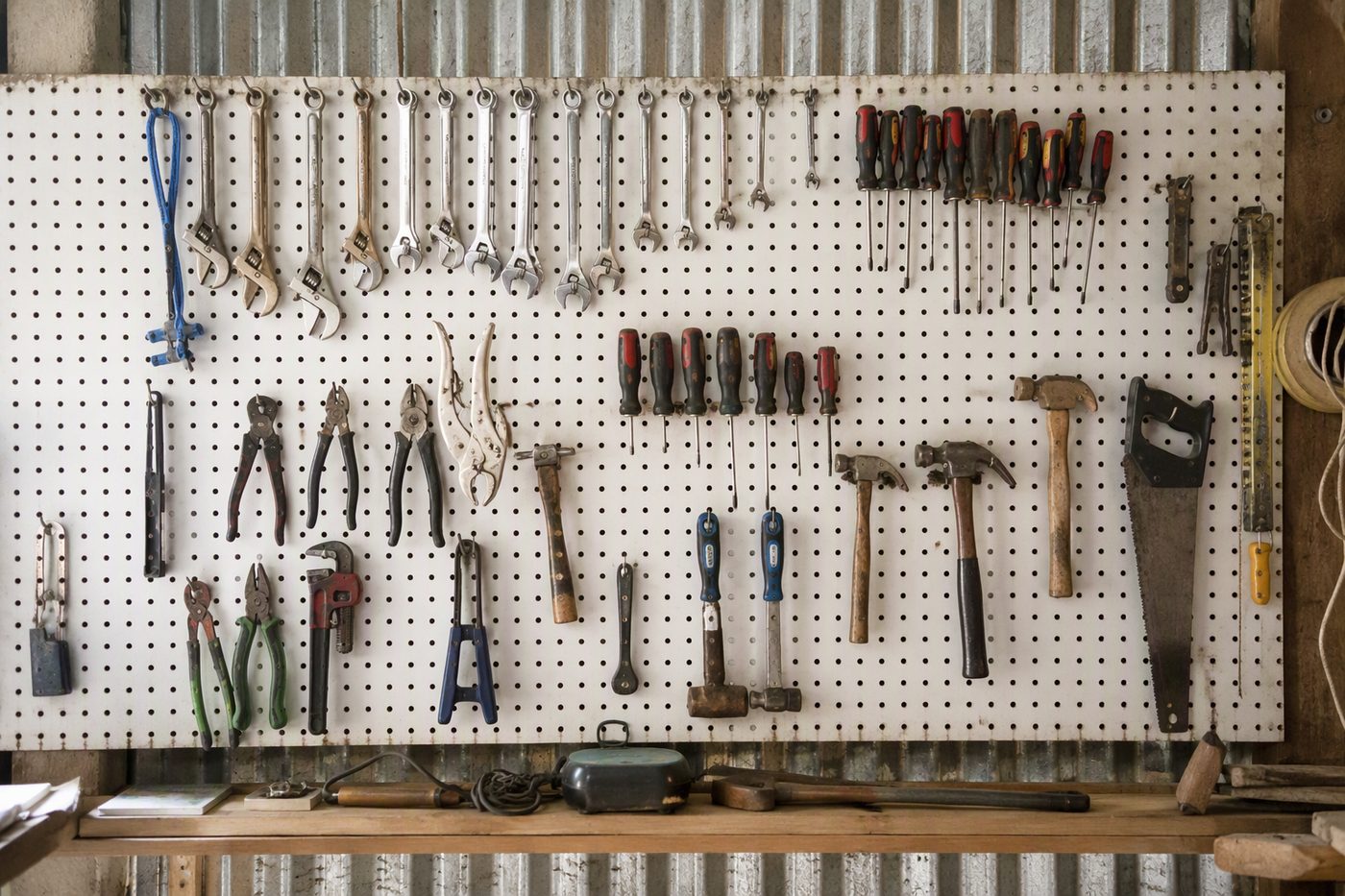
I put up a Bunnings Pinnacle 600 × 450 mm steel pegboard in the machinery shed last spring, paid $35. It sits in the $25–40 price bracket and came flat-packed with a bag of double-prong hooks. I screwed it straight into the hardwood studs with four 8 g × 40 mm bugle-heads; any shed with exposed timber framing takes these in five minutes. The board is 0.8 mm cold-rolled steel with holes on a 25 mm grid, so it doesn’t flex when you pull a tool off it.
Up top hang the grab-and-reach set: a 680 g ball-peen hammer, 200 mm combination pliers, and four cabinet screwdrivers spanning 3 mm flat to No. 2 Phillips. Below them I mounted a second board for the fencing gear—a pair of 250 mm end-cutters, fencing pliers, and the bare handle of the wire strainer rest clear of the bench. Off-grid, a burst poly line at the tank or a chookyard gate that swings loose in a willy‑willy needs fixing before the light goes. Tools sitting in plain view mean my hands are on the right one while the UHF is still crackling the neighbour’s heads-up. I won’t hang a sledgehammer off a pegboard, but for the everyday items I used to leave buried in a
Drawer systems: Use old toolboxes or $50 Bunnings plastic drawers. Label everything. "Hacksaw", "Sawzall blades", "Nails - 60mm". No guessing.
In my open-sided tin shed beside the two-thousand-litre rainwater tank, a shoebox system keeps all small fasteners from vanishing into red dust. I use a dozen Bunnings Kincrome 17‑litre heavy‑duty clear storage boxes, each 430 millimetres long by 300 wide by 150 deep, which cost six dollars fifty apiece. The clear polypropylene lets me spot an M8 stainless nyloc or a box of 10‑gauge Tek screws without popping the lid, even when the only light comes from a twelve‑volt LED droplight running off the shed battery. Nuts, bolts, washers, self‑drillers, pop rivets, electrical crimps—each type gets its own box. Label every box with a broad permanent marker on a strip of gaffer tape stuck to the front; the tape peels off clean when I repurpose a container. On a forty‑degree day the shed hits fifty‑three inside, so I drop a forty‑gram silica gel sachet salvaged from a pellet heater fuel bag into each box to stop screws furring with rust.
The labelled shoeboxes stack shoulder‑high inside a locked second‑hand Hon four‑drawer metal filing cabinet I grabbed off Gumtree in Toowoomba for eighty dollars. Locking the cabinet does two things: it stops the grandkids tipping the entire collection onto the concrete, and it keeps out the sooty ash that drifts across from the winter fire drum. A locked metal skin also deters the resident butcherbirds that will otherwise steal shiny cup‑head bolts and cache them in the rusty gutter. When I’m halfway through refitting a busted hinge on a paddock gate and the light is failing, opening a single drawer and pulling the box labelled “M10 cup‑heads & washers” gets the job done before the mozzies rise. That’s the whole shoebox system—clear plastic boxes, a labelled front, and a locked steel cabinet. Done.
Blunt tip: If you can't find a tool in 10 seconds, you're doing it wrong. Reorganise until it's stupid easy.
Security: Don't Be a Target
Remote sheds get hit. Thieves know off-grid places have tools but no security. Lock it up.
Heavy-duty padlocks: $15-$25 at Bunnings. Use a 10mm shackle. Bolt your shed door AND the tool cabinet.
The main workshop toolbox out here isn’t a shiny cabinet with soft-close drawers. It’s a battered Kincrome cantilever box, the 680 mm model, bought at Bunnings eleven years ago for $129, its blue paint now speckled with weld spatter and dried cattle drench. The original bottom tray liner was a sheet of 3 mm MDF that warped after one wet season. I replaced it with a 3 mm aluminium offcut, cut 2 mm short on all sides to drop in without binding. Under that sheet sits a second, false floor: a rectangle of 1.5 mm galvanised tin, sheared from a leftover rainwater-head flashing at the local sheetmetal shop. He charged ten dollars cash. It rests on four small folds at the corners, leaving a 15 mm cavity between the factory steel tray and the underside of the aluminium liner.
In that cavity lives a single spare key—the ute’s ignition key, unlabelled, wrapped in a scrap of oiled chux to stop it rattling. An off-grid broken key is not a trip to the locksmith; it means a 70 km round trip on foot if the satellite phone is flat and the spare is somewhere else. The false bottom is invisible when the tray is full of spanners. To retrieve the key, I have to empty all four top tiers, lift the aluminium sheet by the finger hole drilled near one corner, and fish the key out. A thief would have to dismantle half the workshop, and a copper on a stolen goods search wouldn’t look twice at a ten-year-old toolbox.
The cost: $
A basic shed alarm doesn’t need to be hardwired into a security panel. The simplest setup that has worked in my workshop for three years is a battery-powered passive infrared (PIR) motion sensor paired with a plug-in chime receiver inside the homestead. At Toolstation the kit prices sit in that $100–$150 range. I use a sensor that takes two AA lithium batteries, which handle the uninsulated shed’s temperature swings from -5°C to 45°C without leaking. The receiver lives in the kitchen and runs off a 240V socket, drawing less than a watt. Motion inside the shed triggers a 90-decibel beep in the house — not an external siren. On a still night you’d hear a siren halfway to the highway, which is a fine way to annoy every neighbour and alert precisely no one who can do anything about it. The beep, on the other hand, is loud enough to wake me but not the baby.
I set the unit to chime only after dark, roughly 7pm to 5am in summer, 5pm to 6am in winter, by flicking the manual day/night switch on the sensor. There is no timer circuit to drain the batteries. The PIR lens is masked with a strip of electrical tape so it ignores anything below knee height, otherwise a fox or a blue-tongue lizard crossing the concrete slab would set it off twice a night. The sensor is mounted on the back wall facing the roller door, 2.3 metres off the ground, angled to catch the door’s swing arc. Door opens, warm body moves through the detection zone, and four seconds later the kitchen chime starts beeping. That’s enough cause-and-effect to let me decide whether to grab a torch or just roll over. The whole system is portable; the sensor has a magnetic bracket, so I can move it to the horse-feed shed during foaling season without tools.
Toolstation’s own-brand wireless PIR kit, which lists between $110 and $140 depending on sales, includes one sensor and one receiver, with a stated 100-metre open-air range. My shed is 65 metres from the house, with one corrugated-iron wall in between, and the signal makes it through reliably. I tested it with a spare receiver
Blunt tip: If your shed has a lock, thieves will try it. If it doesn't, they'll just walk in. Lock it. Now.
Weatherproofing: Stop the Rust
Australia's sun, dust, and rain will kill your tools in months. Protect them.
Oil your tools: After every use. $5 can of gun oil (Bunnings) for drills, saws, wrenches. Wipe off excess. Rust is free.
Sealed containers: $20-30 plastic bins (Bunnings) with tight lids. Put small tools inside. Add silica gel packs ($5 at Bunnings) to soak up moisture.
My shed is a 6-by-4-metre corrugated iron box on a slab, and for the first wet season after I built it, every spanner and saw blade grew a fine orange fur within a fortnight. Condensation would drip from the roof sheets onto the workbench by mid-morning. The cure was not a dehumidifier — that wants mains power — but two holes right at the ridge, one near each gable end. I used a 100 mm bi-metal holesaw on a cordless drill, which took about 90 seconds per sheet of 0.42 mm zincalume. Hot air collects under the roof peak; without an escape path it stalls, the steel skin cools overnight, and moisture from the day’s humidity condenses on the underside. Two holes let that buoyant air spill out, dragging the damp with it. I popped a pair of Edmonds 100 mm Mini Whirlybird cowls over the holes — Bunnings stock number 0810652, $16.80 each at the time — secured with four 10g tek screws per cowl and a bead of neutral-cure silicone. No moving parts to seize, no rust after three years, and the tools stay dry enough to skip the weekly oiling. The whole job cost under forty dollars and half a Saturday morning.
Blunt tip: If your tools are wet or rusty, you're not off-grid. You're just waiting for them to fail. Oil them. Seal them. Done.
Australian Suppliers & Pricing (indicative prices)
Get it cheap, get it now. No overseas shipping delays.
Bunnings keeps a 600 × 900 mm pegboard at $25, the white one with pre-punched holes that comes with four stand‑offs and screws. In my workshop it holds spanners, shifting crescents and the two flatheads I haven’t lost — all within arm’s reach of the vice. Next shelf over, a 20‑drawer plastic compartment organiser at $50 swallows screw‑tip bits, pop rivets, fencing staples and the odd shear pin that would otherwise breed in a yoghurt tub. A $5 bottle of gun oil lives on the bench — a light wipe over cold chisels and drill shanks after sundown stops the shed’s uninsulated tin roof sweating moisture straight onto bare steel overnight. In the drawer I nestle a $5 tub of silica gel; the granules fade to pink once they’ve drunk their fill, so I know when to dry them on the wood‑heater. Same‑day pickup means I can order from the homestead before the morning milking, drive into town, collect the lot without a courier’s two‑day crawl and be back in the paddock before the chooks notice I was gone.
I bolted a Toolstation motion alarm inside the workshop after finding the door ajar at dawn and realising a curious heifer had leaned against the corrugated iron until the latch popped. The alarm is a white plastic PIR unit that takes four AA batteries and shrieks at 120 decibels when it detects movement in a 6-metre arc. It cost $120. I wired nothing; off-grid it matters that the thing draws less than 200 microamps on standby and will sit quiet for a year on a set of alkalines. When the siren triggers, the sound cuts straight through a tin shed and carries down the gully far enough to wake me in the house 80 metres away.
Outside, the door is held shut by a pair of heavy padlocks, $25 each, 50-millimetre laminated steel bodies with boron shackles that need an angle grinder to cut. I keyed them alike to avoid fumbling through a ring of keys in the dark. Toolstation ships online and the order lands in 2 days, which is fast enough when you live where couriers only come twice a week. One lock secures the main roller door, the other locks the side access panel where I keep fuels and bar oil. No thief has tested them, but a feral goat spent half an afternoon headbutting the hasp and left only horn scuffs in the paint.
At my local metal shop—the one behind the servo that still cuts plate to your chalk marks—I had them fold up a couple of custom shed lockers. Not Bunnings flat-pack, but 1.6mm galvanised sheet with a full-length piano hinge and a welded-on hasp for a padlock. My first one, $300, holds the chainsaw, bar oil and 2-stroke fuel. The second, $500, is taller, floor-to-purlin, and swallows the brushcutter, spare line, and the fencing gear. I told them to leave a 12mm hole in the hasp so a Lockwood 120 series padlock slips through without rattling. Both lockers are tek-screwed direct to the shed’s C-section purlins, off the ground, so condensation drains and snakes don’t nest underneath. Three wet seasons in, the zinc is still sound. The padlock does not care if the inverter is gasping or the generator has chewed its carby—the tools stay locked. The only damage so far is a dint from a red heeler chasing a rat, and that’s her problem.
⚠️ SAFETY WARNING: Working with electrical systems, structural modifications, or gas installations carries inherent risks. If you are not confident in your abilities, always engage a licensed professional.
They walk through using reclaimed hardwood to build a solid workbench that can be bolted directly to uneven floor joists, giving you a stable base for mounting pegboard or wall‑mounted tool holders in an off‑grid shed. The video also shows simple fastening and bracing tricks that survive dusty, remote conditions.— Jenny Mills
Frequently asked questions
How do I stop my shed tools from rusting in a tin shed?
Wipe metal down after use and keep the shed doors shut — dust and condensation do more damage than the work itself. If you're in a humid or coastal spot, chuck a rechargeable silica gel canister in there or use a VCI liner. Standing cabinets off the slab on packers or a pallet stops rising damp and pooled water getting to the bottom tray.
What's a cheap way to organise a shed with no power?
A steel pegboard is your mate. I put up a Bunnings Pinnacle sheet in the machinery shed last spring for about thirty-five bucks, came flat-packed with a bag of double-prong hooks. Screw it to the wall and you've got every drill, spanner and screwdriver right where you can see them. No power needed.
How do I keep thieves out of my off-grid shed?
Don't leave gear loose on open shelves — it advertises what's inside. A lockable steel cabinet or a heavy-duty site box is worth every cent, even on a tight budget. Anything that's bolted down or padlocked is a harder ask than something just sitting on a shelf waiting to be grabbed.
Do I really need to put my tool cabinet up off the concrete floor?
Yeah, I reckon so. Packers or a scavenged pallet lift the base clear of the slab, which stops rising damp and pooled water wicking into the bottom of your cabinet. Costs nothing, saves you a heap of rust headaches down the track.
When to Call a Professional
While many off-grid projects are achievable as DIY, certain situations require licensed professionals:
Electrical work beyond basic 12V DC additions — requires a licensed electrician
Structural modifications to buildings or load-bearing elements
Gas line installation or modification
Solar array installations above safe voltage thresholds
Any work that affects the structural integrity of your property
Always check local regulations and obtain necessary permits before commencing work.