By Sarah Chen · environmental engineer · water, waste and everything that flows downhill
“My first system choked with 150kg of crushed basalt, proving that density matters more than the soil itself.”
By Sarah Chen · environmental engineer · water, waste and everything that flows downhill
“My first system choked with 150kg of crushed basalt, proving that density matters more than the soil itself.”
Running an off-grid system means every component has to earn its keep. The grow bed is the heart of a media-based aquaponics setup, doing the jobs of three separate filters in one box. Getting the media choice and planting density right from day one is the difference between a stable system and a constant battle with pH swings, root rot, or stunted plants.
This guide sticks to the specifications I use on my own media-bed system at Beecher, working in metric, 230V/50Hz, and Australian dollars. Every number here traces back to the Aquaponics Source Australia rules-of-thumb, which I've cross-checked against my own operation.
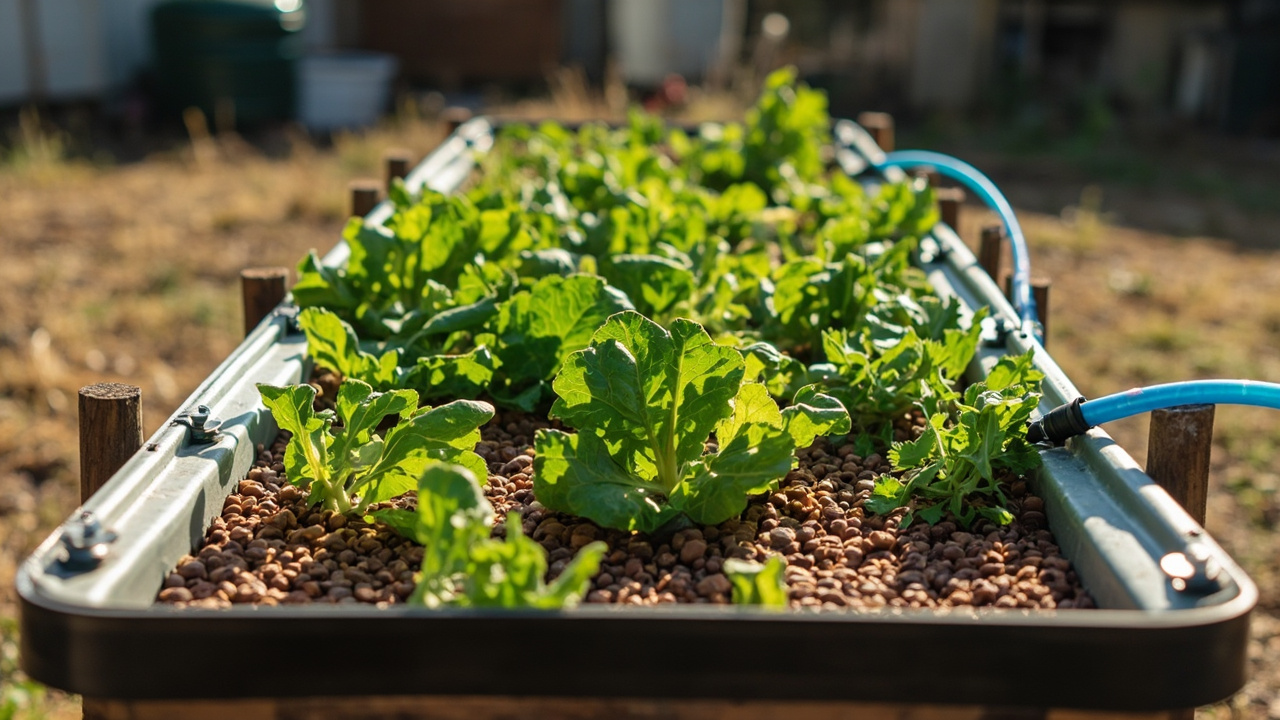
A flood-and-drain media bed handles mechanical filtration (catching solids), mineralisation (breaking those solids down into plant-available nutrients), and bio-filtration (the bacteria that convert ammonia to nitrates) all in one component. For an off-grid operator with limited power budget and no desire to run separate filter tanks, that consolidation matters.
NFT (Nutrient Film Technique) and DWC (Deep Water Culture / raft) systems are not recommended for new growers because they require separate filtration stages. Media beds do everything in one unit, which is why they're the industry-recommended starting point for backyard and hobby builds.
| Specification | Target | Source |
|---|---|---|
| Grow bed depth | ≥ 300 mm (12 in) | Aquaponics Source Australia |
| Fish tank volume (new system) | ≥ 1000 L | Aquaponics Source Australia |
| Stocking density (new system) | 20 kg fish per 1000 L water | Aquaponics Source Australia |
| Planning ratio | 5 kg fish per 1 m² grow bed surface | Aquaponics Source Australia |
| Timer cycle (timer-driven beds) | 15 min on / 45 min off | Aquaponics Source Australia |
| Target flow rate | 1× fish tank volume per hour | Aquaponics Source Australia |
| Power supply | 230V/50Hz (AU mains or inverter) | AU standard |
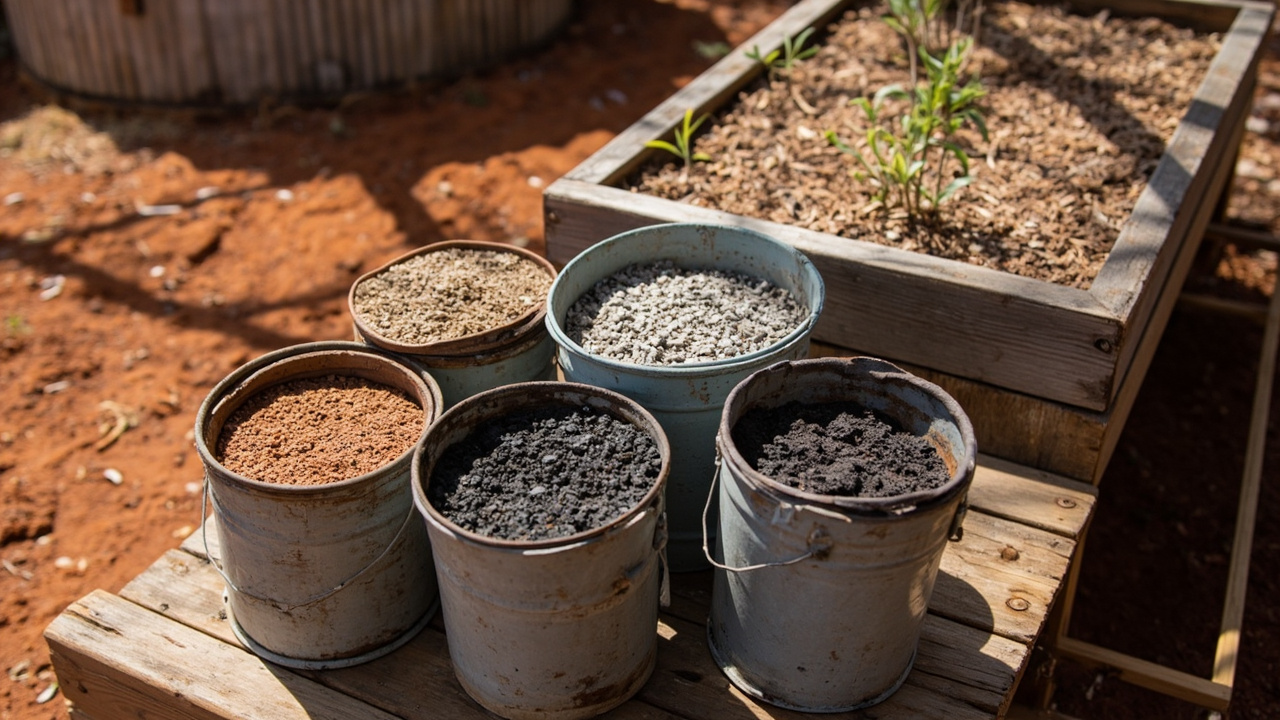
The media must be inert — it cannot decompose and it cannot alter the pH of the system. That second point rules out a lot of cheap options.
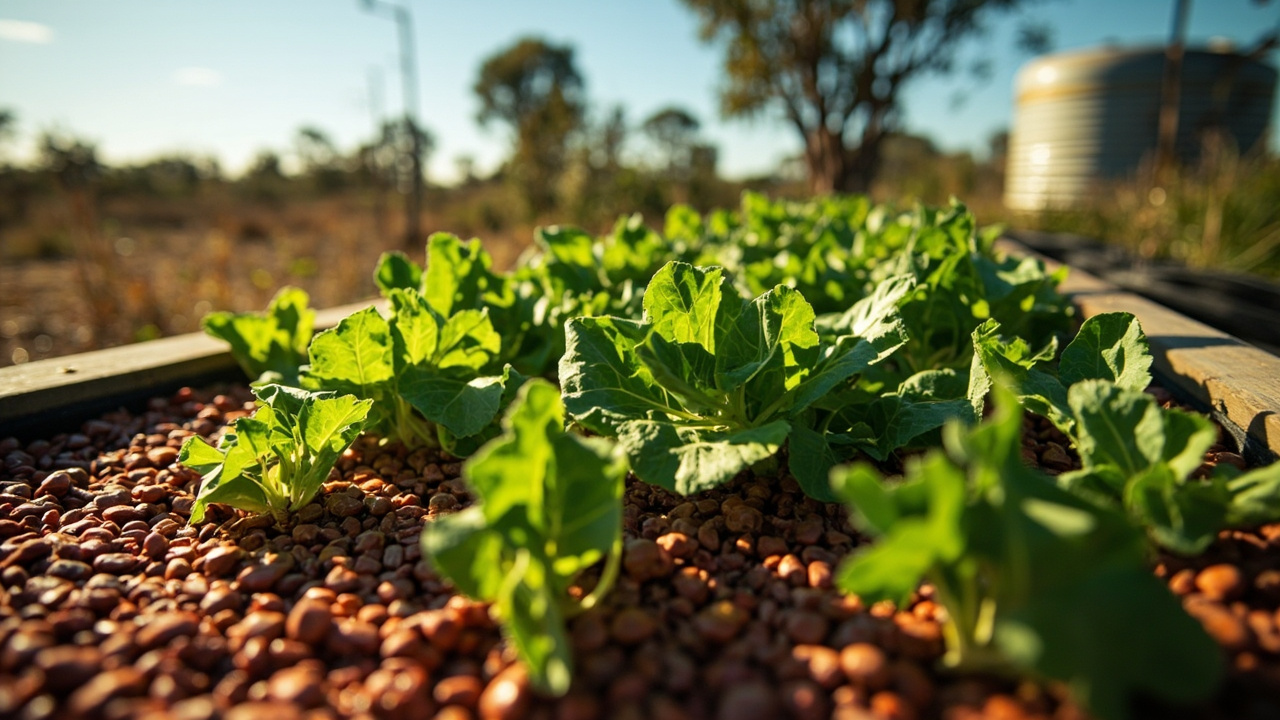
Expanded clay pebbles (LECA / Hydroton / CANNA clay): Durable, inert, and pH-neutral. Long service life, which offsets the higher upfront cost. The go-to for serious hobby builds.
Lava rock and gravel: The most widely used and least expensive options. Gravel is fine provided you understand the source — any media that may contain limestone must be avoided because limestone will drive pH upward and fight your system. If you can't verify the quarry or river source, don't use it.
Coconut coir: Cheaper and works for short-term crops, but it degrades over roughly 12–18 months and will eventually clog the bed. Acceptable for annual cycles, not for permanent installations.
Perlite: Floats and is hard to manage in a water-saturated bed. Skip it.
Concrete, limestone-rich stone, or any reactive aggregate: Out. They'll alter pH and contaminate the system.
Before installing any media, rinse it thoroughly to remove dust and fines. Skipping this step is the most common cause of clogged standpipes and murky water in a new build.
A 300 mm depth is the standard because it gives you complete filtration in a small home system and supports the widest range of crops — from shallow-rooted lettuce to deeper-rooted herbs and small fruiting plants. Shallower beds compromise filtration and crop choice.
The bed should be flood-and-drained. The drain phase pulls fresh oxygen down through the media, which is what the root zone and the nitrifying bacteria both need. Two control methods work:
Target flow is one full fish-tank volume per hour through the grow beds. Hitting that target in a small backyard system can be difficult; get as close as the plumbing allows, then monitor ammonia and nitrite to confirm the bed is keeping up.
For new systems, the safe stocking ceiling is 20 kg of fish per 1000 litres of water. Larger tanks (1000 L+) are more stable because changes happen slowly, giving you time to react. Going above this density in a new build risks system failure.
The planning ratio ties fish biomass to bed area: 5 kg of fish for every 1 m² of grow bed surface area, assuming beds are at least 300 mm deep.
Worked example: Two grow beds at 1 m² each = 2 m² total. That supports a mature fish weight of no more than 10 kg, which requires a minimum 500 L fish tank. The ratio scales linearly — more bed area means you can carry more fish, but only up to the point where filtration breaks down.
These are starting rules, not laws. There are exceptions to nearly every one under the right conditions. Treat them as guardrails for the first 12 months while you learn your specific system's behaviour.
Aquaponics lets you plant more densely than soil because the root zone has constant access to water, oxygen, and nutrients. That said, crowding still costs yield — mainly through light competition and airflow reduction around the canopy.
For a 300 mm deep media bed:
Match planting density to your fish load. A heavily planted bed draws nutrients down fast and supports more fish. A sparsely planted bed leaves nutrients in the water and can stress the biofilter — pair it with a lower stocking density.
Most of an aquaponics build is straightforward plumbing and waterproofing, but some tasks sit outside what a hobbyist should handle:
If in doubt, get a professional in. Water and electricity fail in unhelpfully spectacular ways.
1. Can I use soil in my grow bed?
No. Soil compacts, waterlogs, and releases nutrients in uncontrolled amounts. Use only inert media.
2. How often should I test the water?
Weekly for the first three months; fortnightly once the system is cycled and stable. Test pH, ammonia, nitrite, and nitrate each time.
3. Is rainwater safe to top up the fish tank?
Yes, and it's the off-grid default. Just check pH after rain — roof catchment can run acidic. Avoid runoff from treated timber or metal roofing without food-safe coatings.
4. Do I need to add nutrients if my plants look pale?
Possibly. Iron and potassium are the common deficiencies in established aquaponics. Iron chelate (FeEDDHA) is the standard supplement; add per label rates and re-test.
5. Can I run an aquaponics system on solar alone?
Yes, for media-bed systems with auto siphons. Pump wattage is typically 30–100 W. A single 400 W solar panel with a small battery bank can run a 1000 L system continuously, though sizing depends on your location's insolation.
6. What's the biggest mistake beginners make?
Overstocking the fish before the biofilter has cycled. Wait at least 4–6 weeks after first fish introduction before adding to the biomass, and respect the 20 kg/1000 L ceiling.
Worth a watch: New Aquaponics System Design · Rob Bob's Aquaponics & Backyard Farm