By Dave Miller · off-grid sparky · 22 years wiring solar, batteries and sheds in central QLD
“I once blew a $15 fuse in 1200 amps of solar current because I assumed a car fuse would hold, leaving my shed dead for a week in the Queensland heat.”
By Dave Miller · off-grid sparky · 22 years wiring solar, batteries and sheds in central QLD
“I once blew a $15 fuse in 1200 amps of solar current because I assumed a car fuse would hold, leaving my shed dead for a week in the Queensland heat.”
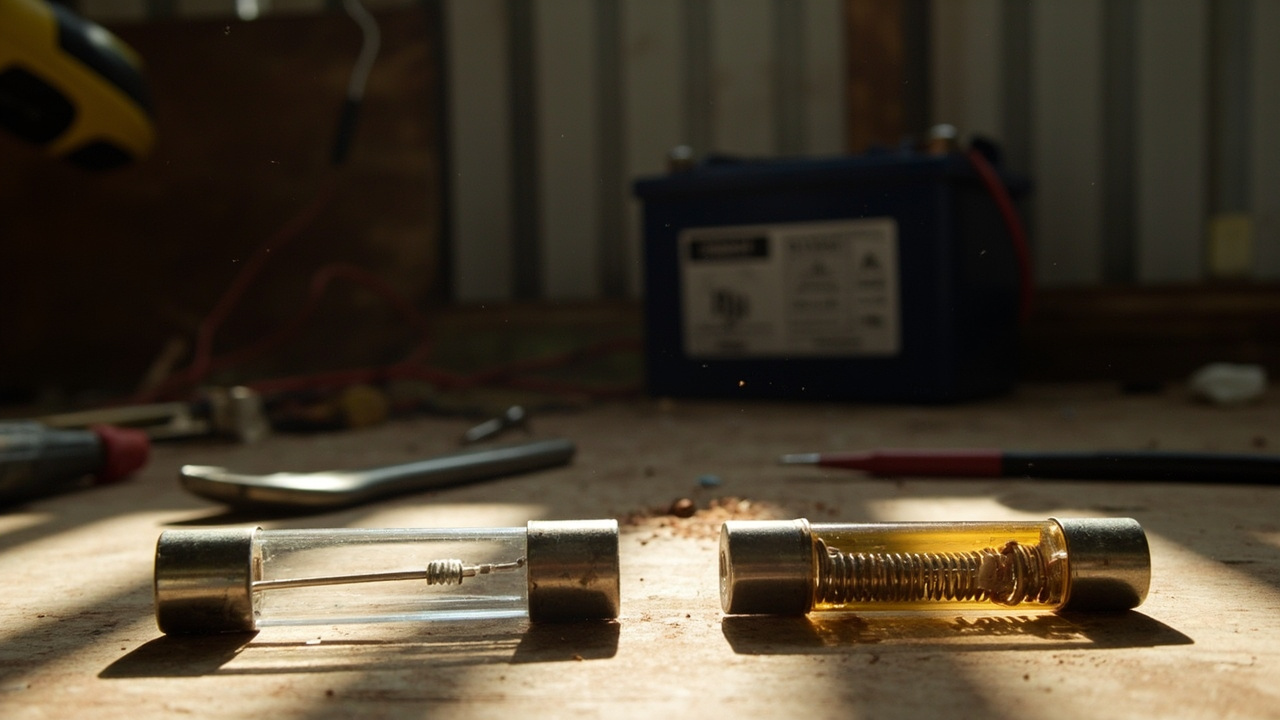
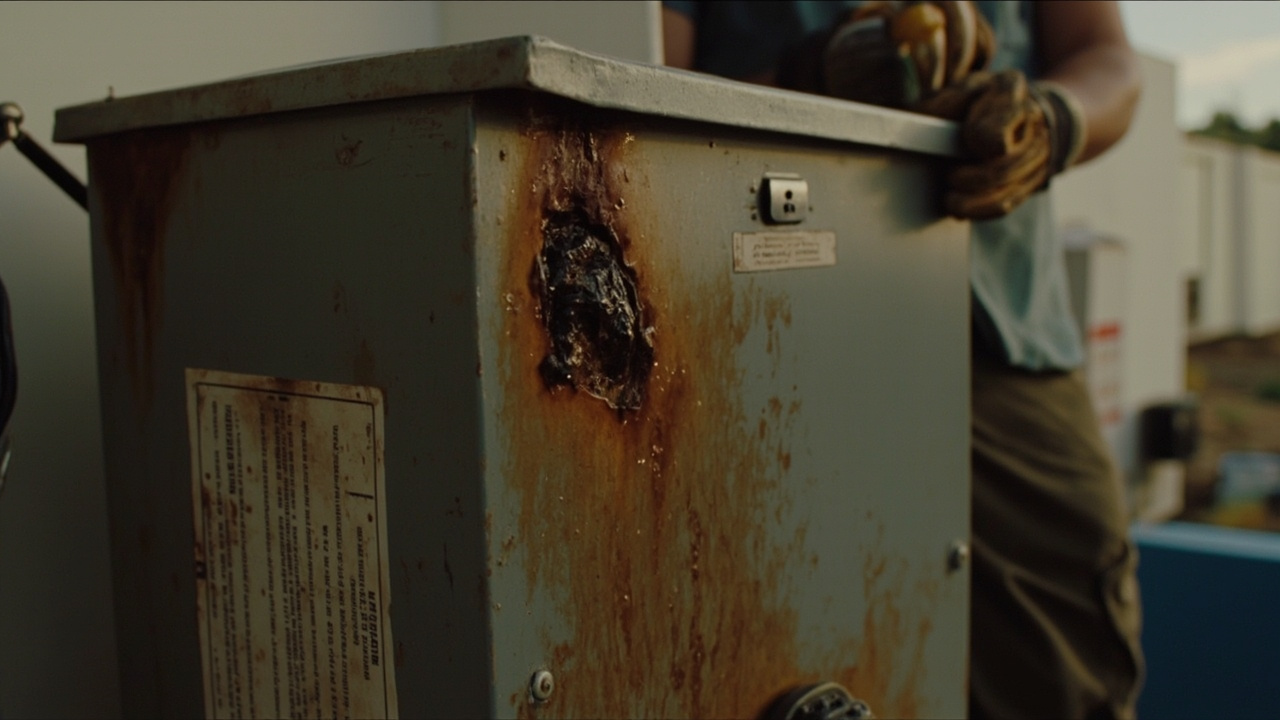
A battery bank sitting in a dusty shed outside Winton doesn’t care how much you spent on it. When a 48-volt, 400 amp-hour lithium pack shorts because a snake found its way behind the inverter, the only thing between you and a fire is the fuse. A slow-blow automotive fuse or a cheap ANL holder from a weekend-market stall won’t clear that fault before the copper busbar softens. I’ve pulled a half-melted 200-amp ANL from a mates’ install where the fuse element sagged but never parted, while the 70-millimetre-square cable jacket blistered along its full length.
A proper gG cylindrical fuse, rated 125 volts DC and built to interrupt 50,000 amps, reacts in milliseconds. It costs around $80, fits a standard 22 x 58 mm holder, and doesn’t leave a paddock full of smoke. Off-grid in Australia, you’ve got a battery bank. You aren’t waiting for a fuse to blow — you’re betting the shed on it. Get the right one.
Battery fuses are the single most-skipped piece of safety gear in off-grid and mobile DC systems. They cost almost nothing relative to a lithium bank, they fit in the palm of your hand, and they stop a welding cable from becoming the thing that burns your bus down. If you skip the fuse, you have built a 200-amp arc welder inside a plastic enclosure. That's not a risk profile — it's a liability.
This guide is the spec sheet first, the warnings second. No fluff.
A fuse on the battery positive conductor has one job: protect the cable downstream from over-current. It does not protect the battery, the inverter, or the connected appliance. It protects the wire between the fuse and the load, because the wire is the thing that can melt, arc, and start a fire when current goes wrong.
Battery banks are the source of power in this circuit. Anything they feed — house bank, inverter cable, winch, windlass, thruster, solar charge controller feed, DC-DC charger feed — needs over-current protection (OCP) on the positive conductor between the bank and the load.
Every correctly sized battery fuse follows the same four-step sequence. Skip one, and you'll either nuisance-trip under normal load, or fail to open during a short.
1. Know the load amperage. What continuous current does the downstream device actually pull at full load? Check the spec plate, not the marketing.
2. Know the cable ampacity. What is the current rating of the cable you are protecting? The fuse must protect the smallest cable in the run, not the biggest.
3. Determine the AIC of the battery bank. Ampere Interrupting Capacity (AIC) is the maximum short-circuit current the fuse can safely interrupt under standard test conditions. Battery banks can dump enormous fault currents; underspec the AIC and the fuse can rupture or explode rather than open.
4. Size the fuse to at least 125% of expected continuous loads. Anything expected to run for more than three hours continuously is, by convention, a continuous load.
Done in that order, you end up with a fuse that opens only when the wire is actually in danger, and survives the short-circuit event when the wire goes wrong.
Over-current protection on a battery bank must be installed close to the source of power — that is, close to the battery terminal — so that the unprotected run of cable between the bank and the fuse is too short to develop a meaningful short-circuit fault.
In practice, the fuse block sits directly on the positive post, or within a handsbreadth of it on the first cable leaving the bank. If you can see the battery terminal without the fuse in between, the fuse is in the wrong place.
A Main Over-current Protection Device is the one with no other OCP between it and the battery. On any non-trivial off-grid build, the main fuse lives on the positive post or the first jump from the bank.
AIC (Ampere Interrupting Capacity) is what separates a real battery fuse from a hardware-store blade fuse. A 100 A automotive fuse can typically interrupt a few thousand amps before its body ruptures. A 100 A lithium house bank at 24 V can deliver tens of thousands of amps into a dead short for the first few milliseconds. Under-spec the AIC, and the fuse doesn't open — it detonates.
Practical rule of thumb:
| Bank voltage | Approximate available fault current | Minimum recommended AIC |
|---|---|---|
| 12 V lead-acid, modest Ah | ~1,000–3,000 A | 5,000 A AIC |
| 12 V large lead-acid / LiFePO4 | ~3,000–10,000 A | 10,000 A AIC |
| 24 V / 48 V LiFePO4 bank | 5,000–20,000+ A | 10,000–20,000 A AIC or DC-rated |
The numbers above scale with bank size and chemistry. Treat them as minimums, not targets. ABYC's seven-inch rule is a bare minimum and is sometimes described as inadequate compared with best practice — running the fuse closer, and on a heavier-rated holder, is always the safer option.
Not every fuse holder belongs on a battery post. Off-grid and high-current DC systems have a few go-to options.
MRBF (Marine Rated Battery Fuse). Stud-mount fuse that bolts directly to the battery terminal. Compact, sealed, high AIC, and the standard pick for the main battery fuse. Blue Sea Systems makes a 300 A MRBF that's a textbook example of this style.
NH (knife-blade) fuses. Common in European DC and solar combiner work. Better contact resistance than ANL/Mega fuses, much higher breaking capacity, and easier to find in high-AIC ratings. For high-current off-grid battery and inverter protection, NH is generally a better choice than ANL or Mega.
ANL and Mega fuses. Common, cheap, but with lower contact integrity and lower breaking capacity at the same current rating than NH. Acceptable for lower-fault-current banks; not the first pick for a large lithium bank.
What to avoid at the battery post. Standard automotive blade fuses, holder-style fuses not rated for the available fault current, and any fuse without a published AIC at the system voltage.
A 24 V LiFePO4 house bank feeds a 3,000 W inverter through 5 m of 70 mm² cable. Accounting for inverter efficiency, the battery-side current at full load is:
`3,000 W / (24 V × 0.90 efficiency) ≈ 139 A continuous`
That gives a 175 A NH or MRBF fuse, mounted within 7 wire inches of the battery positive, on the short jumper between the bank and the inverter cable. The fuse protects the cable, not the inverter.
Working on a battery bank is not a Sunday-afternoon job if the bank is larger than a small jump-start pack.
When to call a licensed professional:
Do I need a fuse on every positive cable off the battery, or just one main fuse?
Every positive conductor that leaves the bank needs protection. A main fuse covers the main run to the distribution; every sub-circuit then needs its own fuse or breaker sized to its cable.
Where exactly does the fuse go if I have multiple batteries in parallel?
Each parallel battery/string should have its own fuse sized to its conductor, located at that string's positive post. A main fuse is also required at the bank output. Per-string fusing protects each parallel string from an internal string fault; paralleled strings do not self-balance once they have diverged.
Is a circuit breaker acceptable instead of a fuse at the battery?
Yes, provided it's DC-rated, the correct AIC, and correctly torqued. A fuse is simpler and has no moving parts; a breaker gives you a reset switch. Both work; mixing them is fine.
What size fuse for a solar charge controller feed from the battery?
Same rules: 125% of the controller's max output current (or max load, whichever is larger), within 7 wire inches of the bank, and AIC-rated for the bank. The controller's internal electronics are not battery-fault-current protection.
Do lithium banks need different fuses than lead-acid?
Yes. Lithium house banks, particularly LiFePO4 systems, need DC-rated fuses with AIC matched to the bank's published `Isc` — commonly 10,000–20,000 A or higher for 24/48 V LiFePO4 banks. Confirm the fuse selection against the battery manufacturer's installation guide.
How do I know the AIC of my bank?
The battery manufacturer's datasheet will state available short-circuit current (`Isc`). If it doesn't, contact the manufacturer. The number drives the fuse spec — no number, no install.
Worth a watch: How to Size Your Battery Fuse to Inverter · Cleversolarpower by Nick
Fast-blow fuses trip the instant they see a fault, while slow-blow (time-delay) ones can handle a brief surge — like an inverter kicking in — before they let go. For most off-grid battery setups, slow-blow is your mate, because gear like inverters and motors pull a big hit of current for a split second at start-up. Pick the wrong type and you'll be replacing fuses every time you switch something on.
You size the fuse to protect the wiring, not the battery — work out what your cables can safely carry, then choose a fuse rated just above your normal load but below the cable's limit. The article hammers this: grabbing a fuse rated way too high "just to be safe" is the opposite of safe, and that's exactly the sort of mistake that lands people in the cautionary tale pile. If the maths feels over your head, that's a call-the-sparky moment.
The article runs through Australian suppliers with indicative pricing, so have a squiz at that section for current ballpark figures. Generally, you'll find decent stock at solar wholesalers, 4WD outlets, and the bigger online retailers that post out to the bush. If you're remote, factor in the postage — some of the chunkier fuses aren't light and the freight adds up.
Too right you do. The article opens with a lithium battery bank that shorted out because someone skipped a fuse, and the outcome wasn't pretty — melted busbars and a write-off job. A correctly sized fuse is the cheapest insurance you'll ever own on a battery bank worth a small fortune. Skipping it is how you end up as the story everyone tells down at the pub.