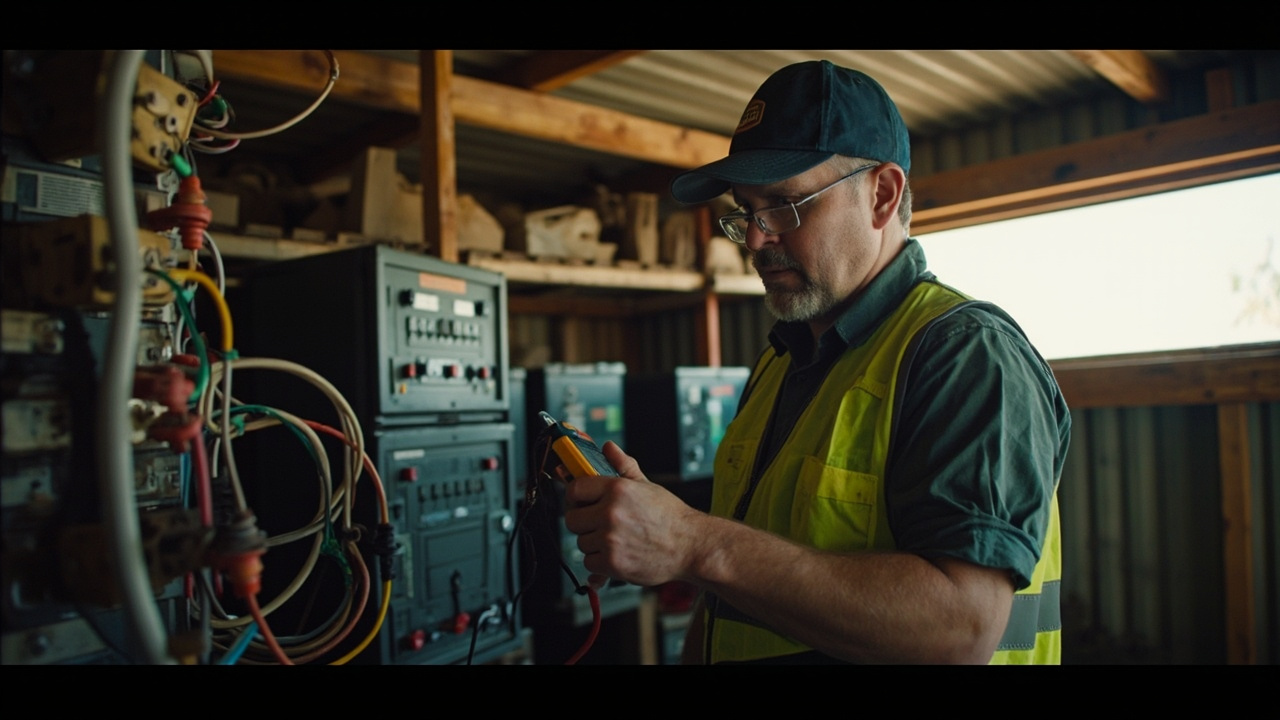
By Dave Miller · off-grid sparky · 22 years wiring solar, batteries and sheds in central QLD
“After a Queensland summer heatwave, I watched my LiFePO4 bank fail because I ignored a 45°C battery temp and forgot to check my sensor wire.”
Listen up. If you're running off-grid in Australia and not monitoring battery temperature, you're gambling with a fire hazard. No exceptions. Lithium batteries explode if they get too hot or too cold. Your shed, your house, your life – it's on the line. Stop reading and fix this now.
By Dave Miller · off-grid sparky · 22 years wiring solar, batteries and sheds in central QLD
“After a Queensland summer heatwave, I watched my LiFePO4 bank fail because I ignored a 45°C battery temp and forgot to check my sensor wire.”
I've watched batteries cook on a 42 °C Queensland afternoon and seen the same chemistry sulk through a frosty Central Highlands winter morning. Temperature is the single biggest variable you can actually control in an off-grid battery bank, and it's the one most people retrofit too late. This article is the temperature playbook: what each chemistry wants, where it goes wrong, how to monitor it properly, and when the problem is bigger than a DIY fix.
Voltage tells you where the battery is right now. Temperature tells you what's happening to the battery over its lifetime. The two are linked, but the slow damage is all thermal.
The chemistry rule that drives everything else: every 10 °C above 25 °C roughly doubles the rate of internal chemical reactions, which cuts battery life in half. That single rule is why a lead-acid bank in a tin shed out here dies in three summers instead of lasting seven. Heat also pushes batteries into other failure modes:
Cold is the opposite problem: reactions slow down, capacity drops, and charging becomes dangerous. Lead-acid batteries deliver only 50–70% of their rated capacity at freezing temperatures, and their electrolyte can freeze if the battery sits discharged in extreme cold. Charging LiFePO4 below 0 °C causes lithium plating damage — permanent, irreversible capacity loss. Cold is not your friend for charging; it's only tolerable for storage at moderate state of charge.
This is the table worth laminating and sticking on the battery box door. Numbers come straight from manufacturer-style guidance for each chemistry.
| Chemistry | Optimal Range | Charging Limit | Discharge Limit | Notes |
|---|---|---|---|---|
| Flooded Lead-Acid (FLA) | 15–25 °C | -20 °C to 50 °C | -20 °C to 50 °C | Water loss accelerates above 30 °C; specific gravity matters |
| AGM / Gel | 15–25 °C | 0 °C to 50 °C | Wider | Charge below 0 °C can damage; voltage must be temperature-compensated |
| Standard LiFePO4 | 10–30 °C | 0 °C to 45 °C | -20 °C to 60 °C | Never charge below 0 °C without a heating system |
| Heated LiFePO4 | 10–30 °C | Down to -20 °C with heaters | Down to -30 °C | Internal heaters auto-activate below freezing |
Three things jump out of this table. First, AGM/Gel is more charge-restrictive than flooded lead-acid in cold — a common install error. Second, standard LiFePO4 has a hard 0 °C floor for charging that no amount of insulation safely bypasses. Third, "heated LiFePO4" exists as a product category precisely because Canadian, alpine, and even southern-Australian winter users kept destroying standard cells.
Most off-grid systems I've audited have a voltmeter. That's not enough.
Monitoring battery state of charge (SOC) is more critical than just monitoring voltage for off-grid use. Simple voltage readings are inaccurate for SOC because temperature, battery type, age, and charge/discharge state all skew the reading. A 12.6V reading on a warm afternoon means something different than the same number on a frosty morning.
The fix is a shunt-based battery monitor. A shunt is a precision resistor wired into the battery cables that measures current flow into and out of the battery in real time. The monitor integrates that current over time (coulomb counting), corrects for temperature, and gives you an actual percentage remaining. This is the only sensible way to know whether your house batteries can run the fridge, lights, water pump, and propane furnace through the night — running house batteries to 0% SOC disables all of those systems.
If you're running an RV or caravan, the case is even harder. Many state and national park campsites lack electrical hookups, which means the entire stay runs off the battery. A shunt monitor isn't luxury; it's the only way to avoid a flat bank on day three.
Temperature monitoring is a sensor problem, not a screen problem. You don't need a fancy dashboard; you need sensors in the right places, connected to something that will alarm or shed load.
BMS temperature sensing. A Battery Management System should read temperature from an NTC thermistor mounted on the cell case or terminal — that's the standard practice. BMS-mounted sensors protect against cell-level over-temperature during charge and discharge. If your lithium pack doesn't have a BMS-probe on the cells, it isn't properly monitored.
Ambient and enclosure sensors. Add a separate thermistor inside the battery enclosure or room. This catches slow problems BMS sensors miss: ventilation failure, solar gain through a western wall, a heater stuck on.
Where to put sensors:
What the readings should drive:
Monitoring only matters if you can actually move the temperature. Two categories of control.
Battery temperature work crosses into licensed territory faster than most people realise.
When to call a licensed professional:
Never:
How often should I actually check battery temperature?
Daily during heatwaves or cold snaps; weekly in mild weather. The BMS should log it continuously and alarm on thresholds — your job is to respond to the alarm and verify the sensors monthly.
Do I really need a shunt if I have a BMS?
For lithium, the BMS protects the cells. For you knowing how much capacity is left, you still need a shunt monitor. They're complementary, not alternatives.
Can I put my LiFePO4 bank in a shed that hits 50 °C in summer?
Discharge is fine down to 60 °C for most cells; charging above 45 °C is the danger. Either move the bank, ventilate aggressively, or accept derated life. A 50 °C shed with no fan will kill the bank.
What temperature should I set my battery box fan to trigger?
Roughly 27–29 °C is the standard fan-cut-in temperature for thermostatic ventilation. It should run before the cells heat-soak, not after.
Is insulation enough to keep LiFePO4 above 0 °C in winter?
Insulation slows cooling; it doesn't generate heat. In a Central Queensland winter, a well-insulated box often stays above 0 °C overnight. In a frost hollow, it won't — you'll need a heating pad or heated cells.
Why does my fully charged lead-acid battery read "full" but dies quickly in cold weather?
That's the 50–70% capacity drop at freezing. It's not a SOC problem; it's a chemistry problem. The battery is genuinely full, just genuinely smaller.
Worth a watch: How to install, wire up and program a Kings Battery Monitor & Shunt! · Adventure Kings