Containerized Wastewater Treatment: Sewage in a Shipping Container
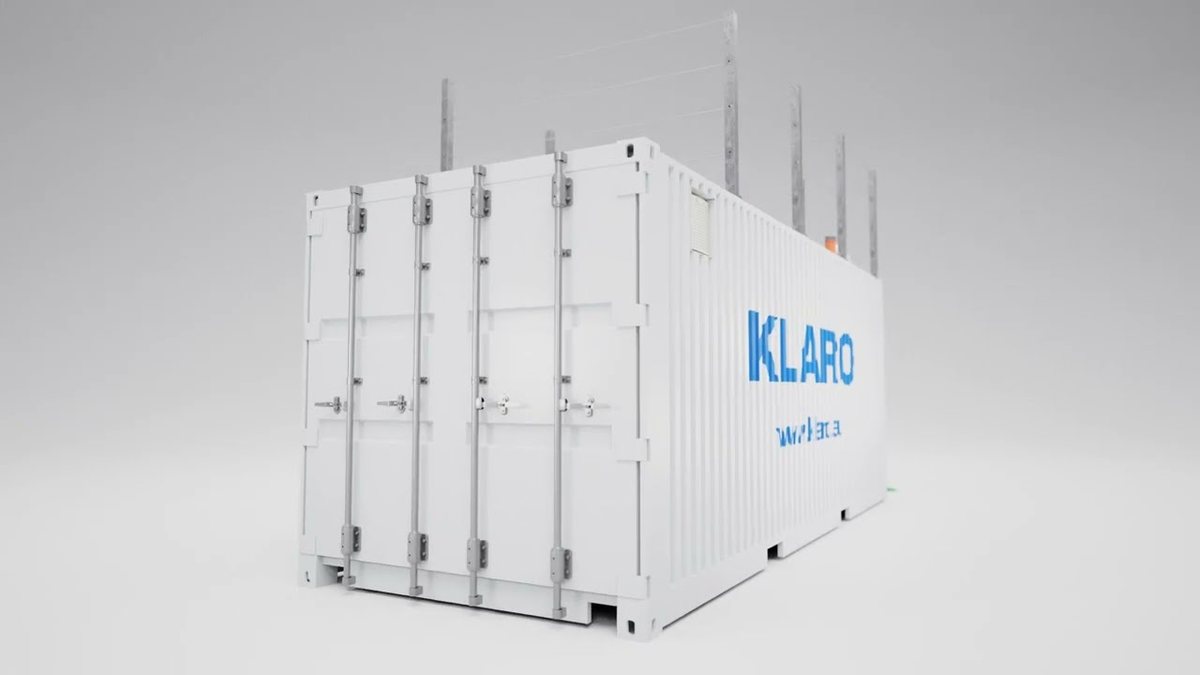
Everybody off-grid plans the power wall and the water tanks. Almost nobody plans what happens after the flush, until the first council letter or the first smell. Here is the good news: the "Solarcontainer for sewage" absolutely exists. Dozens of manufacturers build complete, tested wastewater plants inside standard shipping containers, and they range from a 68-watt household unit to membrane plants that serve five thousand people.
This guide is the full picture I wish I'd had before our first septic quote came back at five figures: what these systems actually are, who makes the decent ones, what they cost to buy and to own, the rules that decide what you're allowed to install in Australia, the UK, Europe and North America, and an honest DIY and ROI score for each. Where a system is the kind of thing you buy from a factory rep, I link you straight to the manufacturer. The consumables and maintenance gear, the pumps, aerators, test kits and chlorine, those you can actually get on Amazon, and those cards localize price and stock to your nearest store.
One framing before we start: containerized doesn't mean small, and it doesn't mean casual. It means the plant room, the biology and the plumbing were assembled and tested in a factory instead of welded together in your paddock. The container is the delivery method. Whether that's right for you depends on headcount, soil, rules and whether you ever intend to move the thing, all of which we score below.
TL;DRThe short version
Full reasoning, eleven systems, the rulebook and the maths below.
MethodHow we chose
- Verified, not vibes. Every Amazon product card on this page was checked live on 31 August 2026: ASIN, rating, review count, price and image. Manufacturer specs come from the makers' own datasheets and government approval lists (WA Health's approved-systems register, EN 12566 certification records), not from brochures alone.
- Honest downsides, always. Every system and every product below carries a watch-out. A page of pure praise is an ad; this isn't one. Where stock was thin or a listing is a local substitute, we say so on the card.
- Scored on two axes. DIY score (1–10) is how much of the acquisition, install and upkeep a competent owner-builder can genuinely do. ROI score (1–10) is how hard the system pays back against the realistic alternatives: pump-outs, sewer connection quotes, or trucking liquid waste off a camp. Both are our editorial judgement from the cost data, clearly labelled as such.
As an Amazon Associate, OffGrid Masterplan earns from qualifying purchases made through links on this page. It changes nothing about the price you pay or what we recommend. Prices are dated snapshots and move; the card button is the source of truth on the day. Commercial system prices are indicative budget ranges, request a written quote.
01 · First principlesWhat's actually in the box
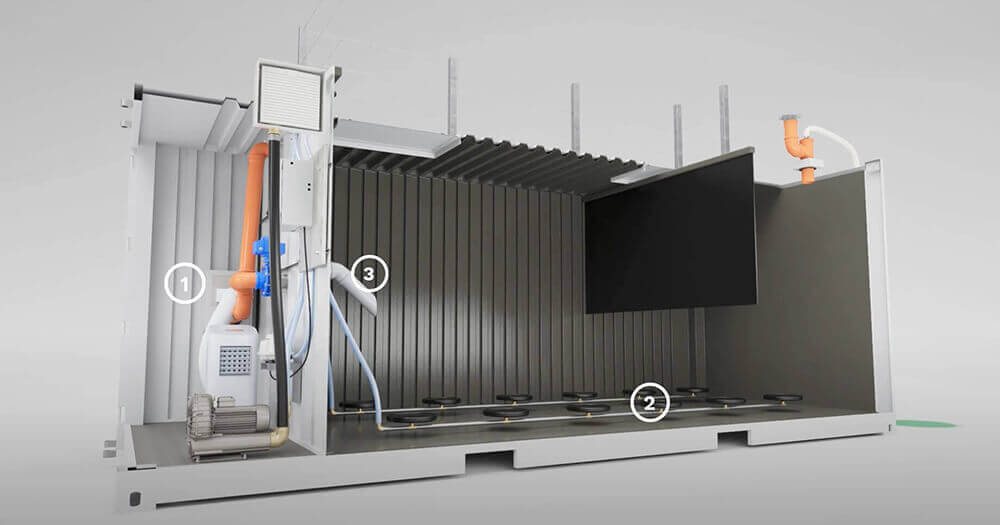
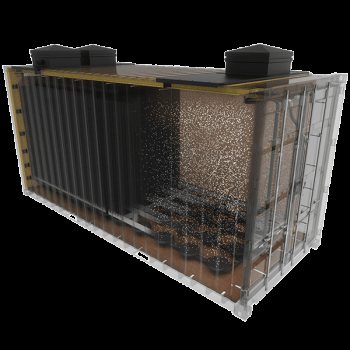
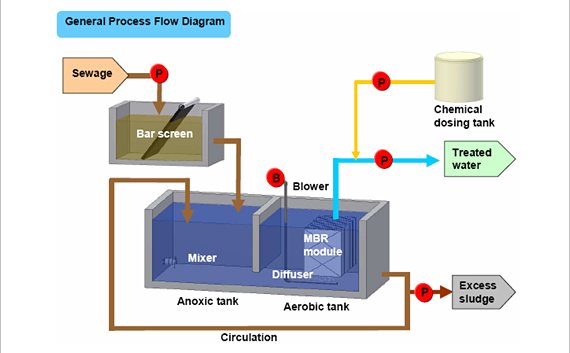
Every containerized plant is the same three-act play, whether it costs five grand or three hundred. Act one, settling: solids drop, grease floats, the crude stuff separates. Act two, biology: bacteria eat the dissolved organics, and this stage defines the machine, more below. Act three, clarification and disinfection: the clean water separates from the biology and gets polished with UV or chlorine if you intend to reuse it.
What flows in matters more than the box. Greywater (showers, sinks, laundry) is low-grade: screen it, filter it, disinfect it, irrigate with it, our greywater guide covers the simple end of that. Blackwater (toilet) is pathogen-heavy and needs real biological treatment. Almost every container plant treats combined grey plus black in one train, which keeps the plumbing simple: one pipe in, one pipe out. If you can keep blackwater out of the system entirely, see the compost-toilet exit ramp in the DIY section, the remaining greywater job gets dramatically cheaper.
The four biologies you'll be quoted
| Tech | What it is | Effluent (BOD / TSS) | The trade |
|---|---|---|---|
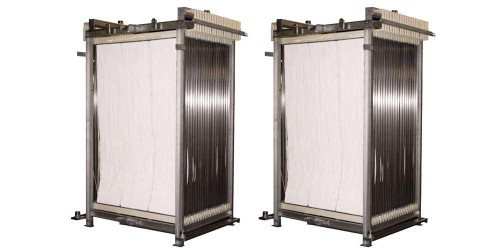
| MBR — membrane bioreactor | Biology plus ultrafiltration membranes that physically block solids and bacteria | <5 / <5 mg/L, near-potable clarity | Best water out, smallest footprint; membranes foul and need replacing every 5–7 years |
| MBBR — moving bed biofilm reactor | Thousands of little plastic wheels tumbling in the tank, bacteria live on them | <20 / <25 mg/L | No membranes to die, shrugs off shock loads; slightly thirstier blower |
| SBR — sequencing batch reactor | One tank, run in timed cycles: aerate, settle, decant, repeat | <10–20 / <10–30 mg/L | Few moving parts, tolerant chemistry; needs a competent control panel |
| SAFF / aerated filter — fixed film | Bacteria grow on static media while air bubbles through | <20 / <30 mg/L | Dead simple and robust; larger tank for the same result |
Rule of thumb: if you want to reuse the water (irrigation, flushing, dust suppression on a mine site), you want MBR or an SBR/MBBR followed by disinfection. If you just need to discharge legally to a drain field, MBBR or SAFF does it for less money and less maintenance.
02 · The fine printThe rules, country by country
You can buy a container plant from Alibaba with a credit card. Installing and discharging from it legally is another matter, and it's the matter that decides the machine. Here's the map.
Australia
Onsite wastewater is governed by AS/NZS 1547:2012 (site management) and the AS 1546 series for the units themselves: AS 1546.3:2017 covers secondary treatment systems, AS 1546.4 covers greywater units. Your council approves the install, and in most states the unit itself must sit on the health department's approved list, which is a certification to AS 1546.3 after a 28-plus-week performance trial. WA Health's register, for example, lists the Fuji Clean ACE 1200 (1,200 L/day, 8 people) and ACE 3000 (3,000 L/day, 20 people) with tested results of BOD under 2 mg/L and E. coli under 1 CFU/100 mL. Translation: for a house, you buy a certified domestic unit and get it signed off. Container plants show up in Australia mostly on mine camps and council works, where state environmental licences apply instead, and that's where MAK Water and Hydroflux make their living. The water rights guide covers the neighbouring turf, and the waste calculator sizes your load.
United Kingdom
England runs on the Environment Agency's General Binding Rules: a small sewage discharge needs no permit if it stays under 2 m³/day to ground (about 13 people) or 5 m³/day to surface water (about 33 people), and the treatment unit must carry BS EN 12566 certification. The famous "2020 rule": a septic tank may no longer discharge to a watercourse at all, full stop, only a proper treatment plant's secondary effluent may. Breach the limits and you're into permits; since April 2026 there are at least faster standard-rules permits for systems that just miss the criteria. Scotland, Wales and Northern Ireland run their own registration regimes, Wales wants registration with Natural Resources Wales, free for small domestic discharges.
European Union
The EU makes it structural: small wastewater plants up to 50 PE sold in Europe must be tested to EN 12566-3 (a 38-week independent performance test) and carry the CE mark under the Construction Products Regulation, without it the unit is illegal to sell. EN 12566-6 covers prefabricated septic-effluent treatment units. The 2020 EU Water Reuse Regulation (741/2020) then sets the quality classes for using the output on crops. Buying a container plant into the EU? No EN 12566 paperwork, no install, whatever the listing says.
United States & Canada
There's no single US federal permit for a household system; states and counties run onsite wastewater, and the de-facto performance yardstick is NSF/ANSI Standard 40 (residential treatment units rated 400–1,500 gallons/day, requiring roughly ≤25 mg/L CBOD and ≤30 mg/L TSS). Environmentally sensitive counties increasingly demand NSF/ANSI 245 (at least 50% total nitrogen reduction), and NSF/ANSI 350 covers systems whose effluent you plan to reuse. Some states flatly require chlorine disinfection before any spray distribution, Texas being the well-known case. Canada uses CAN/BNQ 3680-600, same idea with cold-climate teeth. Larger container plants discharging to waterways fall under state EPA or federal NPDES permits, where the classic secondary-treatment bar is 30 mg/L BOD and TSS.
Everywhere on this list, the discharge location matters as much as the machine: distance to wells, watercourses, boundaries and buildings, groundwater protection zones, soil percolation. A certified container plant draining into the wrong ditch is still illegal. Ten minutes with the local authority before purchase beats a relocation invoice after it.
| Jurisdiction | Unit certification | Permit-free ceiling | Notes for buyers |
|---|---|---|---|
| Australia | AS 1546.3:2017 on state health register | None, council approval always required | Reuse classed A+ to C; irrigation rules per state |
| England | BS EN 12566-3 | 2 m³/day ground · 5 m³/day watercourse | Septic-to-watercourse banned since 2020 |
| EU | EN 12566-3 + CE mark (mandatory) | National rules per member state | 38-week certified performance test behind every CE mark |
| USA | NSF/ANSI 40 (+245 for N, 350 for reuse) | Set by county/state, varies wildly | Spray distribution often requires chlorine disinfection |
| Canada | CAN/BNQ 3680-600 | Provincial | Cold-climate testing baked in |
03 · The marketThe systems worth knowing
Eleven systems, ordered roughly by the size of the job they suit. Prices are indicative 2026 budget ranges in US dollars unless marked, equipment only, FOB or ex-works, freight, cranes, slabs and commissioning come later in the cost section. The scores are ours: DIY measures how much a competent owner-builder can do themselves; ROI measures how convincingly it beats its alternatives.
The household anchor: Fuji Clean ACE series (Japan / Australia)
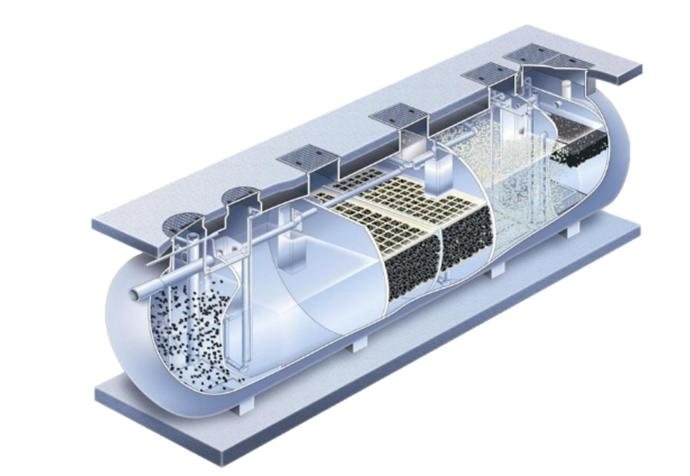
Fuji Clean ACE 1200 / ACE 3000
Type: compact FRP contact-aeration plant (the "johkasou" Japan has used for 60 years) · Serves: 8 people (1,200 L/day) to 20 people (3,000 L/day), commercial series to 20,000 L/day · Power: 47–68 W blower, roughly A$130 a year in electricity · Budget: ~A$13k installed for the ACE 1200 in WA, services A$200–400 a visit.
Not a shipping container, but it's the certified "plant in a box" a single dwelling actually needs: one light FRP tank an excavator can place in a morning, on the WA Health approved register with tested BOD under 2 mg/L and E. coli under 1 CFU/100 mL. Watch-out: quarterly service visits are part of the approval, not optional, and it's a fixed home, not a relocatable asset.
The relocatable benchmark: GRAF KLARO Container.One (Germany)
KLARO Container.One
Type: SBR in a 10/20/40-ft ISO container · Serves: ~100 PE (15 m³/day) per 20-ft unit, parallels to 1,380 PE · Power: ~13 kWh/day for the 20-ft (400 V, 16 A) · Budget: on request, expect the Western-container band of roughly US$40k–120k landed.
The spec sheet reads like an off-gridder wrote it: sludge pump-out quarterly, no membranes to replace, no chemicals in routine operation, a technical room with the blower and controls behind a lockable door, WebMonitor remote supervision as an option. A Swiss village ran one as its temporary town plant while the sewer was connected; Togo power-station staff live behind one with UV fitted. Watch-out: 400 V three-phase supply assumed, operating range −10 to +35 °C means insulation or heating past those marks, and the inlet wants a lift pump since the box sits above ground.
The global workhorse: BioKube BioContainer (Denmark)
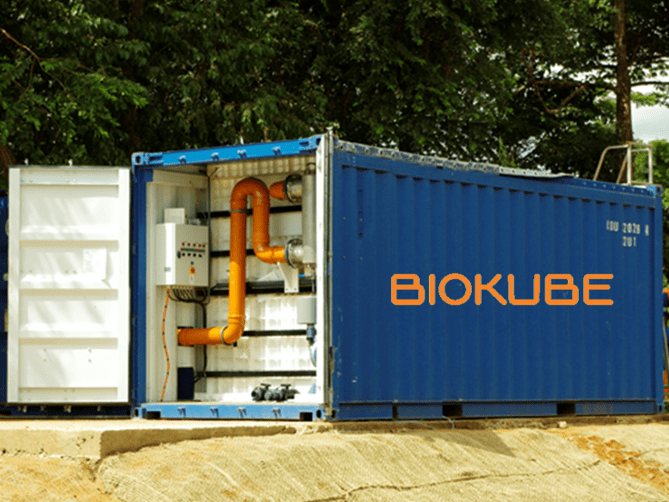
BioKube BioContainer, 20-ft and 40-ft
Type: submerged aerated fixed-film (SAFF) in ISO containers, UV disinfection option · Serves: small camps to 5,000+ PE in modules · Budget: ~US$30k–150k depending on capacity.
Danish, CE-marked and CEN 12566-certified, with two decades of deployments from Bolivian villages to Iraqi oilfields. The sales pitch is plug-and-play in 1–2 days; the quiet truth is it behaves, fixed-film systems are the forgiving end of the biology spectrum, tolerant of the variable loads camps actually produce. Watch-out: grid or generator power assumed (no integrated solar), and SAFF effluent is excellent for irrigation but not the near-potable clarity MBR delivers.
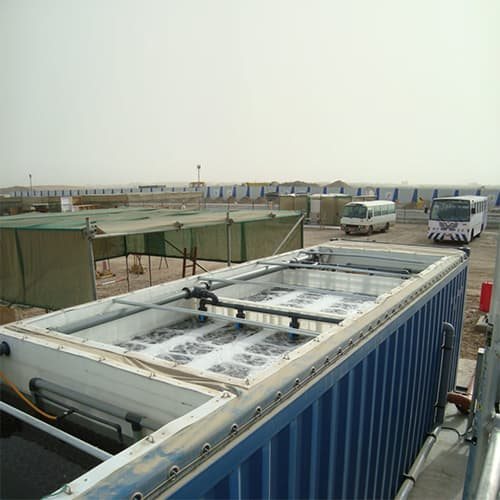
The Australian camp specialists: MAK Water & Hydroflux Epco
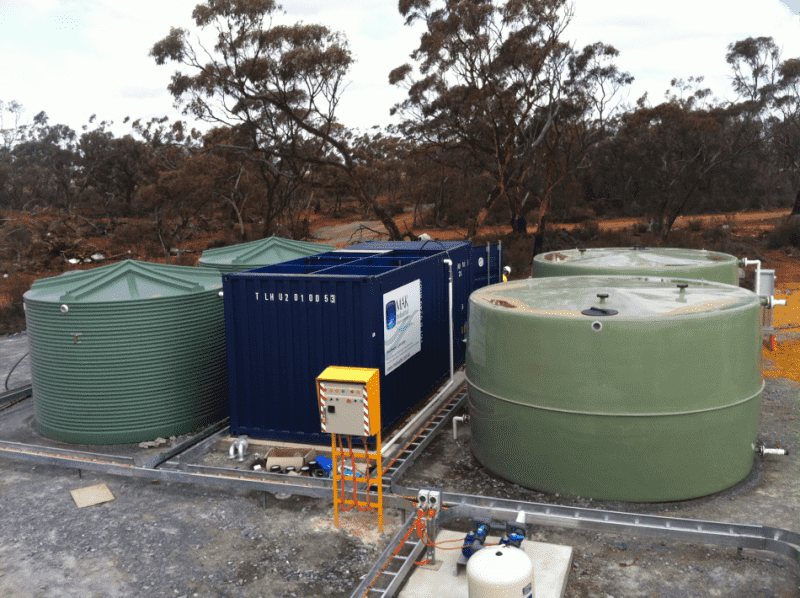
MAK Water containerized STP (Perth, WA)
Type: containerized MBBR / ASBR (activated sludge batch reactor), FRP bioreactors rated to a 15-year design life · Serves: camps and sites from ~50 m³/day down and up · Budget: ~A$50k–300k+ project-dependent.
The Pilbara-proofed option: insulated, air-conditioned containers, ClearAccess remote monitoring, Class C recycled water out for irrigation. Their references are the names you'd hope for, iron-ore mine camps including a 500-room FIFO village. Watch-out: this is a turnkey engineered project, not a box you order online; lead times and pricing follow the project.
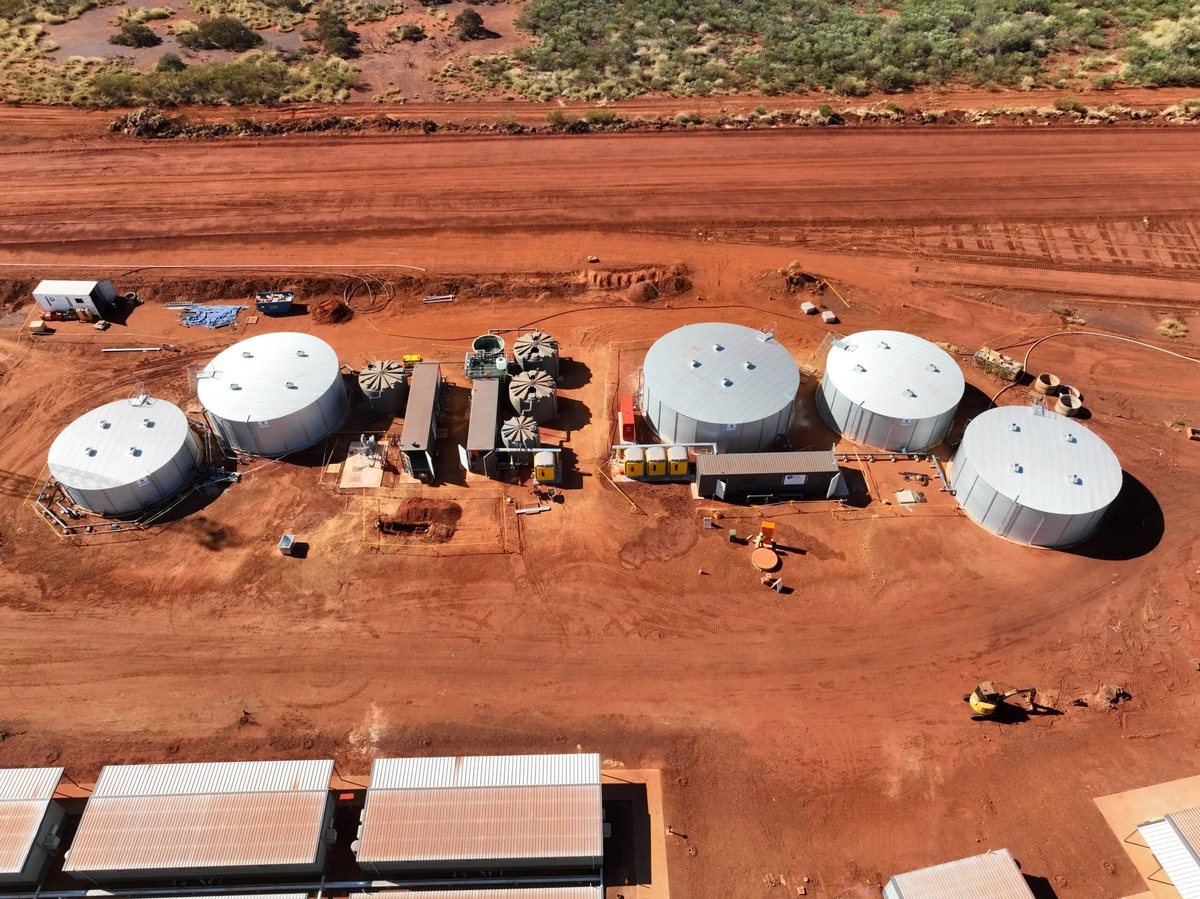
Hydroflux Epco RoadTrain (Australia-wide)
Type: packaged extended-aeration / MLE / MBBR / MBR / SBR trains, welded or flat-pack bolt-up · Serves: 60–1,000 EP per train, modular beyond · Budget: ~A$30k–200k+ per train.
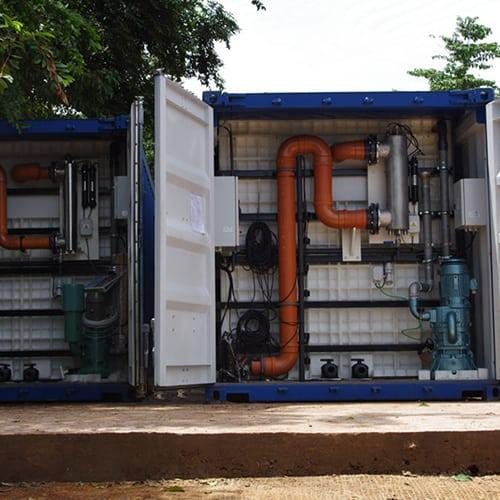
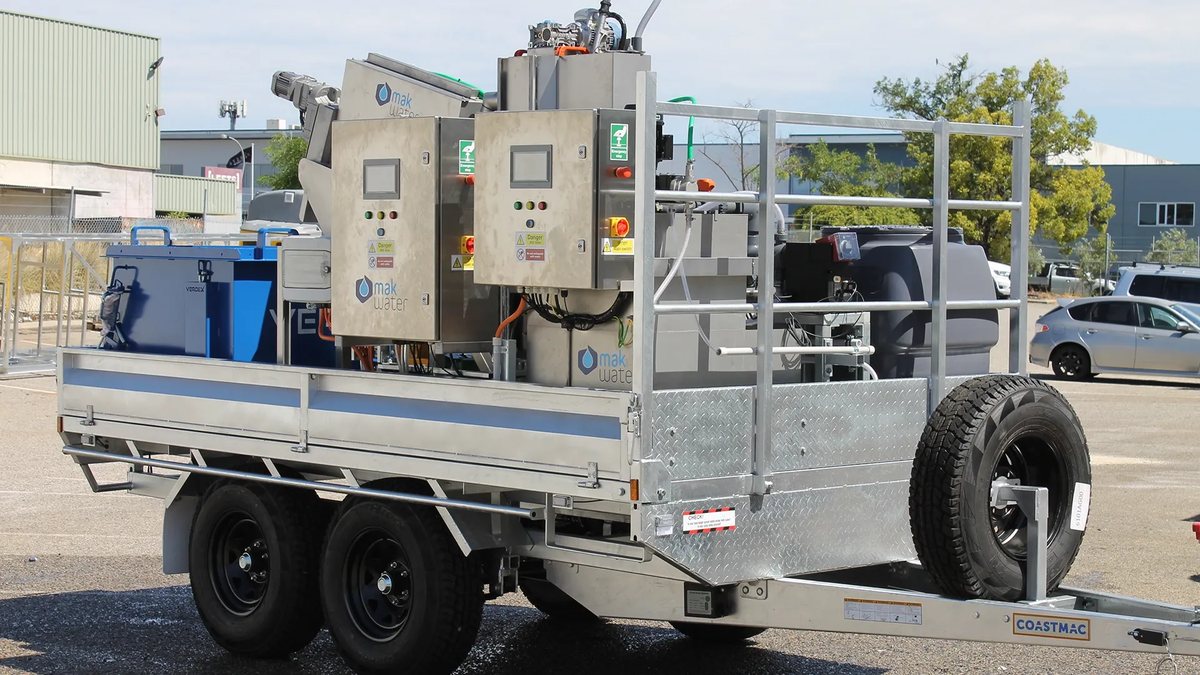
RoadTrains have been treating sewage at Australian mine sites since the late 1960s, and units from the 1970s are still running, which is the whole value proposition: boring, redundant, proven from the Great Barrier Reef to the Torres Strait. The flat-pack bolt-up version exists for sites a crane truck can't reach. Pictured above is the camp-scale reality of this class of plant (a MAK Water install): tanks and containers, not magic. Watch-out: sized for communities and camps, overkill below ~50 people.
The premium effluent club: Newterra, Modular Water, Biocell
Newterra Clear3 MBR (US/Canada) is the one you spec when the effluent numbers are the whole point: BOD under 5, TSS under 5, turbidity under 0.2 NTU, total phosphorus under 0.05 mg/L, good enough to reuse with no further treatment, in a factory-tested modular train you can expand as the village grows. Budget US$100k–350k+; DIY 2/10, ROI 6/10. newterra.com ↗
Modular Water Systems EveraSKID (USA) packages IFAS or MBR in an ISO container with an integral HVAC equipment room, touchscreen and remote monitoring, the closest thing to a consumer-friendly "order a plant" experience in the US, at roughly US$30k–150k. DIY 3/10, ROI 7/10. modularwater.com ↗ Also worth a look stateside: Dynatec (containerized MBR for campgrounds, resorts, rest stops, ~US$40k–200k, dynatecsystems.com ↗) and Pure Aqua (climate-controlled MBR-C containers, ~US$25k–150k, pureaqua.com ↗).
Biocell Water (UK/Ireland) covers 50 to 20,000 persons with containerized MBBR plus clarification and disinfection, aimed squarely at construction sites, rigs and factories, roughly US$15k–200k, DIY 4/10, ROI 7/10. biocellwater.com ↗ And for the small UK end, WPL HiPAF / WCS Environmental Engineering does 1–3,000 PE aerated-filter units with a 25-year tank warranty, ~US$10k–100k. wcsee.co.uk ↗
The budget path: Chinese container plants (Alibaba & Made-in-China)
Containerized MBR plants: Skyview, JiangSu LiDing, Teenwin & co.
Type: mostly A2O + MBR in 20/40-ft high-cubes · Serves: 5-person mini units to 300+ m³/day multi-container plants · Power: 8–20 kW connected for the 50–200 m³/day sizes · Budget (FOB): roughly US$520–5,000 for 1–5 m³/day, US$3k–15k for 10–30 m³/day, US$8k–35k for 30–100 m³/day, US$30k–150k+ beyond 300 m³/day.
Representative names and live price points at research time: Skyview's JT-series containerized MBR (50–200 m³/day, TSS <2 mg/L claimed) at mbrwatertreatment.com; JiangSu LiDing (including a solar-powered above-ground variant); Shenzhen Teenwin's mini MBR from around US$1,680; Qingdao Juchuan's domestic-sewage containers from around US$520. Watch-out: the FOB price is the beginning, not the end, freight (US$2k–10k per container), import duty (5–15%), commissioning and spare parts ride on top, and EN/AS/NSF certification is rare at this end of the market, so regulator sign-off is on you.
The solar-integrated outlier: NuWater (South Africa / global)
NuWater is one of the few builders offering solar-powered water and wastewater treatment modules as a designed-in feature rather than a bolt-on, aimed at off-grid mines, municipalities and relief work. Pricing is on-request and premium; the more common pattern is a standard container plant plus a separately engineered solar array, which we cost in the solar section. DIY 3/10, ROI 7/10. nuwater.com ↗
04 · Side by sideThe big comparison
Everything above on one table. Budget = indicative 2026 equipment pricing; "Power" is the connected or daily draw that matters for your solar sizing; scores are our editorial judgement from the cost and maintenance data, not lab measurements.
| System | Tech | Serves | Budget (equip.) | Power | DIY /10 | ROI /10 | Best for |
|---|---|---|---|---|---|---|---|
| Fuji Clean ACE 1200/3000 | Contact aeration | 8–20 people | ~A$13k installed (WA) | 47–68 W | 7 | 9 | A single certified house |
| Chinese mini-MBR (Teenwin etc.) | MBR | 5–50 people | US$1.7k–8k FOB | ~1–3 kW | 5 | 8 | Budget clusters, cabins |
| KLARO Container.One | SBR | ~100 PE / 20-ft | ~US$40k–120k | 13 kWh/day | 4 | 8 | Relocatable camps, temporary works |
| BioKube BioContainer | SAFF | to 5,000 PE | US$30k–150k | grid/gen + UV | 4 | 7 | Global remote sites |
| Biocell containerized | MBBR + disinfection | 50–20,000 people | US$15k–200k | site-dep. | 4 | 7 | UK/EU construction & rigs |
| Skyview JT MBR series | A2O + MBR | 50–200 m³/day | US$8k–30k+ | 8–20 kW | 5 | 8 | Value MBR with reuse quality |
| Modular Water EveraSKID | IFAS or MBR | small towns, resorts | US$30k–150k | site-dep. | 3 | 7 | US buyers wanting hand-holding |
| MAK Water containerized | MBBR / ASBR | camp-scale | A$50k–300k+ | site-dep. | 2 | 7 | Australian mine camps |
| Hydroflux RoadTrain | EA / MLE / MBR / SBR | 60–1,000 EP/train | A$30k–200k+ | site-dep. | 2 | 6 | Proven remote communities |
| Newterra Clear3 | MBR (ZeeWeed) | villages, resorts | US$100k–350k+ | site-dep. | 2 | 6 | Strictest effluent limits |
| NuWater solar modules | various + solar | site-scale | premium, on request | solar-integrated | 3 | 7 | No-grid sites wanting one vendor |
| DIY homebuilt MBBR | MBBR + UV | 1 household | the kit below + tanks | ~100–300 W | 9 | 9 | Owner-builders, where legal |
| Separett Villa (exit ramp) | none, waterless | 1 household | ~US$1k | 1.5 W fan | 9 | 8 | Deleting blackwater entirely |
Reading the scores: DIY 9 = owner-buildable end to end; DIY 2 = sign the contract and stand back. ROI 9 = pays for itself fast against any alternative; ROI 6 = wins in its niche, pointless outside it.
05 · The honest filterIs a container plant viable for you?
Four tests, in order. Fail any of them and a container plant is the wrong tool, no matter how good the brochure photography is.
- Headcount test. Below ~20 people, a certified domestic unit (Fuji Clean class in AU, NSF 40 aerobic units in the US, EN 12566-3 package plants in the UK/EU) does the identical job for a fifth of the money. Containerized starts making sense at cluster scale: multiple dwellings, camps, resorts, workforces, or anywhere the plant itself must be able to leave on a truck.
- Permission test. If your jurisdiction won't certify the unit (see the rules section), the deal is off before it starts. This kills most direct-from-Alibaba purchases for regulated domestic installs in AU/UK/EU/US, and is exactly why the domestic certified units exist.
- Power test. Biology needs air every day, forever. MBR containers want 8–20 kW connected at the 50–200 m³/day scale; a 100-person SBR wants ~13 kWh daily; a household AWTS wants 68 W continuous. If your power plan is a weekend generator, size this first with the solar calculator and the waste calculator together.
- Soil and water test. Treated effluent goes somewhere: soakaway, irrigation, watercourse. Clay that won't percolate, a high water table, or a creek 10 metres away can veto the layout regardless of the machine. The water guide and water independence plan cover the catchment side.
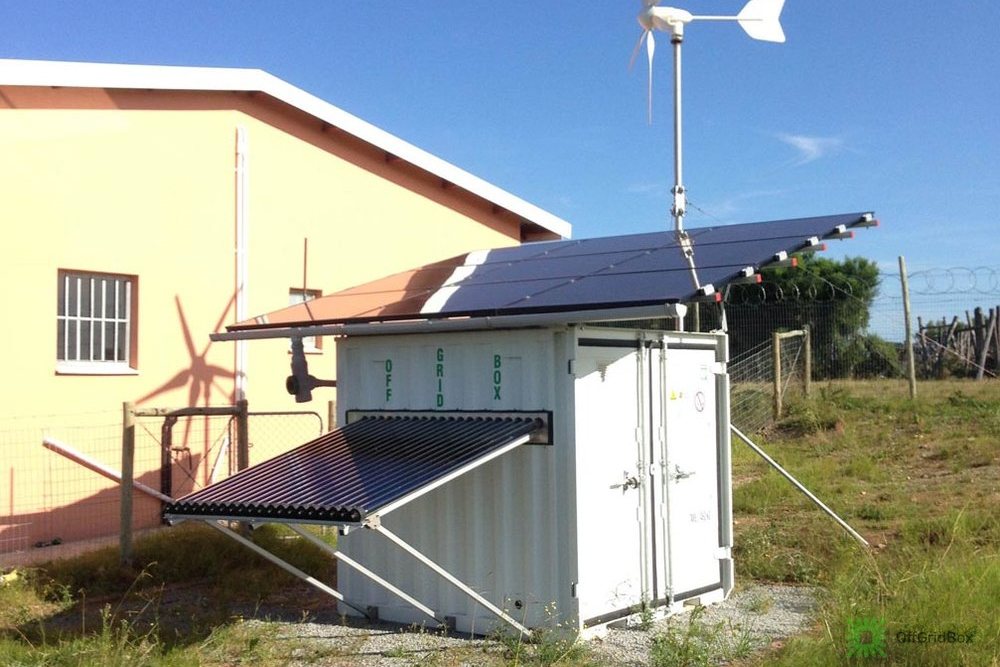
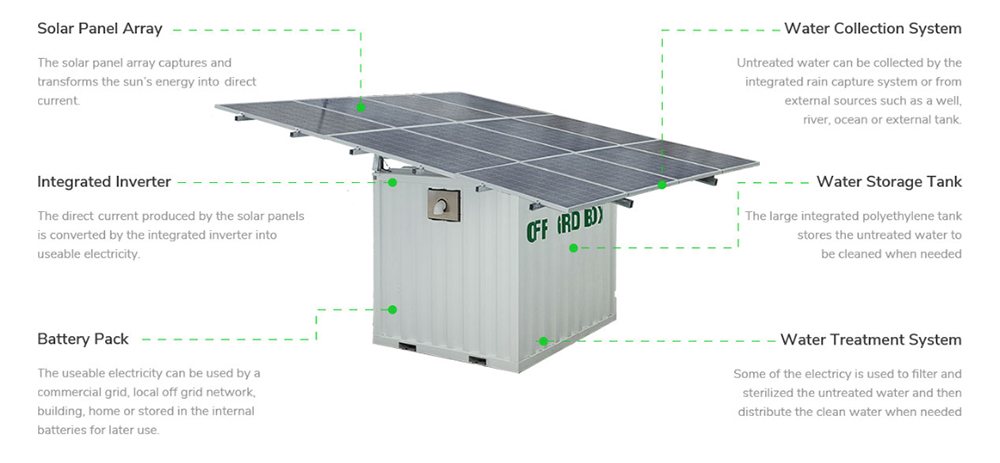
It doesn't exist commercially, we looked hard. The clean pattern is a two-container cluster: one box doing rainwater catchment and filtration (a water treatment plant), a second doing sewage (MBR/MBBR), and suppliers like MAK Water sell both as separate packages. OffGridBox deserves an honourable mention here: a solar-panel-topped container that purifies sourced water to drinking standard, catchment side only, no sewage. Rain sizing lives in the rainwater calculator and the roof harvesting guide.
06 · AcquisitionBuying one without getting burned
Western & Australian manufacturers
You're buying a project, not a parcel. Get the written datasheet, the effluent guarantee in writing, the power and slab requirements, and the commissioning scope (who flies out, who pays). Ask for two reference sites with phone numbers. Payment in milestones tied to factory test, dispatch and commissioning is standard and reasonable. Lead times run 8–20 weeks; budget freight at US$2k–10k per container internationally, a crane and slab at home, and import duty of roughly 5–15% where applicable.
The Alibaba path, done properly
- Shortlist three suppliers with transaction history and audited-supplier status, not the three cheapest listings.
- Demand certificates and verify them with the issuer, ISO 9001 via the registrar, CE via the notified body number. A PDF of a certificate proves a PDF exists.
- Live video factory walkthrough with your unit's serial number visible. Reputable factories do this without blinking.
- Trade Assurance or LC payment, never 100% upfront by wire.
- Spec the spares kit in the purchase order: blower diaphragms, diffuser membranes, a membrane cassette where fitted, control-board spares. The cheapest plant in the world is expensive with a dead board and a six-week parts wait.
- Price the whole landing: freight, insurance, duty, GST, quarantine cleaning (Australia inspects used containers hard), crane, slab, sparky, plumber, commissioning.
What lands on your slab, all-in
| Line item | Typical range (US$) |
|---|---|
| International freight, per container | 2,000 – 10,000 |
| Customs / import duty | 5–15% of equipment value |
| Local transport + crane | 500 – 5,000 |
| Slab / civil works | 1,000 – 20,000 |
| Install & commissioning | 3,000 – 15,000 |
| Electrical connection | 500 – 5,000 |
| Annual O&M (energy, chemicals, services, sludge) | 1,000 – 15,000 / yr |
07 · Off-grid powerRunning it on solar
The maths is friendlier than the reputation. Take the KLARO 20-ft: ~13 kWh/day serving a hundred people. In a decent-sun climate that's a 4–6 kW array plus a battery bank sized for overnight aeration and a grey week, call it US$8k–15k of solar gear added to the project. The household end is trivial: a Fuji Clean blower at 68 W is a rounding error next to a fridge, roughly 1.6 kWh a day. The rule that matters: aeration is a medical ventilator, not a pool pump. Stop the air for a day and the biology starts dying; restart smells like it. Design the battery for continuity, not averages.
Payback on the solar add-on runs three to seven years against diesel generation at remote-site fuel prices, faster where fuel flies in. NuWater builds it in; JiangSu LiDing sells a solar above-ground domestic unit; everyone else expects you to bring the power. Our solar sizing calculator and ROI calculator take the blower's kWh straight as an input.
08 · OwnershipMaintenance, and the small stuff that keeps it alive
Every plant above, container or household, runs on the same short list of consumables and spares. This is the part of ownership you can actually buy online, and it's also the anatomy of a DIY build, so the cards below double as the shopping list for the homebuilt MBBR in the next section. All cards were verified live on Amazon, 31 Aug 2026; prices localize to your store.
The heart: linear diaphragm air pumps
Package plants and homebuilt MBBRs alike breathe through one of these. They run continuously for years, then the diaphragm tears and the plant suffocates quietly. Buy the pump, buy the rebuild kit, write the rebuild date on the case in paint pen.
The Hiblow's honest rival adds the one feature worth paying for: an alarm that tells you the air stopped before the smell does.
The biology's suburb: K1 moving-bed media
These little HDPE wheels are what "MBBR" physically is, thousands of them tumbling in the aeration tank, each colonised by the bacteria doing the actual work. Commercial plants are charged with them at build; homebuilders buy them by the cubic foot; and if a plant ever loses media over the outlet screen, this is the refill.
The polish: UV or chlorine, pick your religion
Reuse water needs disinfection, and permits say so in writing. UV is the no-chemicals path: clear water in, lamp on, bacteria shredded. It demands clarity upstream, which is why it pairs beautifully with MBR and badly with a murky settling tank.
Where spray irrigation is permitted, many jurisdictions (Texas, famously) require chlorine disinfection, and the correct tablets are calcium hypochlorite septic tablets, never pool tablets. Tri-chlor pool tablets in a wastewater chlorinator can react with ammonia and form nitrogen chloride, which is a contact explosive. This is not internet folklore; septic service companies have the scorched hardware to prove it.
The truth-teller: bacteria test kits
You cannot smell E. coli. If treated effluent goes anywhere near irrigation, food gardens or a watercourse, test quarterly and after every service. A lab is the legal record; these kits are the early-warning system between lab visits.
The plumbing: sewage pump and float switch
An above-ground container plant can't be gravity-fed from a house, something has to lift the sewage up into the box. That something is a cast-iron sewage pump in a pit, switched by a float. These two cards are the lift station:
Weekly: glance at the panel, listen to the blower. Quarterly: sludge pump-out (most SBR/MBR containers), chlorine top-up where fitted. Yearly: air filters, diffuser check, blower diaphragm inspection, effluent test. Every 5–7 years on MBR: membrane replacement, the one big consumable. A five-minute weekly habit beats a five-figure failure, and the septic maintenance calendar maps neatly onto this rhythm.
09 · The mathsCosts vs benefits, and the ROI case
Household case (Australia). A Fuji Clean-class AWTS lands around A$13k installed, burns ~A$130 a year in electricity, and wants A$200–400 service visits a few times a year. Against that: a sewer connection quote for a remote block (often A$30k and a shrug), or a plain septic plus trench that can't legally spray-irrigate and will want pump-outs. The certified AWTS typically pays its premium back inside five years through avoided pump-outs and reused irrigation water, and it adds a compliant, sale-proof asset to the property. Hence ROI 9/10.
Camp case. A hundred-person camp trucking liquid waste out pays per load, forever, and fuel only gets more remote. A relocatable container plant at US$60k–120k with ~US$10k/year in operating cost routinely beats two to four years of waste trucking, then keeps paying, and at demob it leaves on a truck with residual value. Hence KLARO and the camp specialists scoring 7–8.
Where ROI is honest-zero: buying any container plant for a single suburban block with a sewer in the street. Connect to the sewer. The container is for where the sewer isn't.
| Scenario | Containerized plant | Conventional alternative | Break-even |
|---|---|---|---|
| Single off-grid house | ~A$13k certified AWTS, A$500–1,000/yr | Sewer connection A$30k+ / septic + pump-outs | ~5 years vs pump-outs; immediate vs sewer |
| 100-person remote camp | US$60k–120k + ~US$10k/yr | Liquid-waste trucking, per load, forever | ~2–4 years, then asset retains value |
| Temporary construction site | Rent or redeploy the container | Portable toilets serviced weekly | Often under a year at workforce scale |
| House with sewer in the street | Don't | Connect | Never |
10 · The DIY endBuild-your-own, and the exit ramp
A homebuilt MBBR is genuinely buildable: two tanks (or one baffled IBC pair), a charge of K1 media, a linear air pump, a settling zone, then UV or chlorine polish. The parts list is literally the cards above plus tanks and plumbing, and a handy builder finishes it in a couple of weekends for under a grand in gear. DIY 9/10, ROI 9/10, with the caveat in bold: a homebuilt unit carries no AS 1546.3, EN 12566-3 or NSF 40 certification, so it cannot be the permitted treatment system for a dwelling in most regulated jurisdictions. Where it shines legally: sheds, workshops, camps and greywater-only loops where rules allow, and as the learning rig that teaches you what the certified box is doing. Check your local rules first, the greywater guide marks the safe territory.
The radical alternative: don't make blackwater
Every dollar and watt above exists because a flush toilet turns clean water into blackwater. A urine-diverting compost toilet deletes that stream at the source: no water, no blackwater tank, no pump-outs, and what's left (greywater) is the easy half of this article. For countless off-grid households this is the actual correct answer, and it's why the Villa gets the final card rather than a footnote. Our compost toilet guide, process explainer and incinerator alternatives go deeper.
InteractiveBuild your kit, live total in your currency
Tick what you need. The keep-it-alive service kit is pre-ticked; add the retrofit and compound gear as the project grows. Totals update to your detected Amazon store's snapshot pricing.
Snapshot prices from 31 Aug 2026 at your detected Amazon store. Where a pick isn't listed locally it shows a converted estimate (≈) or a search link, the card button has today's live number.
Budget vs qualityWhat the upkeep costs
Three rungs, none of them wrong, pick by what you're actually running.
| Tier | Rough total | What changes |
|---|---|---|
| Keep-it-alive service kit | ~A$700 | Spare aerator, float switch, chlorine, test kits: the spares shelf every package-plant owner should own |
| DIY retrofit build | ~A$1,300 | Adds K1 media and the UV stage, plus a chlorinator allowance: the homebuilt-MBBR / plant-upgrade path |
| Full off-grid compound | ~A$4,500 | Adds the lift pump, alarmed aerator and the waterless toilet, plus a plumbing allowance: blackwater deleted, greywater treated |
The service kit pays for itself the first time a blower dies on a Friday afternoon and the rebuild happens Saturday instead of next month. The retrofit tier is the heart of a DIY build. The compound tier is the full household answer where regulation allows it, and note it still costs less than the delivery on most commercial container plants. Totals compute live from the product data above, in your store's currency; the second and third tiers include a cash allowance for the chlorinator pot and plumbing, which aren't Amazon items.
Prices were checked on 31 August 2026. The product cards on this page localise pricing snapshots to your nearest Amazon store, Amazon prices change, so treat the button as the source of truth on the day.
Worth a watchSee the boxes move
Three short films, three angles: the container itself, the membrane biology, and the household unit that's been doing this for sixty years. Players load from YouTube only when you click, the page stays tracker-free until then.
The 20-ft SBR box touring its own insides: technical room, diffusers, decanter. Watch on YouTube.
Fluence's Aspiral containers run MABR, passive-aeration membranes that cut aeration energy up to 90%. Worth understanding before you size the solar. Watch on YouTube.
The johkasou lineage behind the ACE series, half a million units installed. Watch on YouTube.
Non-negotiablesSafety, and when to call a professional
Raw wastewater carries hepatitis A, E. coli, norovirus and parasites. Gloves and hand-washing discipline around any open tank; never enter a tank or pit yourself (confined-space gases kill quickly and quietly); never substitute pool chlorine tablets into a wastewater chlorinator (nitrogen chloride, explosive); and get a licensed sparky for anything beyond a piggyback plug. Untreated discharge into a watercourse is a prosecutable offence in every jurisdiction this page covers.
Call a professional when: the permit requires certified commissioning (it usually does), the discharge point sits near a well or watercourse, anything electrical goes beyond a plug, the effluent tests positive after servicing, or the plant serves more than one household, shared systems carry shared liability. DIY the sitework, the spares shelf and the weekly checks. Don't DIY the sign-off.
AnswersFAQ
Does a containerized treatment plant make sense for a single house?
Usually not. A household makes a few hundred litres of wastewater a day, and a certified domestic secondary system (an AWTS in Australia, an NSF 40 aerobic unit in the US, an EN 12566-3 package plant in the UK and EU) does the same job for a fraction of the money. Containers earn their keep from roughly twenty people upward, or anywhere the plant must be relocatable: camps, sites, resorts, villages, temporary works.
Is the treated water safe to reuse?
From an MBR with disinfection, yes for irrigation and toilet flushing, often cleaner than the creek below a town plant. But reuse rules are set by your permit, not by the machine. Subsurface irrigation of ornamentals is the lowest bar everywhere; anything higher needs disinfection and usually periodic lab testing. A cheap coliform kit is the between-visits check.
Can a container plant run off-grid on solar?
Yes. A 20-ft SBR container serving about a hundred people draws roughly thirteen kilowatt-hours a day, coverable by a modest array plus batteries in a sunny climate; a household aerated unit sips under seventy watts. Size the battery for continuous overnight aeration, not the nameplate, biology is a ventilator patient. The solar calculator takes the load straight.
Are the cheap Chinese container plants on Alibaba any good?
Sometimes, and the price gap is real: comparable MBR containers run a third to half of Western pricing, FOB. The risk transfers to you. Verify ISO/CE paperwork with the issuing body, demand a live video walkthrough, pay via Trade Assurance, spec the spares kit into the order, and confirm your regulator accepts the certification before any money moves.
Do I need approval to install one?
Effectively everywhere, yes. Australia certifies units to AS 1546.3 and councils approve the install and discharge; England allows permit-free discharge only under the General Binding Rules (2 m³/day to ground, 5 m³/day to surface water, EN 12566 plant); the EU mandates CE-marked EN 12566-3 plants; US counties approve onsite systems against NSF/ANSI standards. The paperwork routinely takes longer than the shipping.
What maintenance does a container plant actually need?
Weekly panel-and-blower checks, quarterly sludge pump-outs on most SBR/MBR units, chlorinator top-ups where fitted, annual air-filter and diffuser service, blower diaphragm rebuilds every few years, and membrane replacement every five to seven years on MBR. Keep a spare pump and diaphragm kit on the shelf; that's most of the battle.
Free toolsPlan the rest of the system
Wastewater is one output of a bigger off-grid design. These free calculators do the maths for the rest of it, no signup, no email wall.