After my first bushfire evacuation from the Murrumbidgee flats, I grabbed the usual documents, meds, water — and a single $40 cast-iron pot. The electricity went out twelve kilometres from the fire front, long before the flames reached the substation. My neighbour’s lpg stove still had pressure, but the auto-igniter was dead and she had no matches. My other neighbour’s portable butane cooker flared when a gust whipped under the verandah. The cast-iron pot functioned on a bed of coals scraped from a fallen ironbark, no pressurised fuel, no solenoid, no glass top to shatter from thermal shock.
Affordable Cast Iron Camp Ovens
A standard 4.5-litre Australian camp oven — bare iron, three legs, flat lid with a rim for holding coals — weighs around 8 kg. Preheat it slowly over kindling and it holds enough even heat to bake damper or slow-simmer a rabbit. In 2019, Bunnings and Mitre 10 regularly sold Chinese-made unbranded units for $38 to $45, and most country showground markets had secondhand Furphy-style pots for similar coin. That price has nudged closer to $50 in 2025, but the original $40 pot still sits in the back of the ute, seasoned with lard, no carrying case needed.
Cast Iron Versatility In Grid Down
Cast iron does not care if the induction cooktop is dead. It can nestle directly into wood coals, sit on a gas ring, hang from a tripod over a pit, or balance on a brick rocket stove. The only failure mode is rust — a scrub with river sand and a wipe of oil fixes that. In a grid-down scenario, a pot that doubles as both kettle and oven means one less device to fuel, one less seal to perish, one less warranty card nobody ever honours.
Living off-grid demands cooking solutions that work without grid electricity or propane, yet my first attempt near Broken Hill proved how easily things go wrong. I spent $420 on a high-end portable gas stove, expecting it to handle the wind, only for the regulator to snap on a Tuesday, leaving me with a pile of uncooked beans and a $420 loss. That failure taught me that relying on a list of top-rated products with Amazon affiliate links is no substitute for knowing what actually holds up in the Australian outback.
Cooking off-grid in Central Queensland means working with heat, fuel, weather, and the occasional dust storm — and deciding in advance which trade-offs suit the way you actually live. The goal here is a working kitchen that produces reliable meals without depending on the 230V grid for everything, while keeping fire and CO risk firmly outside the living space. The focus below is specs, gear categories, fuel choices, and safety boundaries, not brand worship.
Core Off-Grid Cooking Methods
Four methods cover most off-grid cooking needs: gas stoves (canister, liquid fuel, propane), solid-fuel cooking (wood fire, charcoal, Dutch oven), solar ovens, and electric induction on battery/inverter. Each has a use case.
Compressed-gas canister stoves: Lightweight, compact, fast to deploy. Best for backpackers and short trips. Canisters are often more expensive per megajoule than larger fuels.
Liquid-fuel stoves (white gas/petrol): Burn hotter, handle cold and altitude better, but are heavier and bulkier. Suited to serious backcountry work.
Propane stoves (bottle-fed): Affordable, accessible fuel, with multi-burner models ideal for group car camping and base-camp setups.
Wood/charcoal fire + Dutch oven: Cast iron Dutch ovens handle open flame, charcoal, and embers; brands such as Lodge and Camp Chef are common. Fire restrictions are common, so always confirm the local rules before lighting up.
Solar ovens: Tube-style solar ovens (e.g., GoSun Fusion, GoSun Go) cook with stored thermal energy and are advertised to cook through clouds, cold, and at night without direct sun. The Fusion is sized for roughly four to six people; the Go can reach around 290 °C in under 20 minutes and can be set up vertically to heat water.
Induction on battery/inverter: Efficient and controllable, but only practical with stable battery capacity and a pure-sine inverter that can handle the surge.
Cookware Materials at a Glance
Material choice matters more off-grid because every gram and every cleaning step is harder.
Material
Weight
Heat behaviour
Care / quirks
Aluminium
Light
Conducts heat well
Dents easily; reactive to acidic foods
Stainless steel
Heavy
Less even conduction
Durable, easy to clean
Cast iron
Very heavy
Excellent heat retention
Nonstick when seasoned; rusts if neglected
Enamel-coated metal
Light to medium
Even heating
Easy to clean; enamel can chip
Backpackers generally pick lighter aluminium or nonstick-coated kits; car campers can carry the heavier stainless, cast iron, or enameled pieces without drama.
Core Camp Kitchen Kit
A core kit that covers 90% of meals:
Nested pots: ~2 L small pot and ~4–6 L large pot, ideally with a shared lid.
Kettle: For heating water fast (drinks, rehydrating meals, cleanup).
Frying pan / skillet: Cast iron for the fire, hard-anodised for the gas stove.
Dutch oven (base-camp only): For stews, bread, and roasts over coals.
Utensils: Long-handled spoon, spatula, tongs, lid lifter, oven mitts that can take radiant heat.
Cutting board + knife: A single sharp chef's knife and a plastic board handle most prep.
Windshield: Folding windshields keep stove flames steady in wind.
Fuel management: Spare canisters, a gas bottle with regulator, or matched fire tools — sized to the trip.
Water containers: Cooking and cleanup water counts alongside drinking water when planning supplies.
Solar Ovens: What They Actually Do
Solar ovens are fuel-free, silent, and low-maintenance, but performance depends on tube design and stored thermal mass rather than moody weather.
The GoSun Fusion is sized for about four to six people and can cook using stored thermal energy in its tubes when it is dark.
On a sunny day, a smaller meal in the Fusion takes roughly 20 minutes; larger meals at night or on cloudy days take around 90 minutes.
The GoSun Go can heat up to about 290 °C in under 20 minutes and can be set up vertically to heat water.
Marketing claims — cook through clouds, in freezing snow and cold, at night without direct sun — are based on the thermal storage in the tubes, not on raw photovoltaic output. Treat them as "works under marginal conditions" rather than "magic."
Practical notes: preheating matters; a shaded tube is a slow tube; and a solar oven is a supplement, not a replacement for a stove you can run at midnight in a storm.
Propane as Off-Grid Fuel
Propane is one of the more practical off-grid cooking fuels because the bottles are swappable, the burners are simple, and the heat output is predictable. Portable propane stoves, furnaces, and ovens are commonly used for camping, RVs, and homestead cooking.
Trade-offs to plan around:
Cost per megajoule is higher than wood or charcoal in some regions, and refills can be harder to source in remote areas.
Burning produces emissions — ventilate.
Some propane stoves and ovens can ignite via a battery without being connected to mains electricity, which is useful during outages.
For a base-camp kit, a two-burner propane stove on a stable table, fed from a 4.5 kg gas bottle through a properly fitted hose and regulator, covers most cooking.
Electric Induction Off-Grid
Induction is efficient and precise, but it is a power-hungry appliance and only as good as the battery/inverter behind it. A typical domestic induction zone can pull 1.5–2.5 kW on boost. Running it from batteries means a sizeable lithium bank and an inverter that delivers the surge without tripping.
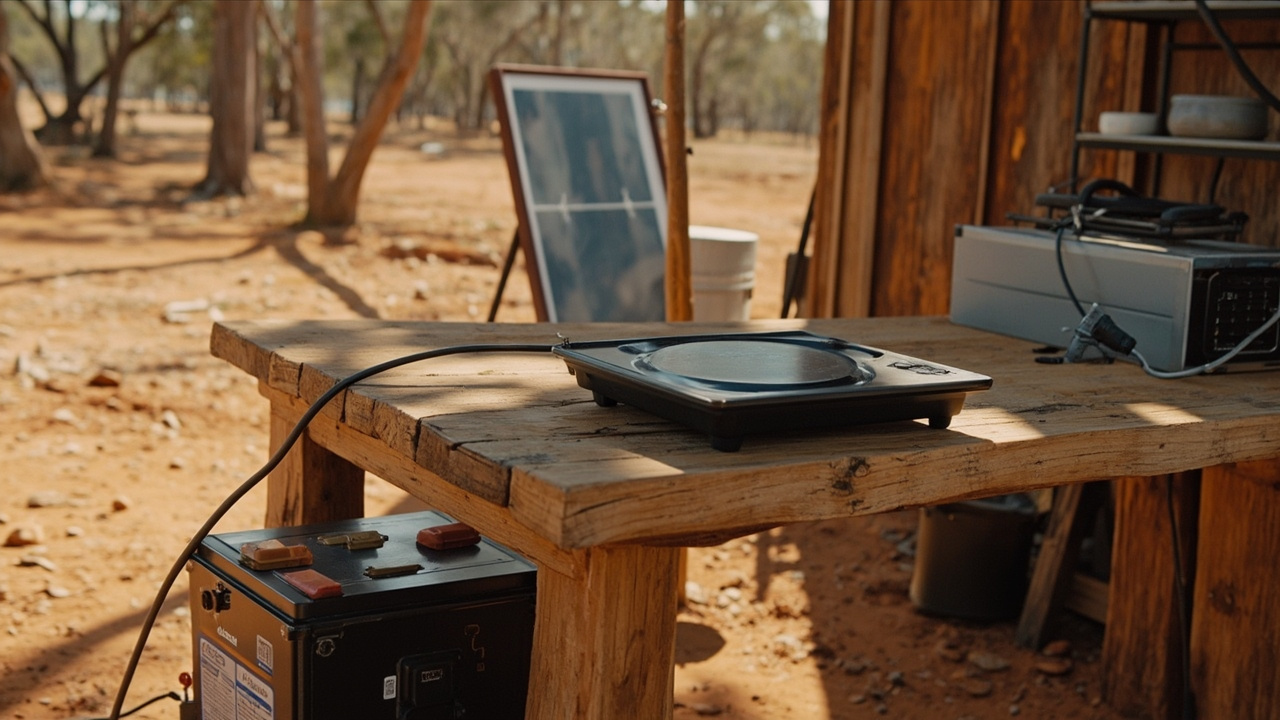
Portable induction cooktop drawing from a battery station
Use induction when:
Battery state of charge is healthy.
Cookware is ferromagnetic (cast iron and most stainless steel pans work).
The inverter is rated for the surge.
Don't use induction as your only off-grid cooking method if your battery is the weak link in the system.
Building a Power-Outage / Emergency Cooking Plan
When the grid drops, the kitchen plan matters more than the kitchen gear.
Stock three days of ready-to-eat, no-cook food as the baseline.
Categorise meals by what they need: no-cook, hot-water-only, brief simmer/heat, long-cooking, or refrigeration-dependent. Match the meal to the fuel you actually have.
Include cooking and cleanup water in your supply calculations.
Keep a manual can opener, a wind-up or battery radio, and a torch with the kit.
Safety: When to Call a Licensed Professional
Off-grid cooking concentrates heat, flame, and fuel in places they do not normally live. Treat the following as hard rules, not suggestions.
Never operate fuel-burning devices indoors. Camp stoves, charcoal grills, generators, propane heaters and similar must never be used in a home, garage, basement, shed, tent, vehicle, or camper, nor in a doorway, on an enclosed porch, or near an open window or vent.
Generators belong outdoors, more than 6 m from windows, doors, and vents, with exhaust directed away from the home, per CDC guidance.
Carbon monoxide is odorless and colorless. Symptoms include headache, dizziness, weakness, upset stomach, vomiting, chest pain, and confusion. A sounding alarm or suspected exposure means: move to fresh air and call emergency services.
Battery-backup CO alarms are a warning layer, not a fix — they do not make indoor fuel burning safe. Maintain them per the manufacturer's instructions.
Charcoal keeps producing CO as it cools. Warm grills and live coals must never be brought indoors.
Portable gas stoves must be used outdoors on a stable surface, with manufacturer-specified fuel and connections. Damaged equipment should not be used. Check local fire restrictions before lighting anything.
Gas installation and repairs (regulators, pigtails, fixed propane lines, gas-leak detection) should be carried out by a licensed gas fitter. If you smell gas, shut the bottle, ventilate, and call a professional.
Electrical work on inverters, battery banks, distribution boards, and generator interconnects must be done by a licensed electrician in line with Australian wiring rules (AS/NZS 3000) and any state-specific requirements.
One colourful aside: solar ovens are the only cooking gear I've used where the user manual actively tells you to cook in a storm. Everything else on this page would rather be outdoors, upwind, and nowhere near a window.
FAQ
Do solar ovens actually work on cloudy days or at night?
Tube-style solar ovens like the GoSun Fusion store thermal energy and are advertised to cook through clouds, cold, and at night without direct sun. Expect longer cook times — a larger meal can take around 90 minutes in those conditions, versus roughly 20 minutes for a smaller meal on a sunny day.
What's the lightest cooking kit that still does real meals?
A small canister gas stove, a ~1–2 L titanium or aluminium pot, a small frying pan or lid-skillet, a long spoon, a lighter, and a folding windshield. Skip cast iron and Dutch ovens if you're carrying everything on your back.
Is induction viable off-grid?
Yes, with caveats. You need a battery bank large enough to supply 1.5–2.5 kW per zone, a pure-sine inverter that can handle the surge, and ferromagnetic cookware. Treat it as a supplement to a gas or solar setup, not a replacement during long blackouts.
How much water do I plan for cooking during an outage?
Cooking and cleanup water counts alongside drinking water. A rough rule is several litres per person per day on top of drinking needs, depending on how much scratch cooking versus no-cook food you do.
Can I use a propane stove inside during a blackout?
No. Fuel-burning stoves and heaters must never be operated indoors, including in a doorway, on an enclosed porch, or near an open window or vent. Use them outside, and run a battery-backup CO alarm as an extra layer.
How do I stop my gas stove flame blowing out in the wind?
Use a folding windshield around the burner, set the stove on a stable surface below waist height, and shelter it behind a vehicle, rock, or windbreak. Liquid-fuel stoves handle wind better than small canister stoves; if you're regularly cooking in strong wind, switch stove type rather than fighting it.
It covers 17 essential off-grid cooking techniques, including practical setups like rocket stoves and dutch ovens, which complement the methods and gear section of my guide.— Jenny Mills
Frequently asked questions
Can I cook on a gas stove during a total fire ban in Australia?
Yep, so long as it carries the AS 2658 Australian Standards certification. The area around it has to be cleared and someone needs to be in attendance the whole time it's lit. My Companion two-burner from BCF is exactly what I fall back on when the RFS slaps a ban on the shire.
What fire safety gear do I need around an outdoor fire pit?
Council here wants a 3-metre clearance from any structure and either a running hose or a 9-litre extinguisher within reach while the fire's going. I hang a dry-chemical ABE 1 kg extinguisher off the verandah post - close enough to grab in a hurry, out of the way enough not to trip over in the dark.
Does using bottled gas count as off-grid cooking?
In my book it does. Off-grid just means no reticulated natural gas line and no leaning on 240-volt appliances for the everyday cook-up. A Swap'n'Go bottle is stored fuel, same as the diesel in the generator - not a grid connection.
How do I get a fire permit in NSW?
Wander down to your local Rural Fire Service brigade and have a yarn with the captain. It costs nothing but a bit of your time, and you need one before you light any solid-fuel appliance outdoors. I also check the Total Fire Ban app on my phone the morning of any cook-up - on a Catastrophic day, nothing gets lit, not the rocket stove, not the fire pit, not the Weber.