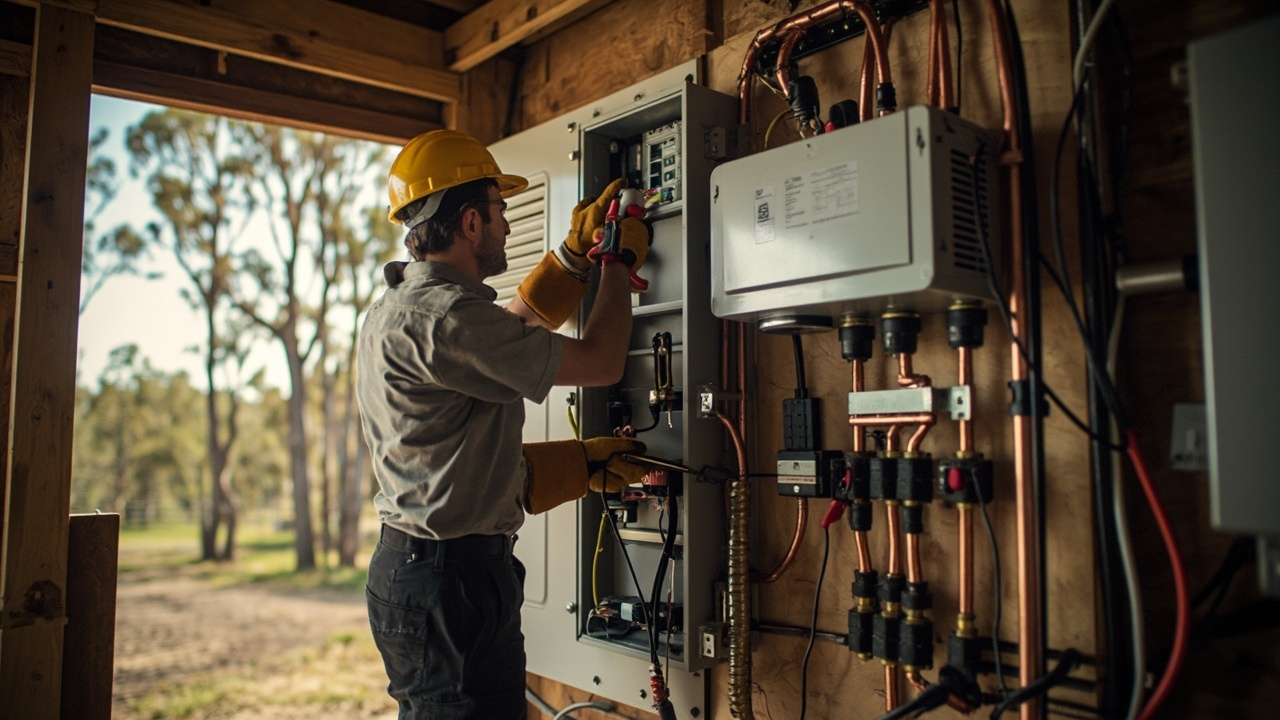
Picking the battery chemistry for a stand-alone power system (SAPS) is the decision you'll live with for the next decade, so it's worth understanding the trade-offs before the panels go up. In my experience in Central Queensland, the storage choice matters more than panel wattage once you're truly off-grid: cloudy weeks, generator run-time, and replacement cost all trace back to what's in the battery box.

By Dave Miller · off-grid sparky · 22 years wiring solar, batteries and sheds in central QLD
“After burying a lead-acid bank in the Queensland heat for three years, I learned 40% of its capacity vanished to acid stratification before the sun even rose.”
Off-Grid Battery Chemistry: Lead-Acid vs Lithium Australia
Below is a working comparison of lead-acid versus lithium (primarily LiFePO4) for Australian off-grid conditions, with notes on the alternatives you'll see in quotes.
Why Battery Chemistry Is the Core Decision
A battery's job in an off-grid system is to store energy from solar PV for use overnight, on cloudy days, and during equipment surges. A deep-cycle battery — designed to be discharged up to about 80% of its full capacity (depth-of-discharge) and recharged repeatedly — is the standard for SAPS. Standard battery life is measured in cycles before the battery can no longer hold a significant charge, usually defined as less than 70% of its original capacity. For SAPS, a full cycle is generally recommended at 70% depth of discharge, and oversizing the battery bank relative to expected consumption extends battery life.
For most Australian residential SAPS, 48V nominal has become the practical standard because it keeps cable currents manageable and pairs with the bulk of available inverters and charge controllers.
Lead-Acid: Flooded, AGM, Gel
Lead-acid batteries (flooded/wet-cell) have been the most common medium for off-grid energy storage and the cheapest way to store energy since their invention about 150 years ago.
How they work: an anode (positive electrode), a cathode (negative electrode), and a sulfuric acid electrolyte. As the battery discharges, the electrolyte becomes mostly water, leaving it susceptible to freezing and evaporation. This is why flooded cells need regular top-ups with distilled water and good ventilation — hydrogen off-gassing during heavy charge is a real safety consideration.
Practical points for off-grid use in Australia:
- Depth-of-discharge: A 50% DoD limit is the safe figure for cycle-life preservation. A "400Ah" flooded bank therefore delivers about 200Ah of usable energy.
- Temperature sensitivity: Heat accelerates grid corrosion and water loss. In CQ summers, battery enclosures need shade and ventilation; cold snaps are less of a worry here than in southern states, but a discharged battery will still freeze well before a charged one.
- Lifespan: Lead-acid batteries have an average lifespan of 3–7 years and are no longer commonly recommended for new off-grid installations in Australia.
- Maintenance: Flooded cells need monthly checks (water, specific gravity, terminals). AGM and gel variants are sealed and lower-maintenance but cost more and are still subject to the same ageing characteristics.
- Round-trip efficiency: Noticeably lower than LiFePO4, so you'll need more solar harvest to refill the same usable energy.
If you're retrofitting an older shed system or running a budget setup that you can nurse along, lead-acid still has a place. For new builds where the cost of swapping banks every 5 years is real money, the maths is harder to defend.
Lithium LiFePO4: The Current Default
Lithium Iron Phosphate (LiFePO4) batteries are lighter, more compact, more durable, and less prone to overheating or fire than earlier lithium-ion chemistries. That last point matters in a Queensland switchroom with 40 °C+ ambient days.
- Depth-of-discharge: Routine use at 80–100% DoD is acceptable, so a "100Ah" LiFePO4 bank typically delivers close to its nameplate capacity.
- Lifespan: LiFePO4 batteries typically last 5–15 years depending on the manufacturer and are considered the best all-round option for residential off-grid use.
- Round-trip efficiency: Higher than lead-acid — less solar harvest wasted as heat during charge/discharge.
- Maintenance: Effectively maintenance-free. No watering, no equalisation charges in most setups, no corrosion on the terminals if torqued correctly at install.
- Weight and footprint: Roughly a third the weight of an equivalent lead-acid bank, which simplifies mounting and shipping.
The trade-off is upfront cost per kWh, which historically has been 2–3× lead-acid. Over a 10-year horizon the lifecycle cost usually favours lithium because of cycle count and usable capacity. Always check the manufacturer's cycle-life curve at the DoD and temperature you'll actually run, not the marketing peak.
One aside: at our place, the day the old flooded bank came out and a LiFePO4 rack went in was the day the generator stopped earning its keep in summer.
Lithium Titanate and Flow Batteries
You may see two other chemistries in quotes.
Lithium titanate batteries are a premium option with a lifespan of 20 years or more, suited to extreme temperatures and high-power, high-cycle use. They're uncommon in residential SAPS because of price, but they shrug off heat that would cook other chemistries.
Flow batteries offer a 20+ year lifespan with highly consistent energy delivery, making them ideal for commercial and large-scale off-grid operations. Vanadium redox is the usual variant. For a homestead SAPS they're usually overkill on cost and footprint, but worth knowing they exist if you scale up later.
Lead-Acid vs Lithium: Side-by-Side
| Parameter | Flooded Lead-Acid | AGM / Gel Lead-Acid | LiFePO4 |
|---|---|---|---|
| Usable DoD (cycle life) | ~50% | ~50–60% | 80–100% |
| Typical lifespan | 3–7 years | 3–7 years | 5–15 years |
| Round-trip efficiency | Lower | Lower | Higher |
| Maintenance | Monthly watering, venting | Low (sealed) | Effectively none |
| Weight per kWh | Heaviest | Heavy | ~1/3 of lead-acid |
| Heat tolerance | Poor (water loss, grid corrosion) | Poor–Moderate | Moderate to good with BMS |
| Upfront cost per kWh | Lowest | Mid | Higher |
| Off-gassing | Yes (hydrogen) | Minimal | None |
| Best fit | Budget retrofits, nurse-able banks | Sealed retrofits, mid-life upgrades | New off-grid SAPS in Australia |
Sizing and Operating Notes for Australian Conditions
- Worst-week sizing: A genuine off-grid system must be sized for the worst week of winter at the property's latitude, with storage sized for days of autonomy rather than marketing figures, and should integrate a generator for extended low-sun periods.
- Hybrid option: Hybrid off-grid systems keep the grid as a fallback, allowing the home to run primarily on its own solar and battery storage; some owners start hybrid and later go fully off-grid after the system proves itself through a storm season. Worth considering if grid connection is available but expensive to leave behind.
- Design matters more than capacity: An appropriately designed solar PV and battery system matters more than a large storage capacity. A well-sized 10 kWh bank will outperform a poorly managed 20 kWh bank.
- Temperature management: Key selection criteria for an off-grid battery system include long cycle life and warranties, ability to operate in high Australian temperatures, modular expandability, and proven chemistry from a reputable manufacturer. In CQ, a shaded, ventilated, and ideally insulated battery enclosure pays for itself in extended cycle life.
- Modularity: Plan for expansion. Battery banks that accept additional modules in parallel without re-balancing headaches save money at year three.
- Reputable manufacturer: Proven chemistry from a reputable manufacturer with a real warranty and service network in Australia is non-negotiable for any chemistry.
Safety and When to Call a Licensed Professional
Batteries store energy for later use and are especially effective when paired with a rooftop solar PV system; they can be grid-connected or stand-alone (off-grid). That stored energy — and the charging equipment that pushes it around — is dangerous if mishandled.
- Installation: Batteries should be installed by accredited installers and properly maintained to ensure safety and performance. Australian CEC-accredited solar designers and licensed electricians are the minimum.
- Voltage hazards: 48V nominal LiFePO4 banks sit above the 50V extra-low-voltage threshold when fully charged per cell. DC fault currents are brutal and don't "switch off" the way AC faults do.
- Flooded lead-acid hazards: Hydrogen off-gassing requires ventilation; a poorly vented enclosure has caused explosions in sheds. Treat any flooded cell area as a confined-space gas hazard during heavy charge.
- PPE: Insulated tools, Class 0 gloves, face shield — non-negotiable for any bank work.
- When to call a licensed professional:
- First install, replacement, or capacity upgrade.
- Any cell that has bulged, vented, leaked electrolyte, or taken physical impact.
- Tripped BMS that won't clear, or repeated charge/discharge faults.
- Generator integration with the battery system (changeover gear, earthing, and inverter-charger coordination).
- Storm or flood damage to cabling, enclosures, or the battery room.
- Insurance claim work — documentation from a licensed installer protects the policy.
Don't trust a handyman's "yeah, I do batteries too" line for high-current DC work. Your life and the warranty both depend on accredited hands.
FAQ
Is LiFePO4 always better than lead-acid for off-grid in Australia?
Not always. For budget-driven retrofits or systems that won't see much cycling, lead-acid's lower upfront cost can still make sense. For new SAPS in Australia, lead-acid is no longer commonly recommended.
How many cycles will I actually get from a LiFePO4 bank?
It depends on the manufacturer, the DoD you run, and the temperature. Treat the published cycle count as a ceiling — real-world figures are usually below it.
Do I still need a generator if I go lithium?
Yes. A genuine off-grid system should integrate a generator for extended low-sun periods. Lithium reduces generator run-time significantly but doesn't eliminate the need.
Can I mix lead-acid and lithium in the same bank?
No. Different charge profiles, voltages, and ageing characteristics make shared banks inefficient and unsafe. Replace the whole bank when you change chemistry.
What incentives exist for home batteries in Australia?
Federal and many state/territory governments offer incentives such as subsidies or low-interest loans for household batteries and renewable energy. Battery payback periods can be shorter than the typical 10-year warranty period once subsidies are applied, but financial benefit depends on circumstances.
Does hot weather kill lithium batteries?
Heat accelerates degradation in any chemistry. LiFePO4 handles high Australian temperatures better than earlier lithium-ion variants, but a shaded, ventilated enclosure still extends service life noticeably.
Sources
- https://www.solarchoice.net.au/blog/batteries-for-stand-alone-solar-power-systems/
- https://greenmagazine.com.au/information/statewide-power/a-guide-to-buying-the-best-off-grid-battery-system-australia/
- https://www.yourhome.gov.au/energy/batteries
- https://www.theoffgridshop.com.au/blogs/article/off-grid-battery-systems-for-australian-homes-a-complete-buyer-s-guide-to-choosing-and-using-solar-storage
Worth a watch: Solar Batteries Explained | Back to Basics | Episode 3 · MC Electrical