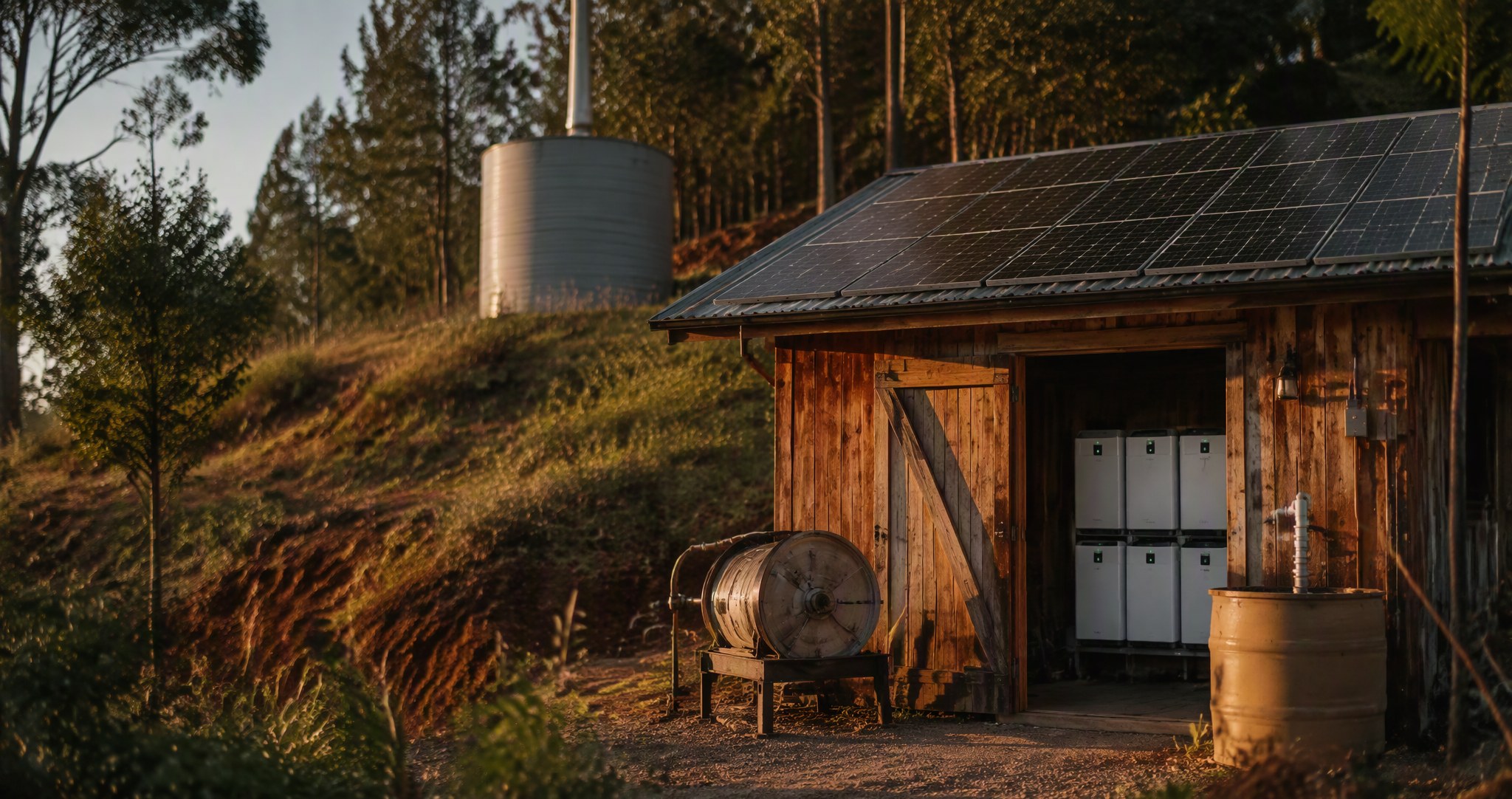
Every summer the same message lands in our inbox: "The shed hits 45°C (113°F) by two in the afternoon. What can I actually run off my batteries?" This is the full answer — every off-grid cooling and dehumidifying option we've tested, priced or dug trenches for, from zero-watt shade cloth to a proper inverter mini-split, plus the water-from-air question everyone asks and nobody answers straight.
Two promises up front. First, every number below is in watts and litres, not marketing adjectives. Second, every product card has its real downside printed on it — if something here is rubbish in your climate, we'd rather you learn that from us than from a courier box. Kit-cost reality: a serious passive-and-fan stack lands around a few hundred dollars, while the full shed-climate build with the mini-split runs to a few thousand. Both totals compute for your store below.
TL;DRThe short version
Quick picks by job
E-E-A-THow we chose
- Watts first, adjectives never. Every option below lists its real power draw or water use, because off-grid you're the power station and the water utility. We're metric-first with US customary in brackets — gallons, feet and °F ride along wherever they matter.
- The downside is printed on the card. Ratings and prices were verified on live Amazon listings on 1 September 2026 (AU and US), and the "watch-out" lines come from actual owner complaints, not our imagination.
- Law is part of the product. The licensing section was checked against the Australian Refrigeration Council and the federal ozone department — because the best air con is the one that doesn't come with a fine.
01 — The physicsFirst: is your heat dry or wet?
Cooling splits into two games. In dry heat — inland Australia, the US Southwest, the Mediterranean interior — water is your refrigerant: evaporate it and the air itself drops toward its wet-bulb temperature. In wet heat — the Queensland coast, the Gulf states, the monsoon belt — the air is already full of water, evaporation stalls, and the only real relief is a compressor (refrigerated air con) or drying the air itself.
One cheap instrument tells you which game you're playing. Stick a hygrometer in the shed for a week of hot weather and look at the afternoon readings:
Your phone weather app reports outdoor RH — useless. You need the number inside the hot room at 3 pm. A cheap ThermoPro TP50 on the wall settles the swamp-cooler-or-air-con argument in a week.
02 — Free coolingPassive & natural: stop the heat getting in
The cheapest kilowatt is the one you never generate. A colorbond roof in full sun can hit 70°C (158°F) and turn the shed into a slow oven; everything else on this page fights that gain. So the first spend is never a compressor:
- Shade the walls and roof. A $60 roll of shade cloth on the west side or a pergola skin over the roof can drop surface temperatures 20°C (36°F) or more. Coolaroo (an Aussie company) has a 15-year UV warranty; owners drape it over pergolas, west walls and catio roofs and report rooms "so much cooler" the same afternoon.
- Reflect the radiant load. A radiant barrier (double-bubble foil like Reflectix) under the roof or on the west wall reflects up to 97% of radiant heat — but only with an air gap beside it, and it does nothing for conducted heat on its own. Pair it with bulk insulation; our insulation guide and the shed retrofit walkthrough cover the stack-up.
- Move the night air through. Cross-ventilation done properly — low inlets on the cool side, high outlets on the hot side — purges a day's stored heat for free. We've a whole piece on ventilation layouts that actually work; the short version is that a single open window is decoration, not ventilation.
- Use mass and earth. Slab floors, earth berming and earth-sheltered walls (see the earth-bag build notes) flatten the daily swing. And if you've got a dam, even a shallow pond loop beats a 42°C (108°F) condenser coil — more on water loops under earth tubes.
Shade cloth: Coolaroo Builder's Block 70%
Six by fifteen feet of knitted HDPE with eyelets top and bottom — cable-tie it to a west wall, a pergola frame or a stretch of fence that bounces sun at your windows. It blocks 70% of UV while letting breeze through (a solid tarp would turn into a sail and a heat trap). For a sun-blasted entertaining area, step up to the 90% version; for the chook run and the west wall, 70% is the sweet spot between shade and airflow.
Radiant barrier: Reflectix BP24010
The "space blanket" of the shed world. Staple a run of it inside a hot tin wall or across the west windows and the radiant gain collapses — owners use it on garage doors, vans, water tanks and dog boxes. It cuts with scissors and weighs nothing. Just don't expect it to replace bulk insulation: it's one layer of the sandwich, not the sandwich.
Load CalculatorBefore buying anything with a motor, know what it costs your system to run it. Open →03 — Buried coolingEarth tubes: free cold air from the ground, honestly
Two metres down, the soil stops caring about the weather. It sits near the local mean annual temperature — roughly 15–22°C (59–72°F) across most of populated Australia — in January and July alike. Earth tubes (also called ground-air heat exchangers, Canadian wells or GAHT) exploit that: pull outside air through buried pipe and it comes out the other end at soil temperature, having dropped some of its humidity as condensation on the pipe wall. It's the oldest trick in the book — Persians and Romans ran versions of it — and it still works.
What it really delivers: on a 40°C (104°F) day you'll get a steady stream of air in the low-to-mid 20s (low 70s°F) — not fridge-cold, but it's every hour of the day for the power of an LED strip. In a greenhouse it can be the whole cooling system (the famous "oranges in the snow" Nebraska greenhouse grows citrus in −20°C (−4°F) winters on this principle alone). In a shed-house it's a superb pre-cooler that takes the brutal edge off, so your mini-split idles instead of grunting.
The honest problems: condensation pools in the pipe — so you slope it 1–3% to a drain or sump, or you grow a mould farm and pump spores into your lounge room. Radon is a real question in some soils (test if your region is known for it). And the retrofit maths is brutal: hiring an excavator to bury 40 m (130 ft) of pipe for a supplement makes engineers mutter; if you're already trenching for water or power, or building new, the economics flip to "nearly free forever". Building-approval and plumbing rules vary — a 20-minute call to council beats a letter.
Player loads from YouTube only when you click it, so this page stays fast and tracker-free until then.
Russ Finch's greenhouse (above) is the proof of concept everyone cites — and note he runs it with a small fan, which is all an earth tube ever asks for. The fan we specced for the job is below; the pipe (100 mm / 4-inch DWV from any plumbing supplier, about the cost of a pub counter lunch per length) goes in the tier maths as an allowance.
The mover: AC Infinity CLOUDLINE T6
A quiet 6-inch inline fan with a proper temperature and humidity controller — which means it can run the whole strategy automatically: pull earth-tube air when the shed exceeds setpoint, or night-purge the building at 2 am when the outside air finally drops below the inside air. Ten thousand ratings at 4.8 stars; growers and server-closet people run them for years. The catch for off-gridders: it's a mains unit, so the inverter needs to be awake — or you run a DC fan instead and lose the smarts.
04 — Moving airFans & vents: watts that punch above their weight
Moving air across skin is worth about 2–4°C (4–7°F) of felt temperature, and it costs single-digit watts. Before any compressor conversation, the airflow layer should be done — it's also the layer that dehumidifies by exhaust rather than by machine.
At body level: SEEKR Sirocco II (12/24V)
Ask any long-term caravanner what fan survives corrugations and it's this Canadian gimbal fan. Three speeds, 360° aim, and 0.35 amps on high at 12V — that's a week of overnight running off a 100Ah battery without the solar even noticing. Mount one over the bed and one over the kitchen bench and most summer nights stop being a problem. Owners consistently report years of daily use; the failure mode worth knowing is the auto voltage-sensing board, so buy from a seller who'll honour warranty locally.
At roof level: MaxxFan Deluxe 7000K
Hot air pools at the ceiling; this punts it outside. The Deluxe's party trick is the integrated rain cover — it keeps exhausting on wet, sticky nights when a cheap vent has to close. Ten speeds, thermostat, remote, roughly 2.8A flat out at 12V. Van-lifers run these 24/7 off a single 100Ah battery. Two honest quirks from long-term owners: a full-charge LiFePO4 sitting at 14V+ can trip its protection circuit and shut the fan down (an inline buck regulator set to 12.5V fixes it permanently), and the white lid plastic goes brittle after years of ultraviolet — a coat of exterior paint at install is cheap insurance.
Fans in, vent out: run the Sirocco pushing across the bed and the MaxxFan exhausting at the roof and you've built a poor-man's breeze tunnel. On a 35°C (95°F) dry night that's the difference between sleeping and not.
05 — Water as refrigerantEvaporative cooling: brilliant in dry heat, useless in wet
A swamp cooler is just a fan blowing through a wet pad — no compressor, no refrigerant, no licence, and about 80–100 W for a serious unit. In return you get air knocked down toward its wet-bulb temperature: on a 38°C (100°F) afternoon at 20% humidity that's air in the low 20s. It adds moisture to the room (which dry-climate skin loves), it wants a window open downstream so the humidity has somewhere to go, and it drinks water — figure 4–10 litres an hour (1–2.6 gal) on a hot day, which is a rainwater-tank conversation, not a mains one (see the rainwater calculator and the roof-harvesting guide).
The workshop standard: Hessaire MC18M
1,300 CFM, 4.8-gallon tank, garden-hose float valve for continuous running, and castors so it follows you from the shed to the verandah. This is the unit dry-climate owners buy a second one of. Now the honesty: its 4.1-star average is not a quality problem — it's a physics problem. People buy swamp coolers in Alabama in August and write furious reviews when the air comes out warm and sticky. Under about 50% RH it's the best watts-to-cooling deal on this page; above 60% don't buy it, buy the split system or a dehumidifier.
The $60 DIY version: the bucket swamp cooler
Five-gallon bucket, a bilge or 12V fan, a pump, some evaporative pad or even blue foam — the classic "bucket air conditioner" build genuinely works for a desk, a swag or a tent, and it's an afternoon project that teaches you exactly why pad area and water temperature matter. It will not cool a room. It will absolutely save a nap.
One of the better bucket-cooler builds: variable-speed fan and a proper ice reservoir. Click to load the YouTube player.
Evaporative gear is a standing-water device: rinse pads monthly, flush tanks weekly in heavy use, and let pads dry out at season's end. A swamp cooler you never clean becomes a mould diffuser with a fan attached — Legionella jokes are funny until they aren't.
06 — Real air conRefrigerated cooling off-grid: the watts, the options, the traps
Ten years ago "air con off solar" was a joke. Then inverter compressors and cheap LiFePO4 happened. A modern 12,000 BTU mini-split draws 900–1,200 W flat out, but once the room's at temperature it modulates down to a few hundred watts — call it 3–4 kWh across a hot afternoon for a small, insulated room. That's a 2 kW array and a 5 kWh battery, not a power station the size of a ute. Run the numbers for your room with the solar calculator and the battery sizer, and if you're still designing the system, our DC-vs-AC architecture piece explains why an efficient inverter AC load beats a native DC unit at house scale.
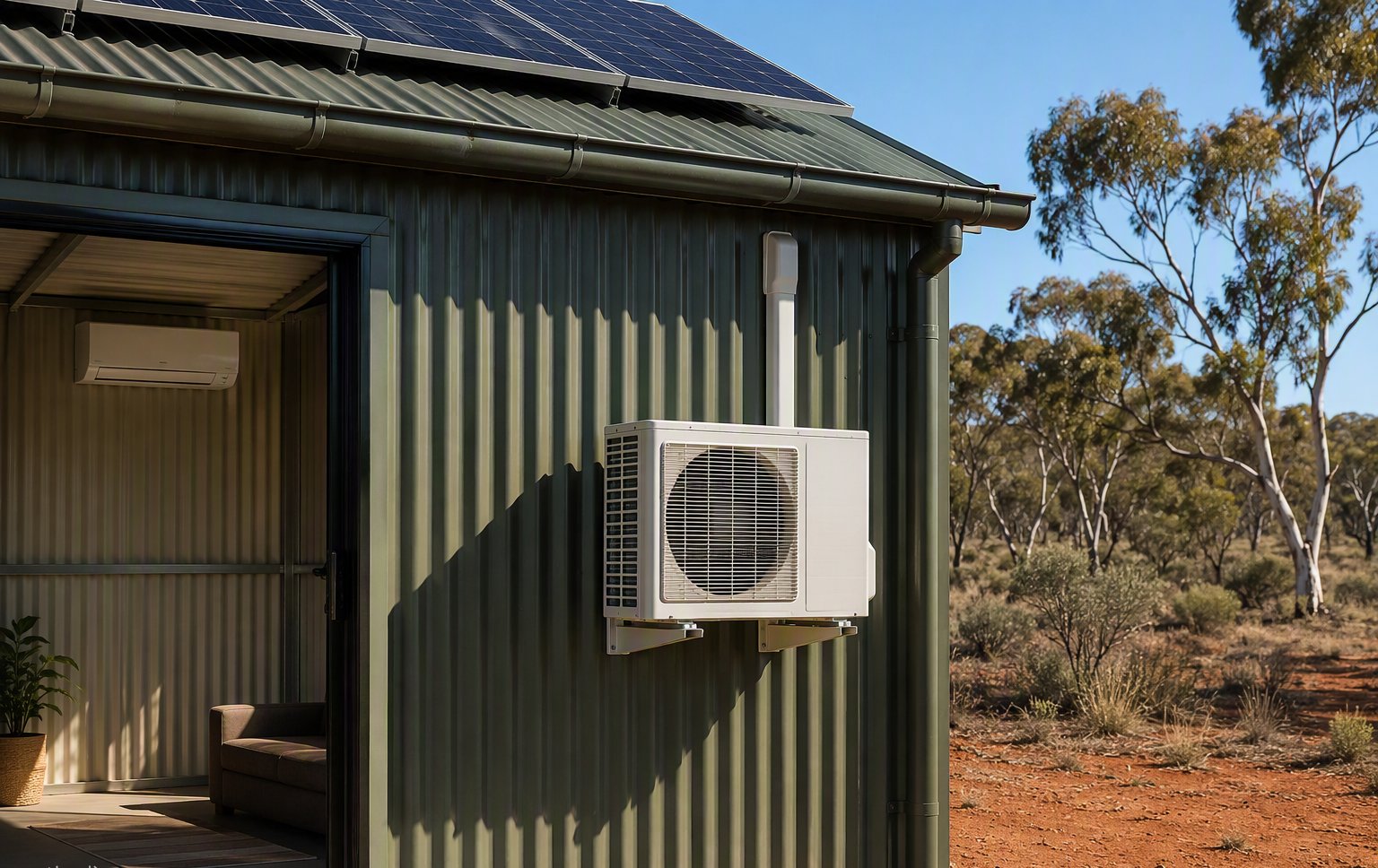
The budget split: Senville LETO 12K
The cheap way into real refrigerated cooling, and the ratings go 2,100 deep because people actually buy it. It cools a well-insulated small room off a 2 kW-class inverter without drama. The compromises are real: it's a conventional flare-fitting install (budget a vacuum pump and gauges, or pay a tech for the commissioning half-day), and owner forums report the auto fan mode letting the indoor coil ice up in heat waves — the fix is setting fan speed manually. For a weekender or a site shed, it's hard to argue with at this price.
The off-grid gold standard: MRCOOL DIY 12K (5th Gen)
MRCOOL built its name on one idea: a pre-charged line set with quick-connect fittings, so installation needs no vacuum pump, no gauges and no refrigerant handling — an afternoon job with a drill and a torque wrench. The 5th-gen 12K runs 23.5 SEER2 on ordinary 115V wall power, cools and heats, and plays nice with inverters because the compressor ramps instead of slamming. It's the unit the US off-grid and van-build communities converge on for good reason. Two flags: the 5th-gen listing is young (ratings are still accumulating, and stock flips), and Australian readers — this is the machine the ARC licence wall blocks; see the law section before falling in love.
The 12V DC rooftop question (vans & truck cabs)
Native 12V/24V rooftop air conditioners (Treeligo, OutEquip and friends) promise compressor cooling with no inverter: variable-speed DC compressors pulling roughly 20–60 amps depending on mode — call it 250–750 W. That's a cab, not a cottage: a 10-hour night wants 210–290 Ah of LiFePO4, which is why these make sense on vehicles with DC-DC charging and not much sense on a dwelling. Also know the category's reputation: ratings sit around 4 stars because install quality and battery sag decide the experience. If you're cooling a van or truck sleeper, browse the current 12V rooftop options and buy from a seller who answers the phone.
Portable ACs: the no-licence compromise
Portable (window-vented) units need no licence anywhere and no install beyond a window kit — which is why they're the Australian DIY answer to the ARC wall. The trade: a single-hose portable is roughly half as efficient as a split (the hose radiates heat back into the room and the fan pumps conditioned air outside). Wirecutter's long-time favourite, the Midea Duo dual-hose inverter, tests well — but check its recent owner reviews before buying; reliability complaints have been stacking up. For a bedroom in a rental or a quick shed fix: acceptable. For a daily-driver off-grid room: the maths says split system.
A real-world RV running a mini-split off lithium and solar — watch the watt numbers, not the scenery.
07 — Wet heat & waterDehumidification — and making water from air
In humid country the enemy isn't temperature, it's moisture: mould in the wardrobes, condensation on the windows, bedding that never quite dries. Two machine families fix it, and they behave very differently off-grid:
- Compressor dehumidifiers (the common kind) are efficient water-pullers in warm, humid rooms — 10–20 L/day (2.6–5.3 gal) at 300–400 W — but they ice up and quit as rooms get cold, and every watt they draw lands in the room as heat. Running one in summer is a trade: drier but slightly warmer.
- Desiccant dehumidifiers use a silica rotor instead of a compressor: they keep working down near freezing (sheds, vans, winter), run quieter, and blow slightly warm dry air — a feature in July, a bug in January.
The AU pick: Ionmax ION610 desiccant
Six litres a day (1.6 gal), works from 1°C to 40°C (34–104°F), laundry mode for drying clothes indoors (which off-grid means no dryer needed — a whole appliance deleted), and an AU brand with local warranty. It lives in the cold damp shed, the caravan through a Tasmanian winter, the sea container you store tools in. Just remember it draws a few hundred watts while it's doing it.
The zero-power pick: Eva-Dry E-333
No power at all in use: a silica-gel brick that drinks cupboard moisture for two to four weeks, turns from orange to green, then plugs into a power point overnight to recharge. One in the gun safe, one in the wardrobe, one in the caravan fridge between seasons. It's a cupboard tool that sips ounces — 35,000 ratings of people using it exactly right. Do not expect it to dry a room; that's the Ionmax's job.
Water from air: the honest arithmetic
Every air conditioner and dehumidifier is already an atmospheric water generator — the condensate dripping off the coil is distilled-ish water. Purpose-built AWG machines (Aquaria, Watergen, Spout and co.) add mineral/carbon filters and UV to make it drinking-grade. The physics nobody advertises: water from air costs about 0.25–2.3 kWh per litre (roughly 1–8.7 kWh per gallon) depending ruthlessly on humidity — cheap in a Louisiana summer, ruinous in the desert where you'd most want it. Peer-reviewed field tests of a commercial unit measured 0.84 kWh/L (3.2 kWh/gal) in muggy months and 2.1 kWh/L (7.9 kWh/gal) in hot dry ones.
So the off-grid water hierarchy stands: roof rainwater first (free kWh), the dam/pond second, bore water third — and air last, as a solar-surplus party trick or an emergency backup. Drinking it: dehumidifier condensate straight from the bucket is a biofilm cocktail — garden, cistern and laundry fine; drinking only after proper filtration and disinfection. The AC condensate, meanwhile, is free irrigation the mini-split gives you all summer.
08 — The matrixEvery option on one table
| Option | Power draw | What you actually get | Water | Typical spend | Licensed? | Climate fit |
|---|---|---|---|---|---|---|
| Shade cloth + radiant barrier | 0 W | Blocks the gain before it starts | — | $50–300 | No | Everywhere |
| 12V cabin fan (Sirocco) | 1–4 W | 2–4°C (4–7°F) apparent at skin level | — | $130–200 | No | Everywhere; best dry |
| Roof vent (MaxxFan) | ≤34 W | Exhausts hot/moist air, works in rain | — | $450–500 | No | Everywhere |
| Earth tubes + inline fan | 10–40 W | Steady air near soil temp (15–22°C / 59–72°F) | Makes condensate (drain it) | $250–600 DIY + trenching | No (check council) | Continental; big swings |
| Evaporative (Hessaire) | ~82 W | Air out near wet-bulb: −8 to −15°C (14–27°F) on dry days | Uses 4–10 L/h (1–2.6 gal) | $190–400 | No | Dry only (<50% RH) |
| Bucket cooler (DIY) | 5–20 W | Personal spot cooling, desk/swag/tent | Uses a few L + ice | $40–80 | No | Dry only |
| Mini-split 12K (MRCOOL/Senville) | 0.3–1.2 kW | Holds 24°C (75°F) in any weather; heats too | Pulls water out (free irrigation) | $800–1,800 + solar | AU: yes (ARC) | Any |
| Portable AC (single-hose) | 1–1.4 kW | One room, −4 to −6°C (7–11°F), no install | Mostly self-evaporates | $450–850 | No | Any (meh efficiency) |
| 12V rooftop (vans/trucks) | 0.25–0.75 kW | Cab-sized compressor cooling, no inverter | Some condensate | $1,200–2,500 | No (12V) | Any; small spaces |
| Desiccant dehumidifier (Ionmax) | 0.4–0.6 kW | Dries air to ~40% in the cold; laundry mode | Makes 6 L/day (1.6 gal) | $300–600 | No | Humid & cold |
| Compressor dehumidifier | 0.3–0.4 kW | 10–20 L/day (2.6–5.3 gal) in warm damp rooms; warms room | Makes 10–20 L/day (2.6–5.3 gal) | $250–450 | No | Humid & warm |
| Purpose-built AWG | 0.25–2.3 kWh/L | Drinking-grade water from humid air | Makes 20–30 L/day (5–8 gal) rated | $1,500–5,000+ | No | Humid only |
Spend figures are typical street ranges in AUD-or-local-equivalent as at 1 Sep 2026; the cards above show the live-localised numbers. "Apparent" cooling from fans depends on humidity and airspeed.
09 — Keeping it aliveMaintenance, mould & the failure modes
- Mini-splits: rinse the indoor filters monthly in summer (a clogged filter is a 10% power tax), hose the condenser coil gently once a season, keep the condensate drain clear, and shade the outdoor unit — a condenser in full sun works measurably harder. Australia: anything beyond filters and hosing is licensed work.
- Evaporative: flush the tank weekly in heavy use, rinse pads monthly, run fan-only at the end of the day to dry the pads (this single habit is the difference between "fresh breeze" and "swamp smell"), descale pumps if your rainwater is hard.
- Earth tubes: cleanable intakes with screens, an annual condensate-sump check, and a hygrometer at the outlet. If outlet air ever smells musty, stop and clean before you breathe it.
- Fans & vents: the Sirocco wants its grille dusted; the MaxxFan wants its fuse checked and its lid watched for UV brittleness; budget a buck regulator if your bank sits at 14 V+.
- Dehumidifiers: wash the filter, descale the tank, and if you're collecting the water, sanitise the bucket — slime builds faster than you'd think.
- Shade & radiant: re-tension shade cloth after storms; check foil tape yearly. That's it. That's why passive comes first.
The instrument: ThermoPro TP50
Every strategy on this page gets proven or busted by an eleven-dollar rectangle. Temperature, relative humidity, max/min memory, and a comfort-face icon that is, no kidding, the fastest "should I bother with a swamp cooler?" test in existence. The max/min records tell you whether your night purge is actually purging. Buy it before anything with a motor.
10 — The paperworkLaw, licences & safety (the Australian bit)
Here's where Australia earns its reputation. In most of the world, bolting a pre-charged quick-connect mini-split to your own wall is a weekend job. In Australia, installing a split system legally requires an ARC refrigerant handling licence — the federal ozone department is blunt about it: handling regulated refrigerant without a licence is an offence, full stop. The reasoning is fair enough (refrigerants are thousands of times worse than CO₂ when vented), but the effect on a handy off-gridder is absurd: you can build the house, wire the solar (with sign-off), and plumb the tanks — yet hanging your own air conditioner needs a ticket.
The penalty ladder, for those who like numbers: unlicensed handling of refrigerant can cop up to $1,800 for an individual; unlawfully discharging refrigerant runs to $54,000 (corporations: $270,000); and in NSW, doing the associated 240V wiring without an electrical licence adds up to $22,000 on top. Warranty and insurance vanish at the same moment. Frankly, the licensing regime here is ridiculous in scope — but it's the regime we've got.
The legitimate paths:
- The restricted split-system licence. ARC issues a Certificate-II-level "Restricted Split Systems — installation and decommissioning" licence for single-head units under 18 kW. If you're building multiple dwellings or just want it done right on your own place, the course is a genuine option — it's the legal DIY-with-a-ticket route.
- Pay for the commissioning half-day. You do the mounting, drilling and cable route; the licensed tech does the flare, vacuum, pressure test and sign-off. Cheapest legal path for one install.
- Stay licence-free by category. Everything else on this page — shade, foil, fans, vents, swamp coolers, earth tubes, dehumidifiers, portable ACs, 12V rooftop units — needs no refrigerant ticket. Which is precisely why they're seven-tenths of this article.
Never vent refrigerant, never "crack a line to see if it's gassed", and never wire 240V without a licence — in Australia the electrical work alone is a five-figure fine, and a flared joint done wrong is a slow refrigerant leak you'll pay for twice. DIY the structure; license the refrigerant.
Elsewhere: in the US, pre-charged quick-connect systems like the MRCOOL DIY are sold specifically for homeowner installation (handling the refrigerant itself is still EPA-608 territory — the sealed lines are the loophole-by-design). In the EU/UK, F-gas rules similarly care about refrigerant handling, not about who holds the drill. The pattern worldwide: the pipe between the boxes is what the law cares about.
RecapThe dozen (well, eleven + one you build)
- Coolaroo 70% shade cloth — block the sun before it's heat.
- Reflectix radiant barrier — 97% of radiant load reflected for the price of lunch.
- ThermoPro TP50 hygrometer — measure first; it settles every argument on this page.
- SEEKR Sirocco II 12V fan — 0.35 A of overnight sanity.
- MaxxFan Deluxe roof vent — exhausts in the rain; the van classic.
- AC Infinity CLOUDLINE T6 — the earth-tube / night-purge mover with a brain.
- Hessaire MC18M swamp cooler — dry heat's best watts-to-cool deal.
- Senville LETO 12K — the budget real air con.
- MRCOOL DIY 12K — the no-gauges, no-pump split (US/where legal).
- Ionmax ION610 desiccant — kills mould in the cold; laundry mode.
- Eva-Dry E-333 — zero-watt cupboard drying, recharge overnight.
- The bucket swamp cooler — the one you build in an afternoon for the price of a carton. Build notes ↑
InteractiveBuild your cooling kit
Tick what your place needs — the total tracks your detected Amazon store and currency. Prices are the 1 Sep 2026 snapshot; anything your store doesn't range falls back to a tagged search link.
Snapshot prices from 1 Sep 2026 at your detected Amazon store. Where a pick isn't listed locally, the card links a tagged search instead.
MoneyWhat it costs: three tiers
| Tier | Rough total | What changes |
|---|---|---|
| Shade & measure | … | Shade cloth, radiant barrier, hygrometer, the 12V fan and a cupboard Eva-Dry. No motors beyond the fan; works everywhere, every day. |
| Heat-wave ready | … | Adds the roof vent, the smart inline fan (earth tubes / night purge) and the swamp cooler for dry afternoons. Still no licence anywhere. |
| Full climate kit | … | Adds the MRCOOL split and the desiccant dehumidifier, plus an allowance for the earth-tube pipe & fittings. This is the "make your own weather" tier — budget the solar to match. |
The thinking, not just the totals: the first tier earns its keep even if you later buy the split — shading a condenser and sealing the envelope permanently shrinks the kWh the compressor owes your battery. Buy the cheap watts first.
AnswersFAQ
Can you run air conditioning off solar panels off-grid?
Yes — and it's no longer heroic. A modern 12,000 BTU inverter mini-split idles along at a few hundred watts once the room is cool. A modest array and a mid-size battery bank will carry a small well-insulated room through a hot day. The trick is insulation first, cooling second, and a unit that modulates instead of slamming on and off.
Do evaporative coolers work in humid climates?
No. Once relative humidity climbs past roughly sixty percent the effect collapses, and by seventy percent a swamp cooler is a heavy, noisy humidifier. They are superb in dry heat — inland, desert and high-dry country — and useless on a sticky coastal afternoon. Measure your humidity before spending a cent.
Are earth tubes worth digging?
If you're building new, have a trencher on site for other jobs, and live somewhere with real summers and winters — yes, they're nearly free cooling for decades. As a retrofit with an excavator on hire, the payback gets long and honest engineers argue about them. The non-negotiables are depth, slope for condensation drainage, and screened, cleanable intakes.
Is water from a dehumidifier or air conditioner safe to drink?
Not untreated. Condensate picks up dust, metals and biofilm from the coil. It's fine for the garden, the dunny cistern or the laundry as-is; for drinking it needs proper filtration and disinfection, and even then a purpose-built atmospheric water generator with mineral filters is the safer machine. Either way, air is an expensive tap in dry weather.
What's the cheapest real cooling for an off-grid shed?
Shade the walls and roof, seal the gaps, put a radiant barrier on the hot side, then move air at body level with a low-draw fan and purge the building overnight. That stack costs less than one month of running a cheap window rattler and works every single day without a compressor.
Can I legally install my own split system in Australia?
Not without a licence. Anything involving refrigerant — including installing a split system — legally requires an ARC refrigerant handling licence, and the associated 240V wiring needs a licensed electrician. The legitimate halfway path is the restricted split-system installation licence (a Certificate II course). Penalties for unlicensed handling start in the thousands and discharge offences run to tens of thousands.
Worth a watchWatch this
If you watch one thing, make it Tech Ingredients' "Solar Powered Air Conditioner!" — a properly instrumented look at what a compressor cooler actually draws from panels, with the kind of bench-measured numbers we wish every maker video had. It pairs well with the RV lithium mini-split run embedded up in the air-con section.
Instrumented, measured, no hype — the Tech Ingredients standard. Player loads from YouTube only when clicked.