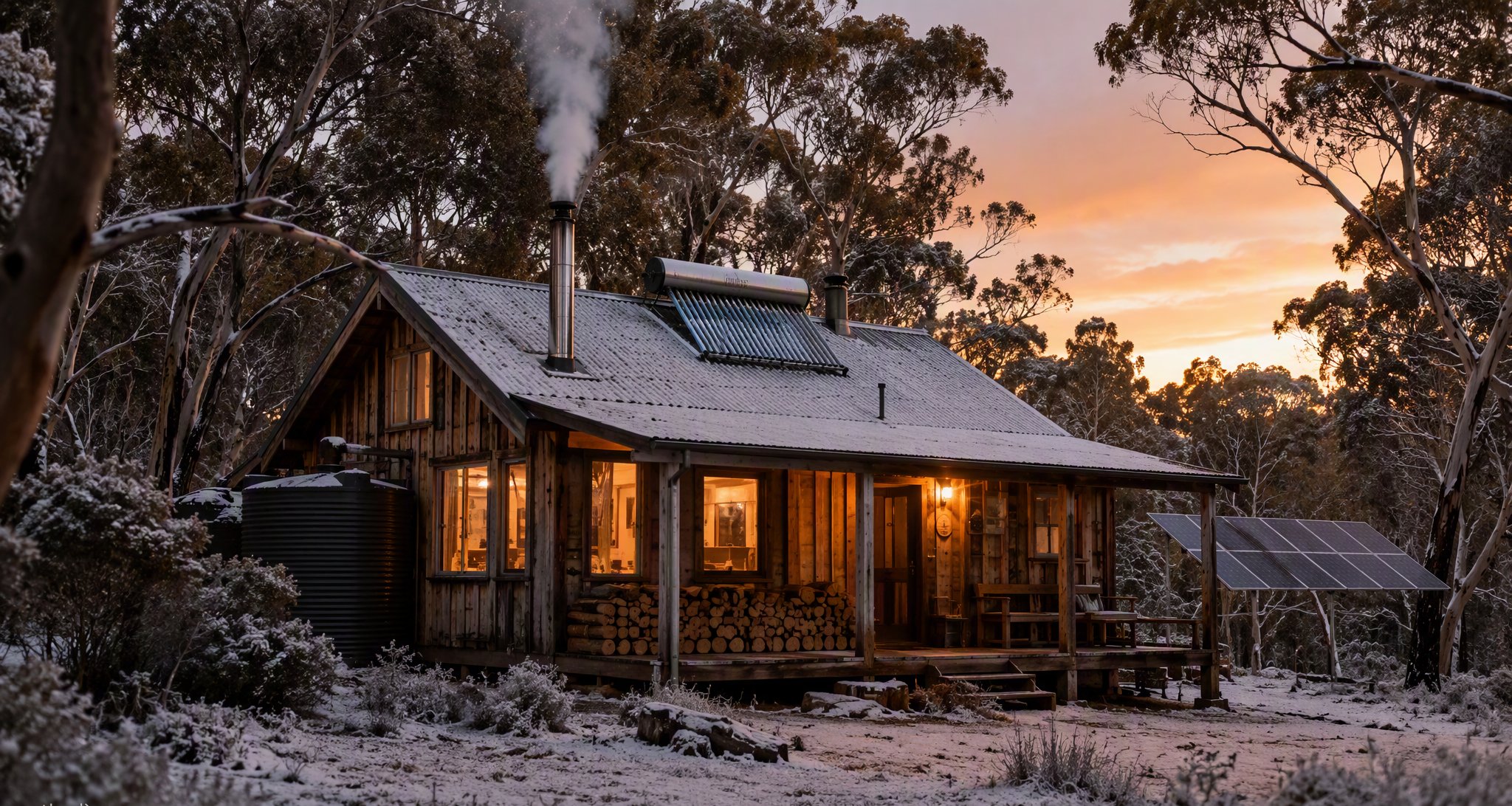
Two promises up front. First, everything here is something I have built, lived with, or watched a neighbour run for years — no theory-only entries. Second, every product card carries its real downside; if a heater is wrong for your climate or your sleep, you should learn that here, not from a courier box. Cost reality: a sensible first-winter stack lands around a few hundred dollars, and the full whole-homestead build with permanent stove, diesel backup and distilling rig runs to a few thousand — both totals compute for your store below.
TL;DRThe short version
E-E-A-THow we chose
- Built and lived with. Mick heats a 28 m² cabin in the Victorian highlands with a batch-box mass heater of his own construction; the firewood, solar-thermal and dump-load sections come from that build log and the neighbours' rigs he services.
- Verified data only. Every ASIN, rating, review count and price was checked against live Amazon pages across multiple stores on 31 August–1 September 2026. Anything we could not verify is either marked as an estimate (≈) or left off the card — we would rather show a gap than invent a number. Picks must clear 4.4 stars with real review depth.
- Honest downsides. Every card carries a "watch-out" drawn from genuine owner complaints, and two famous categories (diesel heaters, budget forges) come with safety caveats most review sites skip.
As an Amazon Associate, OffGrid Masterplan earns from qualifying purchases made through links on this page — it never changes which products survive the cut. Where Amazon is the wrong place to buy (and it is, for solar tubes and heliostats), we link the manufacturer or a specialist supplier instead.
01 — First principlesThree kinds of heat (and why insulation is first)
Every entry in this list moves heat in one of three ways. Radiant heat travels in straight lines and warms surfaces, not air — a stove top, a radiant propane tile, the sun through a window. Convective heat warms air and moves it — diesel air heaters, fan heaters, solar air collectors. Stored heat is energy banked in mass — water, brick, cob, sand — and released later. A comfortable off-grid building usually runs one of each: something radiant for evenings, something convective for mornings, and some mass to carry both through the night.
The unglamorous rule: a degree retained beats a degree generated. Draught sealing, window film and a reflective barrier behind the stove routinely double the practical output of the same heater. That is why the keep-the-heat section and its two cheap cards exist, and why the site's insulation guide is the real companion to this page.
A small well-sealed room needs roughly 1–2 kW of heat in a cold snap; a leaky shed can eat 8 kW and still lose. Run your room through the load calculator before you fall in love with any heater below.
Readers keep asking about friction heating — brake-style heaters on wind turbines, drill-and-plate rigs, "free energy" friction boxes. The physics is real but the economics are brutal: a joule of friction heat is a joule you could have had as electricity or torque, minus losses. The one niche where it earns its keep is wind-turbine dump loads (some designs shed excess rotor power as friction heat in a water brake). For everything else, friction heating is a way to turn expensive mechanical energy into the cheapest kind of energy there is. Admire it, don't build it.
02 — FireWood stoves & rocket mass: the backbone of off-grid heat
Where firewood exists, wood is still the cheapest serious heat. Three levels of commitment cover almost everyone: a portable cylinder stove, a rocket stove for fuel-sipping cooking, and the full DIY rocket mass heater for a permanent building.
1 · The buyable workhorse: Camp Chef Alpine CS14
The CS14 is the stove you bolt a life onto: a 3 mm steel cylinder that heats a wall tent, cabin or shed, cooks on its flat top, dries wet gear on the side racks, and — the bit most reviews bury — takes a clip-on water jacket, so it can make shower water while it makes warmth. Everything, including 3 m (10 ft) of nesting flue, packs inside the firebox. Owners love that completeness; the recurring complaints are the 33.5 kg carry weight and legs that need re-tightening as they bed in. It is unashamedly a car-camp and cabin stove, and a fine first heater for a new block. Note it's sold for tents and outbuildings — a permanent in-home install wants a certified heater and usually a licensed fitter (see safety).
2 · The fuel-sipper: EcoZoom Dura rocket stove
A rocket stove is a small insulated combustion chamber that burns sticks so completely that the exhaust is mostly heat and steam. The Dura is the buyable version — the same design NGOs have shipped to three dozen countries. Feed it wrist-thick prunings and it boils water faster than a kitchen burner once hot; owners consistently marvel at how little fuel disappears into it. It will not heat a room (it puts its heat into the pot), but as the cooking half of a wood-fire life it frees the big stove from kettle duty. Expect a minute or two of start-up smoke before the chamber comes up to temperature.
3 · The DIY crown: rocket mass heater
Take the rocket principle, scale it up, and run the exhaust through a massive bench of cob, brick or stone before it leaves the building. The barrel gives instant radiant heat; the bench steals the rest of the flue heat and radiates it back for 12–18 hours after the fire dies. My own third-attempt batch-box (the first two taught me what not to do) holds the cabin above 17°C overnight from one evening burn of mill offcuts — the build diary is in the site's rocket mass heater build guide, and the deeper theory lives in the masonry heater article.
The honest ledger: materials for a cob-and-drum build run to a few hundred dollars and a couple of weekends; the mass wants a solid floor; and building codes in many areas treat it as an "uncertified appliance" — check before you build inside a dwelling (more in safety). The permies.com RMH community is the deepest free knowledge base on earth for this build.
Player loads from YouTube only when you click it, so this page stays fast and tracker-free until then.
03 — Fire → waterFire coils & wood-fired hot tubs
Fire makes the best off-grid hot water there is, and the physics is a gift: hot water rises, cold water sinks, so a coil of pipe in or around the fire plumbed to a tank above it circulates all by itself. That loop is a thermosiphon — no pump, no power, no controller. The site's heat exchanger sizing guide has the maths for matching coil area to tank volume.
4 · Fire-coil water heating (stainless or copper)
Two proven shapes. In-firebox: a stainless coil (304/316 tube, 12–20 m of it) sits inside a drum stove or dedicated firebox — stainless survives direct flame and flue acids better than copper. In-flue or around the stove: annealed copper coil wraps the flue or lines a jacket — copper moves heat three times better and bends by hand, but keep it out of direct flame impingement. Plumb the bottom of the coil to the bottom of the tank, the top of the coil to the top of the tank, keep every run rising, and the loop self-circulates. Off-the-shelf shortcut: purpose-built stainless coil kits like the Salty Barrel wood-fired coil kit or, in Australia, Stoked Stainless coils and heaters. The one iron rule is below in red.
Water expands ~4% going from cold to hot and violently more if it boils. Every fire-coil system needs an open vent or a temperature-and-pressure relief valve at the tank's highest point, and no shut-off valves that can isolate the coil from that vent. A sealed coil full of steam is a bomb; this is the one rule with no second chances. Open-vented tub systems sidestep it entirely.
5 · The wood-fired hot tub
The same loop, pointed at leisure: a stock tank or timber tub, a coil or submersible stove, and 1.5–3 hours of fire gets 500–1,000 L to soaking temperature. Three build families: the coil-in-firepit (cheapest, watch the smoke direction), the bolt-on coil kit (20-minute install, drill two holes), and the snorkel-style submersible stove (fastest heat, eats tub space). Insulate the tub and make a lid — the difference between a 90-minute and a 3-hour wait is mostly the lid. Pair it with the solar spa-heating guide if you want the sun to do the first 20 degrees for free.
A short playlist of real builds, loads on click.
04 — Liquid & gas fuelDiesel & propane: heat without firewood
6 · The van-life standard: an 8 kW diesel air heater
The "Chinese diesel heater" quietly became the default off-grid space heater of the last five years, and for good reason: it burns a cup or two of diesel an hour, vents all combustion outside (so the heat is dry and condensation-free), starts with a glow plug off your 12 V system, and holds a thermostat setpoint all night. The all-in-one "toolbox" format — tank, pump and heater in one carry unit — needs no install beyond an exhaust pipe out a window or floor. Now the honesty: Amazon's US/AU diesel-heater listings are a lottery of lookalike brands that rate below our 4.4-star cut; the VEVOR all-in-one clears it in Europe (4.4★, 105 ratings and climbing) but budget units still carry no independent R122 combustion-seal certification. For workshops and daytime use, run it. For sleeping spaces, fit a CO alarm, crack a vent, and consider stepping up to a certified Webasto/Eberspächer or a certified mid-range unit if it's in the budget.
The long-running benchmark review of the budget diesel heater genre — fuel use measured, not guessed.
7 · The cupboard staple: Mr. Heater Portable Buddy
Twenty-nine thousand ratings at 4.7 stars makes this the most trusted emergency heater on the internet, and it earns it: piezo ignition, tip-over and low-oxygen shutoffs, radiant tile that warms bodies and bedding directly rather than the whole air volume. It's the heater for the power-cut week, the uninsulated studio, the "take the edge off while the wood stove catches" hour. Two honest watch-outs: on high it empties a 1 lb (450 g) cylinder in about 3 hours, so the hose kit to a proper bottle is close to mandatory; and "indoor safe" still means a CO alarm and a cracked window — no fuel-burning appliance gets a pass on that. It also adds moisture to the room, which matters in a small sealed space.
05 — Stove force-multipliersTwo cheap add-ons every wood stove deserves
8 · Move the heat: Ecofan AirMax 812
A wood stove heats the ceiling first and your feet last. A heat-powered fan on the stove top fixes the distribution for zero watts: a thermoelectric module in the base spins up at 85°C and pushes 175 CFM of warmed air across the room. Owners report rooms warming noticeably faster and wood use dropping — Caframo claims up to 18% fuel saved, and the quiet is uncanny. Set expectations correctly, though: it's a circulator that evens out the room, not a blower you feel on your face. Keep it off the hottest centre spot (past 345°C you cook the module) and it'll outlive the stove. In Australia the local listing is the mid-size UltrAir sibling — same principle, slightly less air.
9 · See the burn: Midwest Hearth stove thermometer
The single best-value item on this page. Too cool a burn makes creosote and tar up your flue; too hot wastes wood and warps steel. A magnetic thermometer with colour zones — creosote, best burn, over-fire — teaches you your stove's personality in a week and keeps you honest forever after. Owners routinely report burning less wood once they can see the zone. It's indicative rather than laboratory-grade, and the magnet gives up above ~425°C (800°F), so place it per your stove manual (usually lower flue or stove top, off to one side).
06 — Sun → waterEvacuated tubes & the black-container principle
10 · Evacuated solar tubes: the winter performers
A vacuum tube is a thermos flask pointed at the sun: two layers of borosilicate glass with a vacuum between, a selective black coating inside that drinks radiation and barely re-emits it. Because the vacuum kills convection loss, tubes keep making hot water in frosty, cloudy, marginal weather where flat collectors sulk — exactly when you want heat most. Each tube's round face also tracks the sun passively across the day. The practical guide is the site's solar hot water tubes article, with the recirculation piece for the plumbing side and off-grid water heating for the whole-system view.
Where to actually buy them: Amazon is the wrong shop for full collectors — freight on 1.8 m glass tubes kills it. Go to the specialists: SunMaxx Solar and Silicon Solar (US; replacement 10-packs of 58 × 1800 mm tubes), Apricus (Australia; complete frost-rated systems), or your local solar-hot-water plumber. Second-hand tube sets turn up cheap on classifieds — the glass is usually fine, it's the heat pipes and manifold seals you inspect.
The manufacturer's own walkthrough — clear on the heat-pipe trick that makes tubes frost-proof.
11 · Black water containers, productised: the solar shower
The oldest solar heater is a black container of water in the sun — paint a drum black, face a water wall's dark side to the equator, or just lay a black bag on a rock. Dark surfaces absorb broadly and re-emit poorly compared to shiny ones (more on that in surface colour), and water is superb storage: 19 L warming 25 degrees banks about half a kilowatt-hour. The Advanced Elements bag is the refined version — four plies with a reflector and insulator panel, a temperature strip that owners confirm actually reads true, and shower-warm water after 1–3 hours of direct sun. For whole-house thermal walls of black drums, the site's thermal mass heating guide has the placement maths.
07 — Sun → air & aimSolar air heaters, mirrors, heliostats and colour
12 · The pop-can solar air heater
A box on the equator-facing wall, a column of aluminium cans painted matte black, glazing over the front, a vent top and bottom: sun heats the cans, air rises through the column, and convection pulls cool room air in at the bottom and pushes hot air out the top. Expect outlet air far warmer than ambient in clear sun — free daytime heat for a workshop, greenhouse or drying room. The honest limits: it does nothing at night or in long cloud, output collapses without direct sun, and sealing matters more than any other detail (leaks kill the stack effect). A small 12 V fan on a PV cell turns it from passive to forceful. The site's solar workshop heating guide covers sizing, and our solar dehydrator build uses the same collector pointed at food.
13 · Mirrors & heliostats: aim the sun where you need it
A mirror doesn't make energy, it moves it — and sometimes moving is exactly what's needed: bouncing winter sun through a dark north window (south window in the northern hemisphere), onto a collector that's shaded in the morning, or into a courtyard that never sees direct light. Even a static, well-angled mirror panel lifts a room noticeably; experimenters report several kilowatt-hours of extra light and warmth per day through one window. The upgrade is a heliostat — a motorised mirror that tracks the sun and holds the beam on one spot all day. This is firmly DIY or specialist-kit territory: the IWillTry.org heliostat build is the classic open write-up (with the warning that concentrated beams and curtains don't mix), and Heliostaat sells a calculation-based dual-axis kit you bolt to your own mirror. Safety note: treat the focused spot like a laser — never where eyes, animals or curtains can wander into it.
The classic backyard "death ray" build — impressive, and a lesson in respecting concentrated light.
14 · Surface colour & passive solar: free heat by design
Colour is a heating decision. Matte black absorbs nearly everything the sun delivers; white and especially shiny metal bounce most of it away; selective coatings (the black inside evacuated tubes) absorb like black but re-emit like polished metal — the best of both. So: paint the collector can black, but the west wall of the house pale. Let low winter sun deep into the main room through clean equator-facing glass, put dark thermal mass where the patch lands, and close thermal curtains at night. This is the whole discipline of passive solar design, and it's cheaper than any product on this page — the site's passive solar design guide and solar thermal transfer article are the deep dives, and the compost-heated greenhouse shows what happens when you add biology's heat to the sun's.
08 — Sun → dinnerSolar cooking (and the hot water that comes with it)
15 · Haines 2.0 SunUp solar cooker
Any device that cooks with sunlight is also a small water heater — and a cooker that makes tea and stew all afternoon quietly displaces fuel you'd have burned. The Haines panel cooker is the reviewer favourite: adjustable reflector panels around a dark Dutch oven, a litre boiled in about 40 minutes of decent sun, roasting up to ~190°C (375°F), and it packs flatter than a camp chair. EcoWatch and Solar Cookers International testers both rate it at the top; owners love the durability of the mylar-and-foam reflector and grumble only about re-aiming it every half hour and cooking around clouds. The evacuated-tube alternative from GoSun cooks faster (their Sport is a vacuum tube with reflectors) but carries a lower rating and a glass tube to mind.
09 — StorageHeat storage: thermal mass & the sand battery
16 · Thermal mass: fire bricks, masonry and water tanks
Storage is what turns two hours of fire or sun into a warm morning. The rule of thumb: water stores the most per litre, brick and stone the most per dollar, cob the most per backache. Brick-flanked stoves, a masonry bench, or an insulated tank of hot water all do the same job — absorb the peak, release the plateau. Rutland's dense clay bricks are the standard repair-and-build currency (rated to 1,090°C / 2,000°F): line a firebox, build a riser, or stack a wall of them behind the stove where the evening heat can soak in. For the building-scale version, read the thermal mass heating, masonry heater and radiant floor guides — hydronic floors are just mass you walk on.
17 · The sand battery: bank surplus energy as hot sand
Sand is honest thermal storage: dirt cheap, can't boil, doesn't degrade, and happy at temperatures that would ruin water tanks. The DIY version is an insulated drum of dry sand with a resistive element buried in it — charge it with surplus solar (see dump loads) or an off-peak burn, and it holds useful heat for days, bleeding it out through the drum wall or a ducted air loop. Set expectations to "physics, not magic": dry sand stores roughly a fifth of the heat of the same volume of water, so the drum needs to be big and very well insulated; think shed-sized supplement, not whole-house furnace. Finland's Polar Night Energy runs the grid-scale proof that the principle scales.
Builds plus follow-up videos with actual measured results — the honest kind of maker content.
10 — Surplus PVExcess solar to heat: the dump load done right
18 · Turn wasted watts into hot water
Every off-grid solar system has the same daily waste: by early afternoon the batteries are full, the controller throttles back, and perfectly good sunshine goes nowhere. A dump load (diversion load) spends that surplus on heat — usually a low-voltage DC immersion element in the hot-water tank, switched on only when the battery bank is genuinely full. Three switching paths, cheapest first: the load/relay output on a charge controller programmed to connect at full voltage; a voltage-sensing relay; or a plain timer on the solar peak hours. The discipline that makes it safe: the battery always gets priority, the element always gets a thermostat, and the wiring follows the same fusing rules as any DC circuit. Clever Solar Power's dump-load walkthrough is the clearest free wiring guide we've found, and the site's solar water heating guide covers the plumbing side. Size the array for winter with the solar calculator.
The element to buy: purpose-made low-voltage DC immersion elements (12/24/48 V, 300–600 W, 1-inch NPT/BSP thread) from specialists like Dernord — the Amazon listings in this category rate below our cut, so we link the manufacturer. A 600 W element dumping four surplus hours is ~2.4 kWh into the tank — most of a family's hot water, from watts that were being thrown away.
11 — Beyond comfortPut heat to work: distilling & smelting
19 · Water purification by heat: distiller + the solar still
Heat purifies water better than almost anything: boil it off, condense the steam, and salts, metals, pathogens and most chemicals stay behind. Off-grid you can do it two ways. The plug-in way is a countertop distiller — the Megahome is the only UL-listed one, all stainless and glass, producing a gallon (3.8 L) per 5.5-hour cycle; run it off the solar peak and it's effectively sun-powered purification (pair with the load calculator — 580 W for hours is a real load). The zero-power way is a solar still: a black basin under sloped glass, condensate running to a clean jar, a few hundred millilitres to a litre a day — emergency gear, brilliantly simple, and fully explained in this solar-still guide.
20 · Serious heat: the propane forge & melting furnace
The same "make heat without the grid" question, turned all the way up: a propane burner in a ceramic-wool chamber reaches 1,300–1,400°C — enough to melt aluminium, copper, brass, silver and gold, and to forge steel. For metal recycling and casting, the well-regarded starter is a 6 kg propane melting furnace kit (TOAUTO's TSF6000 is the reference design); for forging and knife work, a single-burner forge from VEVOR or TOAUTO's own store. Honest note: the Amazon ratings for these sit just under our 4.4-star cut (crucibles and ceramic wool are consumables that drive complaints), so we link the manufacturers rather than a card — the gear itself is sound and the hobby community's verdict is solid. Safety: outdoors or a drafted shed, leather boots and apron, dry moulds only (wet metal + molten metal = explosion), and a class-D or dry-powder extinguisher within reach.
12 — The multiplierKeep the heat: the two cheapest upgrades on this page
Everything above makes heat; these two keep it. A hair-dryer-shrunk window film turns a single-glazed window into a rough double glaze, and a reflective foam roll becomes thermal curtains, behind-stove panels and attic hatches. Together they're the difference between the heater cycling and the heater idling. The site's thermal curtain guide, R-value explainer and shed insulation upgrades go deep on the subject.
Supporting pick · Duck MAX window insulation kit
Supporting pick · SmartSHIELD reflective insulation roll
13 — The matrixEvery method on one table
| Method | Heat for | Runs on | Power needed | Honest verdict |
|---|---|---|---|---|
| Cylinder wood stove | Room + cooking + water jacket | Firewood | None | The backbone where wood is cheap |
| Rocket stove | Pots, not rooms | Twigs | None | Sips fuel; start-up smoke |
| Rocket mass heater | Whole small home, overnight | Firewood | None | Best heat-per-log on earth; DIY + code checks |
| Diesel air heater | Vans, sheds, boats | Diesel | 12 V, ~10–40 W | Dry heat, thermostat; certification caveat |
| Propane radiant | People, not volumes | LPG bottles | None | Instant; fuel cost and moisture add up |
| Fire coil / hot tub | Water | Firewood | None (thermosiphon) | Magic loop; relief valve mandatory |
| Evacuated tubes | Water, even in frost | Sun | Small pump or none | Winter champions; buy from specialists |
| Black containers | Water, small mass walls | Sun | None | Free; works exactly as physics says |
| Solar air heater | Daytime room air | Sun | None / tiny fan | Brilliant at noon, nothing at night |
| Mirrors / heliostats | Moving sunlight | Sun | Trackers ~few W | Powerful and underused; mind the beam |
| Passive solar & colour | The building itself | Sun | None | Free forever; decided at design time |
| Solar cooker | Food + small water volumes | Sun | None | Real cooking, zero fuel, weather-permitting |
| Thermal mass | Stored stove/sun heat | Any source | None | The plateau after the peak |
| Sand battery | Stored surplus, days-scale | Surplus PV / fire | Element only | Cheap, big, honest; shed-scale |
| PV dump load | Water | Surplus solar | The surplus itself | Nearly free hot water; wire it right |
| Distiller / still | Pure water | 580 W / sun | 580 W or none | Purification, not heating — same toolkit |
| Forge / furnace | Metalwork | LPG | None | 1,300°C+; buy from the maker, respect it |
14 — Care & feedingKeeping it all alive
Wood systems: sweep the flue at least once a season (twice if you burn softwood or smoulder a lot — the thermometer is your early warning), empty ash before it chokes the grate, and inspect door seals and baffle bricks yearly. Diesel heaters: run them hard for 15 minutes every few weeks — long low-output idling is what carbons up the burner; clean the glow plug screen each season and keep the fuel pickup off the tank bottom. Solar thermal: check tube seals and the pump station before winter, and dust the tubes — a dirty tube is a mood, not a heater. Distillers and stills: descale the boil chamber monthly with the supplied cleaner; replace charcoal sachets on schedule. Everything: the day you stop cleaning filters and sweeping flues is the day the efficiency tables in this article stop applying to you.
15 — Safety & the lawStaying warm without the fire brigade
Heating is the one off-grid system that can kill you twice — by fire and by gas — so the honest rules up front:
- Carbon monoxide has no smell. Any fuel-burning appliance in or near a sleeping space gets a battery CO alarm, tested monthly. Propane and butane heaters add moisture and consume oxygen — crack a vent, always.
- Permanent wood installs are regulated. In Australia, solid-fuel heater installation must meet AS/NZS 2918 (clearances, hearth, flue); in the US, EPA-certified stoves and local code; in the UK/EU, HETAS/EN equivalents. DIY rocket mass heaters sit outside most certification schemes — fine for workshops and outbuildings, a genuine legal grey zone inside dwellings. When the install is structural, permanent or insured, call a licensed installer; a certificate matters at claim time.
- Pressure + heat = respect. Fire coils, water jackets and solar thermal loops need relief valves and frost strategy (drain-down or glycol where it freezes). Never valve-off a heated loop.
- Concentrated sunlight burns things. Mirrors, heliostats and solar cookers get treated like flame: no unattended focal spots near curtains, dry grass or eyeballs.
- Molten metal waits for nobody. Forges and furnaces: dry moulds, full PPE, outdoor or drafted use, correct extinguisher on hand.
Flue through a roof or wall, any 240 V wiring, anything involving a pressure vessel or an insurance policy. DIY the bench, the coils and the collectors by all means — but the bits that can burn the house down or void the policy earn their tradesman's invoice.
RecapThe twenty, in order
- Camp Chef Alpine CS14 — the buyable base-camp stove.
- EcoZoom Dura — cooking and boiling on twigs.
- Rocket mass heater — DIY overnight heat from one burn.
- VEVOR 8 kW diesel heater — dry heat without firewood.
- Mr. Heater Portable Buddy — the emergency radiant.
- Ecofan AirMax 812 — moves stove heat for zero watts.
- Midwest Hearth thermometer — see the burn zone.
- Fire-coil thermosiphon — fire makes hot water, pump-free.
- Wood-fired hot tub — the coil, pointed at leisure.
- Evacuated solar tubes — hot water in a frost.
- Advanced Elements solar shower — the black-bag principle, productised.
- Pop-can solar air heater — free daytime warm air.
- Mirrors & heliostats — aim the sun where you need it.
- Passive solar & surface colour — free heat by design.
- Haines 2.0 SunUp cooker — dinner and tea from sunlight.
- Rutland fire bricks + mass — bank the peak, ride the plateau.
- Sand battery — days of stored surplus.
- Excess-solar dump load — wasted watts into hot water.
- Distiller + solar still — heat as water purifier.
- Propane forge & furnace — 1,300°C for metalwork.
Plus the two multipliers nobody regrets: window film and a reflective insulation roll.
InteractiveBuild your heating kit
Tick what your place needs — the total tracks your detected Amazon store and currency. Prices are the 1 Sep 2026 snapshot; anything your store doesn't range falls back to a tagged search link.
Snapshot prices from 1 Sep 2026 at your detected Amazon store. Where a pick isn't listed locally, the card links a tagged search instead.
MoneyWhat it costs: three tiers
| Tier | Rough total | What changes |
|---|---|---|
| First cold night | … | Thermometer, window film, reflective roll and the solar shower. No combustion, no licence — you keep the heat you already make and learn to measure it. |
| Winter-ready | … | Adds the stove fan, rocket stove, fire bricks and solar cooker: cooking and evening comfort handled, with fuel you can pick up off the ground. |
| Whole-homestead heat | … | Adds the cylinder stove, propane backup, diesel heater and distiller, plus an allowance for the flue kit and the fire-coil plumbing. This is "winter is a scheduling problem, not a threat". |
The thinking, not just the totals: tier one earns its keep even if you later buy everything else — a sealed, measured room permanently shrinks every heater's job. Buy the cheap degrees first, then the fire, then the fuel systems.
AnswersFAQ
What is the cheapest way to heat an off-grid home?
Insulation and draught-sealing first — heat you keep is heat you never have to make. After that, a wood stove is the cheapest serious heat where firewood is available, because the fuel can be free labour. For sun-hours, a black-bag solar shower and a window of direct sun cost almost nothing. The expensive mistake is buying a big heater for a leaky room.
Can solar panels really heat a house?
Yes, three different ways. Solar thermal (evacuated tubes or a DIY collector) turns sunlight straight into hot water at good efficiency. Solar PV can run a heater through an inverter, or better, divert surplus power into a hot-water element once batteries are full. And a simple sunlit window with thermal mass behind it is a heater with no moving parts at all.
Are Chinese diesel heaters safe to use off-grid?
Used properly they are the workhorse of van and shed heating: combustion is sealed and vented outside, so the warm air stays dry and clean. The honest caveats are that budget units carry no independent combustion-seal certification, so you fit a carbon monoxide alarm, keep a small vent open, service the glow plug and screen each season, and never run one without an outside exhaust.
Can a wood stove heat water as well as a room?
Yes — it is one of the oldest tricks off-grid. A stainless or copper coil in the firebox or flue, plumbed to a tank above it, circulates water by thermosiphon with no pump at all. Clip-on water jackets do the same job for cylinder stoves. The non-negotiable is a pressure relief path: water expands when it boils, and a sealed coil is a bomb.
Do solar air heaters actually work in winter?
A well-built pop-can or screen collector in full sun delivers air far warmer than ambient even on frosty days — but only while the sun shines. They are daytime supplements that shine on south-facing walls (north-facing in the southern hemisphere), not whole-house heating. The best use is a workshop, greenhouse or drying room that needs heat exactly when the sun is out.
Is dumping excess solar power into heat worth it?
Usually yes, because it is nearly free. Once batteries are full, charge controllers waste the rest of the day. A low-voltage immersion element in a water tank, switched by the controller's load output or a voltage-sensing relay, turns that surplus into stored hot water. The gear is cheap; the discipline is wiring it so the battery always gets priority.
Worth a watchWatch this
If you watch one thing, make it David McLuckie's budget diesel heater review and full-tank run — years of follow-ups, measured fuel use, and the exact failure modes (glow plug, screen, pump tick) you'll meet in your first winter with one. It's the antidote to every glossy listing photo in that category.