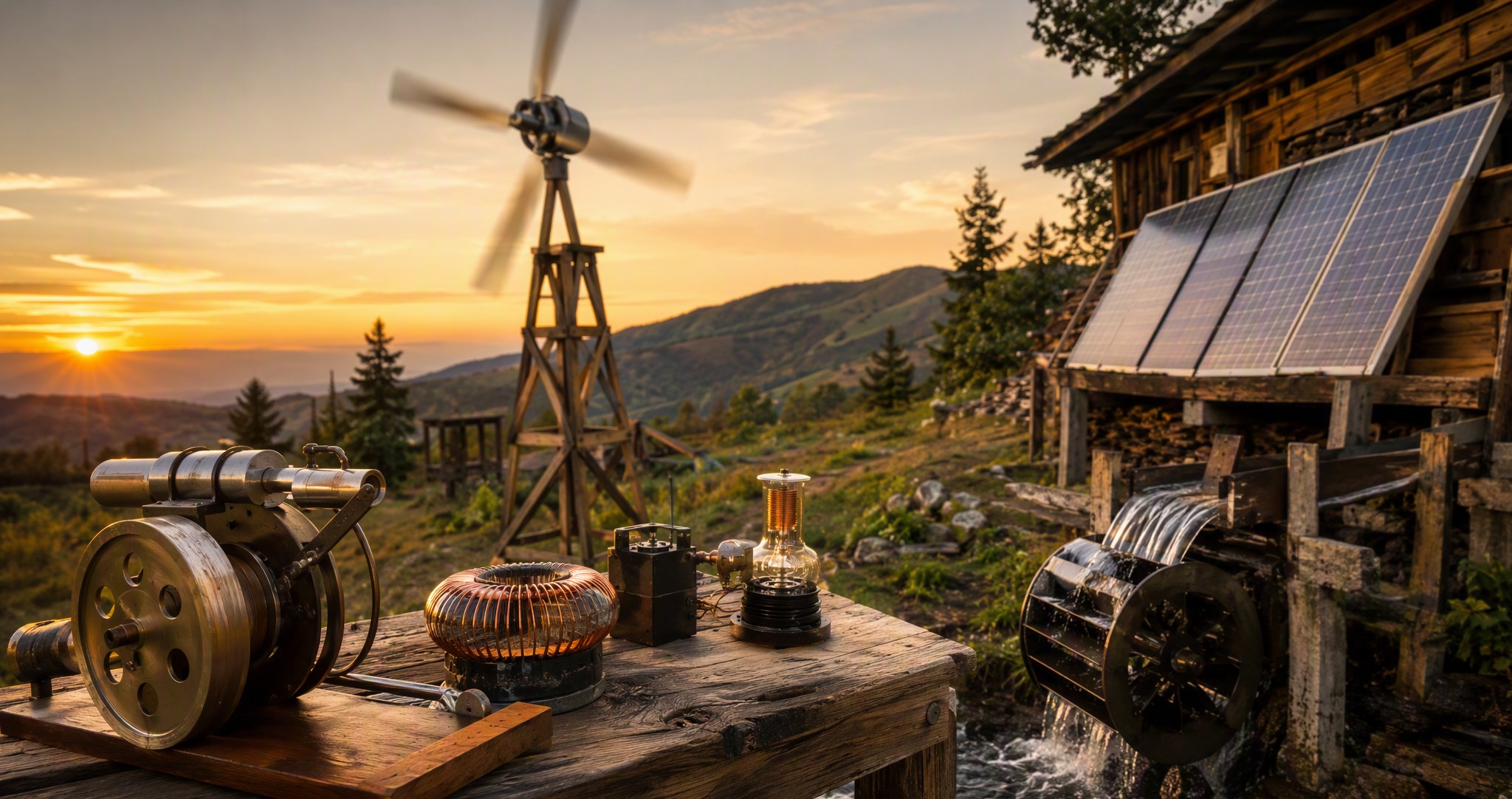
Everyone wants to make their own energy. The internet obliges with two thousand videos of a man spinning a PC fan with a hair dryer, claiming to power his house. This guide is the opposite of that. Below are twenty ways a human being can genuinely generate energy at home — electricity, heat, gas and pumping work — each one costed in 2026 money, each one measured against the two technologies that actually dominate the small-scale world: solar PV and wind.
One rule before any of it: measure first. You cannot size a system for a load you have never measured, and you cannot claim a wind site you have never metered. A plug-in energy meter is the cheapest, most-used tool in this entire article.
The baselinesThe yardsticks: what solar and wind actually cost in 2026
Every method below gets compared against these numbers, so let’s put them on the table. Jargon is defined as we go — no engineering degree required.
| Yardstick | Hardware cost | Cost per kWh | Reality |
|---|---|---|---|
| DIY solar PV (you install) | Panels retail at US$0.30–0.50/W; a complete DIY array — panels, mounts, cabling, controller — lands around US$0.60–1.00/W before the battery | Roughly US$0.06–0.08/kWh over its life, before storage | Silent, solid-state, 25+ year panels. The thing to beat. |
| Pro-installed solar | US$2.50–3.50/W turnkey (Australia’s rebate-driven pricing is the low end) | Still beats the grid in most places | You pay for roof labour, paperwork and margin. |
| Small wind (1–10 kW) | US$8,000–23,000 for 1–2 kW installed; a 5 kW system runs US$35,000–65,000 — towers alone can be US$10,000+ | Often US$0.30–1.00+/kWh on mediocre sites | Utility-scale wind is cheap; backyard wind is not. Site is everything. |
| The grid (for context) | — | ≈US$0.18/kWh at the meter, depending on country and state | The price your DIY kWh has to beat. |
Two terms you’ll see all the way down this page. Watt-hour (Wh) — energy: one watt running for one hour. A day’s energy use is measured in kilowatt-hours (kWh); a modest off-grid home runs on 2–6 kWh/day. Capacity factor — what a generator actually produces versus its nameplate rating over time. Solar manages roughly 15–25% of nameplate across a year. A creek turbine that runs all night can sit above 70%. That difference is why “dollars per watt” misleads and “dollars per daily kWh” is the honest measure — so the big table below uses both.
Every dollar figure in this guide auto-converts to the currency of your detected Amazon store at the day’s reference rate (cached 12 h). ≈ marks a straight currency conversion, not a local price check — where we have a genuine local figure (e.g. Australian installed solar), you see it exactly.
Want to sanity-check any method against your own loads? Run your numbers through the load calculator first, then the ROI calculator once you have a candidate build.
Short versionQuick picks: the right build for the job
If you only read one table
MethodHow we chose (and how we got to twenty)
- Costed against the yardsticks. Every method carries a rough build cost and an honest output figure, cross-checked against published 2026 pricing for solar (US$0.30–0.50/W retail panels; US$2.50–3.50/W installed) and small wind (US$8,000+ per installed kW).
- Real owner evidence. Where we link a product, its rating and review count were pulled from live Amazon pages on 4 Sep 2026, and every pick has at least one genuine complaint listed. No 3-star junk dressed up as a deal.
- Scale honesty. Each entry answers “at what size does this beat buying solar panels — if ever?” Several answers are “never, and here is the maths.”
As an Amazon Associate, OffGrid Masterplan earns from qualifying purchases made through links on this page. Prices and ratings were checked on 4 Sep 2026 and change constantly — the cards show the nearest store to you.
The headline actsThe Top 10 DIY energy generation methods
1DIY solar PV — the benchmark Beats everything on most sites
Solar photovoltaics — PV = panels that turn light straight into electricity, no moving parts — won the small-scale energy race years ago, and in 2026 it is not close. Retail panels sell for US$0.30–0.50 per watt, so a do-it-yourself 400W array with a decent controller and a lithium battery costs less than a fortnight of takeaway coffees and makes roughly 1.5–2 kWh on a decent day. MPPT (maximum power point tracking) — the smart type of charge controller that wrings up to 30% more out of the same panels than the cheap PWM kind. LiFePO4 — lithium iron phosphate batteries: the safe, long-life chemistry that has replaced lead-acid for DIY storage.
At what scale does DIY solar make sense? From 100W (a shed) to 10kW (a whole property). It has no upper limit and almost no lower one. That is exactly why it is the yardstick: anything below it on this list has to justify why you wouldn’t just buy more panels.
Solar sizing calculatorPanels, sun hours and array size for your loads. Open tool →Deeper reads: the solar guide hub, the off-grid solar wiring guide, and the array tilt guide.
2Solar thermal hot water — the cheap heat hack Best payback of the 20
Here is the dirty secret of off-grid energy: heating water with electricity is criminal waste, and sunshine is better at making heat than at making electricity. A solar thermal collector converts 50–70% of incoming sunlight to hot water; a PV panel manages 20–22% to electricity. If hot showers are your goal, skip the middleman.
Two DIY routes. Thermosiphon — a system with no pump: hot water is lighter than cold, so it rises from the collector to a tank mounted above it. Physics does the plumbing. A scratch-built flat-plate collector (black pipe in a glazed box) runs a few hundred dollars; evacuated tubes — glass thermos-flask tubes that grab heat even in cold, cloudy weather push a proper kit into the US$1,300–5,500 range with payback in the 2–7 year zone against electric water heating.
Scale where it wins: any household that heats water with electricity or gas. It is heat, not electricity — you are offsetting water-heating kWh, which is typically a quarter to a third of a home’s energy use. That is a bigger slice than most gadgets on this page will ever touch.
Deeper reads: our thermosiphon installation guide, evacuated tube systems, and off-grid water heating options.
3Micro hydro — the site picks you Wins big, on the right creek
If you have running water and vertical drop, stop reading and skip to the checkout — micro hydro is the one method that beats solar on cost per kWh without breaking a sweat, because it generates at night, in the rain, in winter. Two numbers rule everything: Head — the vertical drop between where you take water and where the turbine sits. More drop = more pressure = more power. Flow — how much water you can take, in litres per second (L/s). Measure with a bucket and a stopwatch: 300 ÷ seconds to fill a 20-litre bucket = L/s.
The rule of thumb: watts ≈ head (m) × flow (L/s) × 5 to 7 (after real-world losses). Ten metres of head and 2 L/s is 100–140W. That sounds trivial until you multiply by 24 hours: 2.4–3.4 kWh a day, every day, matching a solar array four to six times its nameplate size. Installed costs run US$1,300–5,000 per kW of capacity — higher per watt than solar, but at 70%+ capacity factor the energy maths flips. The pipe (the penstock — the pressure pipe running down the slope) and civil works usually cost more than the turbine itself.
Scale where it wins: 100W continuous up to 10kW+. Below ~50W continuous, solar is less plumbing for the same energy. And a legal note with teeth: taking water, building weirs and working in waterways is licensed nearly everywhere — read the dam and water licensing guide before you dig.
Deeper read: micro hydro turbine types (Pelton vs Turgo vs Francis), then size it with the alternative energy calculator.
4Small wind — bought or home-built Site or nothing
Wind is the most oversold category in DIY energy, so let’s be blunt. Power scales with the cube of wind speed: 5 m/s holds nearly twice the energy of 4 m/s, and a 400W turbine’s rating is measured in a gale you will rarely see. On a sheltered block at rooftop height, that “400W” turbine makes 10–40W on a good day and pays back never. Meanwhile a proper small-wind install — turbine, tall tower, wiring — runs US$8,000–23,000 for 1–2kW, which is why bought wind loses to bought solar on most sites.
The exceptions are real, though: exposed ridges, coasts, plains — and crucially, an existing tall structure. If you already have a tower (telecom, water, old TV mast), the single biggest cost of small wind is already sunk. The terrain section has the checklist. For the DIY route, the reference design is Hugh Piggott’s axial-flux turbine — carved wooden blades, hand-wound coils, decades of proven builds worldwide. Materials for a 2.4m machine land in the hundreds of dollars, not thousands. Furling — the tail hinge that swings the rotor out of the wind in a storm so it doesn’t overspeed. Non-negotiable. Axial flux — a flat, pancake-style alternator you can cast in resin on a workbench; the reason home-built turbines work at low wind speeds.
Scale where it wins: 500W–3kW home-built on a genuinely windy, elevated site with a tower you already own or can guy cheaply. Otherwise, measure for a year and be honest with the data.
Deeper reads: the wind guide hub, our DIY turbine workshop guide, blade design, and a field report from a Scoraig turbine workshop.
5Rocket mass heater — heat from sticks Best heat per dollar
A rocket mass heater is a hyper-efficient wood burner: a J-shaped combustion core burns small wood so hot and so completely that the exhaust is mostly steam and CO₂, then the exhaust is pushed through a long bench of masonry (thermal mass — heavy material that soaks up heat and re-radiates it for 12–24 hours after the fire is out). Owners report heating homes on 70–90% less wood than a conventional stove, at a DIY cost of US$50–3,000 — against US$5,000–40,000 for a commercial masonry heater doing the same job.
Scale where it wins: heating one well-insulated home or large room. It makes no electricity — it just deletes most of your heating fuel bill. The catch is regulatory, not technical: many insurers and councils have no box to tick for an RMH. The book below covers the code conversation, and some owners register theirs as a “high-efficiency masonry heater”, which is exactly what it is.
Deeper reads: rocket stove mass heater guide and its code-friendly cousin, the masonry heater build.
6Wood gasification — your generator eats firewood Big effort, real power
Wood gas is the reason European trucks ran on firewood during WWII fuel shortages. Gasification — cooking wood in a low-oxygen reactor until it releases a flammable mix of hydrogen and carbon monoxide (“syngas” or wood gas), which a normal spark-ignition engine can burn instead of petrol. Feed a generator and you have electricity from branches. The physics is proven; the build is genuinely advanced — welding, fabrication, tar management — and the fuel is labour: roughly 1.1–1.5 kg of dry wood chunks per kWh generated.
Cost spread is enormous: Ben Peterson’s plans (below) put a working DIY gasifier in the hundreds-of-dollars zone plus your labour, while the commercial benchmark — ALL Power Labs’ GEK/PP-series gasifier gensets out of Berkeley — lists at around US$19,000 and up (under US$1.50/W). Scale where it wins: anyone with a woodlot, a welder, and a need for serious watts when the sun and wind both fail. It is the only wood-to-electricity route with real capacity — figure 1–10kW while the engine runs — but remember it makes power in noisy, attended bursts, not silently around the clock.
Deeper reads: wood gas generators, gasification boilers, and gas generator options. Size the engine end with the generator calculator.
7Biogas digester — cooking gas from waste Cooking yes, whole-house no
Anaerobic digestion — anaerobic = without oxygen: sealed-tank bacteria that eat food scraps and manure and exhale methane — is the quiet workhorse of the developing world and criminally underused elsewhere. The honest yield numbers: about 1 m³ of biogas per day from a well-fed home digester, and 1 m³ of biogas ≈ 6 kWh of heat, or ≈ 2 kWh if you burn it in a generator. In plain terms: a family’s food waste plus a few herbivores will cook dinner; it will not run your air conditioner.
DIY cost is a drum, three pipes and a weekend (US$100–300 in parts); the polished commercial version (HomeBiogas and friends) is a four-figure purchase. Winter output sags unless the digester stays warm — which is why the classic trick is parking it inside a compost pile (see #15). Scale where it wins: households with steady food waste, and small farms with manure, replacing bought cooking gas. Electricity from biogas starts to pencil out at farm scale (roughly 5+ cows’ worth of dung), not kitchen scale.
Plan the feedstock side with the waste calculator.
8Thermoelectric generation — the wood stove’s side hustle Supplement, not system
Seebeck effect — the physics trick: when two joined semiconductors have a temperature difference across them, electricity comes out. A TEG (thermoelectric generator) module is a ceramic sandwich that turns stove heat directly into DC power, no moving parts. If you already burn wood for heat, a TEG array on the stove or flue gives you free watts every time you light the fire. Real numbers: a few watts per hobby module, 15–50W from a proper bolt-on unit, and a research stove retrofit that produced 94–152 kWh over a heating year for a €350–500 add-on — about a 15–17 year standalone payback, which tells you exactly what this is: a bonus on a stove you already own, not a power plant.
Scale where it wins: winter lighting and device charging for wood-heated homes and cabins; anywhere the fire runs daily anyway. It will never beat solar on an annual basis in a sunny climate — it wins precisely when solar is at its worst.
9Solar cooking — the oven with no fuel bill Free lunches forever
A solar cooker is a greenhouse with ambition: dark pot, trapped heat, done. Panel cookers reach 120–150°C; box ovens hold 150–190°C — enough for rice, stews, bread and slow roasts. DIY cost is cardboard-and-foil cheap to a few hundred dollars for a quality unit; fuel cost is zero for the rest of your life. The catch is scheduling: lunch happens when the sun says so, and clouds vote no.
Scale where it wins: daily cooking in sunny climates, camping, and as the zero-fuel backup that makes your gas bottle last months longer. It generates no electricity — it deletes cooking fuel, which on an off-grid budget is the same money.
Deeper reads: solar oven design and the solar food dehydrator.
10Muscle power — pedal and crank Emergency watts, honest numbers
Here is the truth the survival channels skip: a fit adult sustains about 100W of mechanical output, generators waste a quarter of it, and an hour of honest pedalling banks you roughly 50–75 Wh — a phone charge five times over, or an evening of LED light. A household uses 20–100 times that per day. When the BBC tried to run a house on cyclists, it took 70 of them. So no, you will not pedal-power your home. You will pedal-charge your phone in a blackout, keep a radio alive, and learn in your legs exactly what a kilowatt-hour is worth — the cheapest energy education there is.
Scale where it wins: emergencies, off-grid device charging, classrooms, and keeping your fitness honest. The dedicated hardware (K-TOR’s 50W+ Power Box at US$435, or the US$85 Pocket Socket hand crank) is well-made; a DIY roller-on-back-wheel rig with a scooter motor costs far less if you can solder.
The understudiesThe bench: 10 more that earn their spot
Ten methods that didn’t crack the headline ten on cost or universality — but each is the right answer for a specific site, season or human. Scan for your situation.
11Hydraulic ram pump — free water movement, forever Wins if you have fall + flow
The oldest trick on this list (1796) and still magical: water hammer — when flowing water is suddenly stopped by a valve, the pressure spike shoves a small fraction of it uphill. The ram pump cycles that spike 60+ times a minute, 24/7, with no fuel and no electricity. Rule of thumb: it lifts about 7 metres for every 1 metre of fall feeding it. A DIY PVC build costs US$60–200; the ready-made Land To House unit below costs a little more and arrives with a decade of YouTube support. It makes no electricity — it replaces an electric pump’s entire lifetime energy use, which is why it belongs in an energy guide. Pair it with a header tank on the hill and gravity becomes your plumbing and your battery (see #20).
12Masonry heater — the code-friendly version The RMH’s respectable uncle
A masonry heater is the same idea as a rocket mass heater — burn fast and hot, store the heat in tonnes of brick, radiate for 12–72 hours — but built to a documented, insurable standard. The trade: DIY materials US$2,000–5,000 and real masonry skill, versus US$10,000–40,000+ installed. If the RMH’s grey-zone status worries you (or your insurer), this is the legitimate path. Full build notes in our masonry heater guide; the trade association’s plans library is at mha-net.org.
13Stirling engine — thermodynamics on your desk Education, not energy
External combustion engine — the fuel burns outside the engine; anything hot (a flame, the sun, hot water) can drive it. The Stirling alternately heats and cools trapped gas to push a piston. Low-temperature-difference models run off a cup of coffee. Mesmerising, silent-ish, and brutally honest about why heat engines don’t scale down: friction and sealing eat small engines alive. Buy it to learn and to show kids; do not buy it to charge a phone — the generator versions output milliwatts.
14Steam engine — respect the boiler Never at DIY scale
Steam built the modern world and can absolutely run a generator — that’s what every coal plant is. At home scale it’s a poor deal: boilers are pressure vessels (legally licensed territory nearly everywhere), efficiency at hobby scale is single digits, and the “DIY steam generator” videos gloss over the part where a boiler failure rearranges your shed. The correct DIY steam project is a model: a working beam engine kit teaches you everything about pistons, governors and condensate without a pressure ticket.
15Compost heat — the Jean Pain method Winter hot water for woody properties
In 1970s France, Jean Pain wound 200 metres of pipe through a 60-tonne woodchip mound and got 60°C water at 4 litres a minute for up to 18 months — plus methane from a digester parked in the middle (compost keeps the bacteria warm; see #7). Modern versions work at 2×2 metres. Cost is a pile of woodchips, a roll of poly pipe and a weekend with a chipper; output is space/greenhouse heating and hot water for a season, then finished compost. Biomeiler — the modern European name for a compost heat mound with an integrated heat-exchanger loop. Scale where it wins: properties with free woodchips, greenhouses, and anyone who likes their energy systems compost-scented.
Deeper read: compost-heated greenhouse.
16Solar chimney — the physics works, the maths doesn’t Demonstration only
Heat air under a big glass roof, funnel it up a tall tower, put a turbine in the updraft. It genuinely works: the 1980s Manzanares prototype in Spain ran a 195m tower with a 4.6-hectare collector and peaked at 50kW. Now read that again — eleven acres of greenhouse for 50kW, a couple of home solar arrays’ worth. The physics scales with tower height and collector area, so backyard versions produce enough to spin a pinwheel and teach the stack effect to kids, which is a fine afternoon. For power, buy panels.
17Liquid fuels — biodiesel, veg oil, ethanol Fuel, not watts
Straight vegetable oil in an old diesel, biodiesel from waste cooking oil, or fermented ethanol — all real, all labour-intensive, and all regulated (fuel excise and engine-warranty fine print apply). This is how you keep a diesel generator, pump or ute running when supply chains hiccup. It doesn’t generate energy — it converts biomass into a store of it. Our field guides: vegetable oil as fuel and alcohol fuel production, plus generator fuel efficiency for the engine end.
18DIY geothermal — ground-source heat Rent the excavator first
Two metres down, the ground sits at a near-constant 10–16°C all year. A buried loop (ground loop — hundreds of metres of buried pipe carrying fluid) lets a heat pump move heat instead of making it: 1 kWh of electricity delivers 3–4 kWh of heat (that ratio is the COP — coefficient of performance). That’s not energy generation, it’s energy judo — and it’s the most efficient heating physics available to a homeowner. The DIY part is the trenching, not the refrigerant (licensed). Slinky-loop DIY builds exist and work; budget the machine hire and do the maths against simply insulating.
19Tidal, wave & towed river power Coastal estates only
Moving water is 800 times denser than air, so slow currents carry real energy — a towed or anchored river turbine the size of a toaster can make 300–500W continuously in a decent current. Commercial portable units (the WaterLily river turbine is the known name) exist for paddlers and riverside cabins. Tidal is the same idea with salt and barnacles; unless you own the shoreline and a boat, it’s a specialist game. Scale where it wins: riverside and coastal properties where solar is shaded and the water never sleeps.
20Gravity & pumped storage — a hill is a battery Storage, not generation
Let’s do the honest maths the viral “gravity battery” videos skip: 100 kg dropped 10 metres stores 0.0027 kWh — about one LED for an hour. Concrete-block gravity towers are theatre. Water is different: a 10,000-litre tank 30 metres up your hill holds roughly 0.8 kWh, retrievable through the same micro turbine from #3, and the ram pump from #11 can fill it for free. That is a real, lossy-but-useful battery with a 50-year lifespan and no lithium. If you have the elevation, you already own the battery enclosure.
All twenty, costedThe 20-method cost table vs solar & wind
2026 snapshot figures for DIY-scale builds. “Energy type” matters: heat methods compete with your heating bill, not your power bill. The verdict column asks one question — does this beat buying the same energy from solar PV or, failing that, the grid?
| # | Method | Output | Typical DIY cost | Realistic scale | Verdict vs solar/wind |
|---|---|---|---|---|---|
| 1 | DIY solar PV | ⚡ elec | US$0.60–1.00/W hardware | 0.5–20+ kWh/day | The benchmark |
| 2 | Solar thermal hot water | ♨️ heat | US$300–5,500 | replaces ¼–⅓ of home energy | Wins on payback |
| 3 | Micro hydro | ⚡ elec | US$1.30–5.00/W + civils | 1–30 kWh/day continuous | Wins on the right creek |
| 4 | Small wind | ⚡ elec | US$8k–23k (1–2kW installed); home-built: hundreds + tower | 0.5–15 kWh/day, site-dependent | Only on windy, elevated sites |
| 5 | Rocket mass heater | ♨️ heat | US$50–3,000 | heats a home on sticks | Wins for winter heat |
| 6 | Wood gasification | ⚡ via engine | US$300–800 DIY; US$19k+ commercial | 1–10 kW while running | Backup fuel security, not daily power |
| 7 | Biogas digester | 🔥 gas | US$100–300 DIY | ≈2 hours cooking/day (family) | Cooking & fertiliser; farm-scale for power |
| 8 | Thermoelectric (TEG) | ⚡ elec | US$8–500 modules; US$230–500 bolt-ons | 20–150 Wh/day while stove runs | Winter supplement only |
| 9 | Solar cooking | ♨️ heat | US$0–350 | 1–2 hot meals/day in sun | Free fuel forever |
| 10 | Pedal / hand crank | ⚡ elec | US$85–435 (or scrap-built) | 50–75 Wh per hard hour | Emergencies & education |
| 11 | Hydraulic ram pump | 🚰 pumping | US$60–400 | 300–1,400 gal/day lifted | Wins — replaces pump power entirely |
| 12 | Masonry heater | ♨️ heat | US$2k–5k DIY; US$10k–40k pro | whole-home heat, 12–72h release | Wins where codes matter |
| 13 | Stirling engine | ⚡ mW-scale | US$70–100 models | milliwatts | Desktop physics lesson |
| 14 | Steam engine | ⚡ via boiler | US$150–350 models; real plant: licensed | models: none; real: not DIY | Model kits only |
| 15 | Compost heat | ♨️ heat | US$50–300 + woodchips | hot water for a season | Niche: greenhouses & woodlots |
| 16 | Solar chimney | ⚡ elec | acres of collector per kW | demonstration | Science fair, not power |
| 17 | Liquid fuels | 🔥 liquid fuel | US$100–1,000 processing kit | keeps engines running | Fuel independence, not generation |
| 18 | DIY geothermal loop | ♨️ heat (moved) | US$3k–10k + machine hire | 3–4 kWh heat per kWh in | Efficient but capital-heavy |
| 19 | River/towed turbine | ⚡ elec | US$300–1,500 | 0.3–0.5 kW continuous in current | Coastal/riverside niche |
| 20 | Gravity / pumped storage | ⚡ storage | US$0–500 (tank you may own) | ≈0.8 kWh per 10kL @ 30m | A hill + tank = a real battery |
Cross-check any of these against your own site with the alternative energy calculator, and see how the technologies stack across every criterion in the tech matrix.
Unfair advantagesGot a mountain, a creek or a tower? Read this first
Most energy advice assumes a flat suburban block. If your land has terrain, you’re playing a different game — three of the best builds on this list get dramatically better, or only make sense at all, with the right geography.
- Elevation change + water = micro hydro gold. Every metre of head is free pressure. A property with 30+ metres of fall across it and a year-round trickle is sitting on the cheapest 24/7 electricity in this guide (#3). Even without generation ambitions, a hill lets a ram pump (#11) fill a header tank that then gravity-feeds the whole property — pressure without pumps.
- An existing tower = wind without the tower bill. Tower installation is often half the cost of a small wind system. If you have a telecom mast, water tower stand or tall shed structure, the maths for #4 changes overnight — but have the structure checked for the extra lateral load first, and still measure the wind at hub height with an anemometer before committing.
- A hilltop itself = wind exposure. Ridges and escarpments accelerate wind. The same hill that makes solar trivial (unshaded sky) can double your wind resource versus the valley floor.
- A woodlot = a thermal economy. Firewood runs the RMH (#5), branches feed the gasifier (#6), and woodchips feed the compost mound (#15). If you’re clearing fence lines anyway, your “waste” is a winter of heat.
- Manure + food waste = gas. Livestock turns #7 from a cooking curiosity into a daily resource.
If you’re still evaluating land, this is exactly what the site planner is for — and the energy independence goals guide helps you decide what “enough” looks like before you spend.
OwnershipKeeping it running
Generation is the fun part; maintenance is the part that decides your actual cost per kWh. The short version by category:
- Electrical storage: LiFePO4 banks want a correct charge profile and no charging below freezing without protection. The classics that kill banks are in battery bank sizing mistakes and deep-cycle lifespan.
- Rotating machines: turbines (wind and water) want an annual bearing, bolt and guy-wire inspection. Budget one weekend a year, and after every major storm.
- Gas systems: gasifiers need tar management and filter changes — every run is attended. Biogas wants daily feeding and the H₂S scrubber media replaced on schedule (that rotten-egg gas eats engines).
- Wood heat: RMH and masonry heaters need the annual flue check like any wood burner, and an honest look at clearances every time you rearrange the furniture.
- Water systems: intake screens clog; penstocks want a flush valve; ram pumps want their snifter valve checked seasonally.
Not optionalSafety, and when to call a professional
Three quiet killers deserve their own line. Carbon monoxide — anything that burns (gasifier engines, rocket stoves, steam models) runs outdoors or with verified flues and a CO alarm indoors. Methane — biogas is stored as close to zero pressure as possible, away from sparks, with a flame trap on any burner line. Falling water and towers — the two places DIYers get hurt are penstock trenches and ladders. Neither forgives a shortcut.
The twentyThe full list, linked
- DIY solar PV — the benchmark
- Solar thermal hot water — best payback
- Micro hydro — wins on the right creek
- Small wind — site or nothing
- Rocket mass heater — best heat per dollar
- Wood gasification — generators eat firewood
- Biogas digester — cooking gas from waste
- Thermoelectric (TEG) — the stove’s side hustle
- Solar cooking — free lunches
- Muscle power — emergency watts
- Hydraulic ram pump — free pumping forever
- Masonry heater — the insurable RMH
- Stirling engine — desktop thermodynamics
- Steam engine — models only
- Compost heat — the Jean Pain method
- Solar chimney — science fair special
- Liquid fuels — biodiesel, veg oil, ethanol
- DIY geothermal loop — heat judo
- River & tidal turbines — coastal niche
- Gravity & pumped storage — a hill is a battery
InteractiveBuild your bench: the interactive kit tool
Tick the pieces that fit your site and budget — the total updates at your detected Amazon store’s snapshot prices.
Snapshot prices from 4 Sep 2026 at your detected Amazon store; items without a local listing route to a tagged search.
BudgetsWhat a setup costs: three honest tiers
The thinking: tier one buys information (measure your loads and your wind, and the manual that stops expensive mistakes). Tier two buys first real watts — a small solar system that covers lights, devices and a fridge with discipline. Tier three adds the thermal bench — the books, stove gear and experiment kits that turn winter and waste into energy. Totals below are computed live from the cards above.
| Tier | Rough total | What changes |
|---|---|---|
| Learn & measure | … | Energy meter, anemometer, the wind bible. No watts yet — but zero wasted dollars later. |
| First watts | … | Adds 200W of panels, the Victron MPPT and 1.28kWh of LiFePO4 (plus wire and fuses). Lights, devices, laptop, done. |
| The full bench | … | Adds the thermal and fuel library, stove gear, TEGs, solar cooker, ram pump and fittings for the water builds. |
QuestionsFAQ
What is the cheapest way to generate your own energy?
For electricity, DIY solar PV — panels retail for well under a dollar per watt and last 25+ years. For heat, solar hot water and rocket mass heaters pay back faster than any electricity project. The exceptions: a creek with vertical drop (micro hydro can beat solar on cost per unit) and a windy hill with an existing tower (home-built wind can compete).
Can I power my house with a bicycle generator?
No. A fit adult sustains about 100W; after conversion losses an hour of hard pedalling yields roughly 50–75 watt-hours — a few phone charges or an evening of LED light. A typical home uses 20–100 times that per day. Pedal power is for emergencies, education and devices, not households.
Is a DIY wind turbine worth building?
Only on the right site. Wind energy scales with the cube of wind speed, so a sheltered block is a write-off no matter the turbine. On an exposed hill or coast averaging above ~5 m/s with a proper tall tower, a home-built turbine produces meaningful power for modest cost. Measure your wind first, and build to a proven design.
How much power can a small stream generate?
Watts ≈ head in metres × flow in litres per second × 5–7 after losses. Ten metres of drop with 2 L/s is roughly 100–140W continuously — several kWh per day, day and night. That constant output is why hydro beats solar on cost per unit of energy on suitable sites despite costing more per watt of capacity.
Do I need permission or licences for DIY energy projects?
Often. Water extraction and creek works need approvals nearly everywhere; mains-voltage wiring needs a licensed electrician; gas plumbing, flues and boilers are licensed trades; and solid-fuel heaters face building-code and insurance scrutiny. Check before you build — the fine is always bigger than the permit.
What should I build first?
Measure before you generate: a plug-in energy meter for your loads and an anemometer for your wind. Then the best first builds are a small solar-plus-battery system for electricity and a rocket stove or solar cooker for thermal wins. Books and small experiments before big hardware, always.